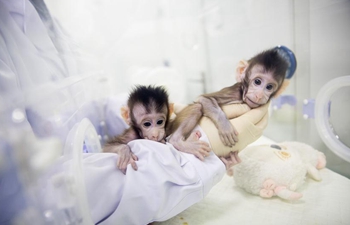

Two cloned macaques named Zhong Zhong and Hua Hua are fed at the non-human-primate research facility under the Chinese Academy of Sciences, Jan. 22, 2018. China on Thursday announced it successfully cloned world's first macaques from somatic cells by method that made Dolly. (Xinhua/Jin Liwang)
NEW YORK, Jan. 26 (Xinhua) -- The successful cloning of two monkeys by Chinese researchers is a "significant advance" for disease research, a U.S. scholar said on Friday.
"The cloning of the monkeys is a significant advance. Others had tried in the past and failed," said Robert Desimone, Director of McGovern Institute for Brain Research at Massachusetts Institute of Technology (MIT) in Cambride in Massachusetts state, told Xinhua in a written interview.
The two cloned macaques, named Zhong Zhong and Hua Hua, were produced at the non-human-primate research facility under the Chinese Academy of Sciences (CAS) at the end of 2017.
"One potential application is in the generation of primate genetic models for disease research, as the authors point out," Desimone said. "Until now, these methods were limited to genome editing in primates using CRISPR or TALEN methods." Both CRISPRE and TALEN are tools for editing genomes and alter DNA sequences.
"The genetic modification of cells followed by somatic cell nuclear transfer can now be added to the options available for creating these new genetic models," he said.
The cloning methods may be "particularly useful for combining several disease-related mutations in the same animal," Desimone noted.
"I and many other neuroscientists believe that primate genetic models will be better for understanding human brain disorders and for developing new treatments compared to mouse models, because the brains of monkeys are more similar to those of humans," he added.
Autism, schizophrenia, and neurodegenerative diseases such as Parkinson's disease, Huntington's disease, and Alzheimer's disease are examples of brain disorders that "might see significant advances based on primate genetic models," he elaborated. "Of course, outside of neuroscience, there are many other diseases where research would benefit from better genetic models."
Desimone pointed out although the work is a significant advance, it should be acknowledged that the primate cloning methods "still have room for improvement."
"The number of live births compared to the number of embryos implanted was fairly small. There are other limitations with using cloned animals for this purpose, but I believe they will get worked out in the future," he said.
Desimone attributed the breakthrough to Chinese researchers' hard work, and China's heavy investment in research and innovation in recent years.
"China has invested much more in developing primate genetic models than any other country developing primate genetic models," he said. "I believe this is partly because monkeys are a natural resource in China, and the large numbers of primates available in China makes the genetic work more feasible.
Another major reason is that Chinese research agencies, such as the Chinese Academy of Science, "have been willing to take risks in funding work like this at an early stage, when it was far from clear that the work would be successful," he added.
Desimone said he himself is collaborating with colleagues at a different Chinese Academy research center in Shenzhen that is also working on new genetic models.
"The support that my colleagues receive from the city and from the Chinese Academy has been substantial. The China Brain Initiative will surely accelerate the research throughout China even more. China is the world leader in this type of research now, and it is investing to remain so in the future."