
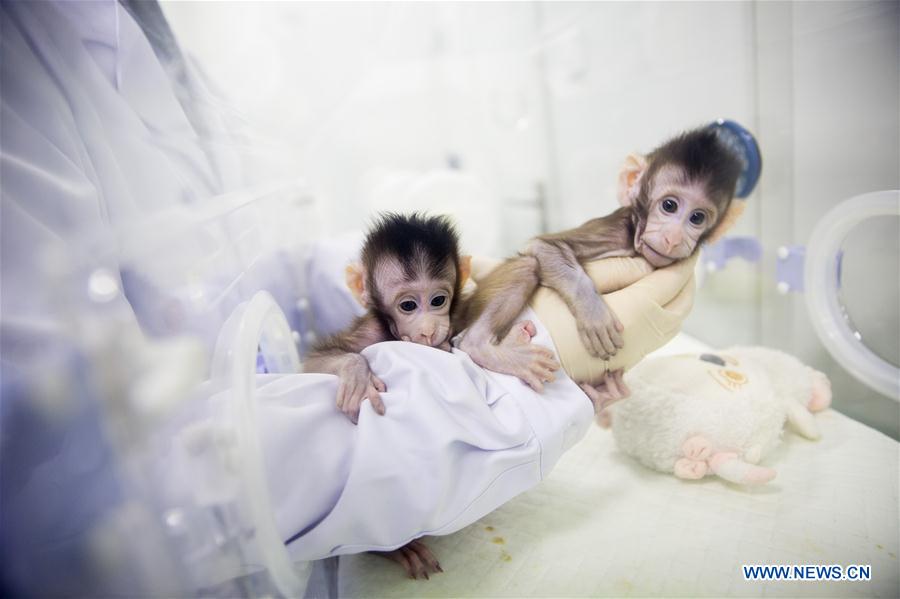
Two cloned macaques named Zhong Zhong and Hua Hua are held by a nurse at the non-human-primate research facility under the Chinese Academy of Sciences (CAS) in Suzhou, east China's Jiangsu province, Jan. 22, 2018. China on Thursday announced it successfully cloned world's first macaques from somatic cells by method that made Dolly. (Xinhua/Jin Liwang)
By Liu Wei, Luo Zhen
BEIJING, Jan. 25 (Xinhua) - China on Thursday announced it successfully cloned world' s first macaques from somatic cells by method that made Dolly. It makes research with customizable populations of genetically uniform monkeys a possibility.
The two cloned macaques, named Zhong Zhong and Hua Hua, were produced at the non-human-primate research facility under the Chinese Academy of Sciences (CAS) at the end of 2017. A third is due this month and more this year, said scientists.
The initial research was published on the website of the scientific journal, Cell.
Since Dolly the sheep was successfully cloned from an adult cell in 1997, other mammals have also been cloned, but macaques, which are closely related to humans, have been a challenge.
Sun Qiang, director of the CAS non-human-primate research facility, led a group of researchers for three years to overcome the biological difficulties.
Zhong Zhong and Hua Hua are the product of somatic cell nuclear transfer (SCNT), the technique used to create Dolly the sheep over 20 years ago.
Researchers edited genes in vitro and accurately sifted and produced somatic cells with the same genotype. They removed the nucleus from an egg cell and replaced it with another nucleus from differentiated body cells.
The reconstructed eggs produced embryos, which were put into the wombs of surrogate female monkeys, producing a group of cloned monkeys with the same genetic background.
The first author Liu Zhen, a postdoctoral fellow, spent three years practicing and optimizing the SCNT procedure. He tested various methods to quickly and precisely remove the nuclear materials from the egg cell and promote the fusion of the nucleus-donor cell and enucleated egg.
"The SCNT procedure is rather delicate, so the faster you do it, the less damage to the egg you have, and Dr. Liu has a green thumb for doing this," said Sun.
This success means China will pioneer in disease and brain science research by taking cloned macaques as animal models, said Muming Poo, a co-author on the study who directs the Institute of Neuroscience of CAS Center for Excellence in Brain Science and Intelligence Technology.
"This is a key development in studying primate biology and making models of non-human primates," said Bai Chunli, president of the CAS.
The models designed for brain diseases will shed light on their study, intervention and even treatments.
At present, the lack of treatments for most brain diseases can be attributed to the fact that the mice widely used in labs have a noticeable gap with humans in genome types. Medicines coming out of the labs are often inefficacious or cause side-effects. But cloned monkey models will make a difference.
Researchers agree that primate research models have a major role to play in many fields. "For the Ebola virus, therapies based on monkey model studies have proved effective and the ongoing study of the Zika virus could prove similar," said Poo.
China has listed the brain science program as a key project for the 13th Five-Year Plan period (2016-2020) and is working to become a world leader in primate research.
Central and local governments have supported the development of high-tech primate facilities in cities like Suzhou, Guangzhou, Hangzhou and Kunming over the past decade.
The cloned monkey models will advance non-human primate model making in China, said Poo. In future, China will be a hub for pharmaceutical research centers where companies will test new treatments for brain diseases, immunodeficiency or tumors on non-human primate models.
"We plan to produce more cloned monkeys designed for gene-related brain diseases, such as the Alzheimer' s, Parkinson's disease and autism. It will give us an international edge in the research of primate brains," Poo added.
The clone babies are currently bottle-fed and are growing normally compared to monkeys their age. The lab is following strict international guidelines for animal research set by the US National Institutes of Health.
"We are very aware that future research using non-human primates anywhere in the world depends on scientists following very strict ethical standards. That' s why cloned monkey models are valuable, but production also needs monitoring," said Poo. "Any abusive use could cause trouble."