



China is contributing to global scientific research on how to harness fusion energy as it joins the rest of the world in searching a potential source of safe, carbon-free, and virtually limitless energy.
China, India, Japan, Russia, the Republic of Korea, the European Union and the United States are now engaged in a 35-year collaboration to build and operate the International Thermonuclear Experimental Reactor (ITER) experimental device and bring fusion to the point where a demonstration reactor can be designed.
HEFEI, Dec. 22 (Xinhua) -- Fusion, the nuclear reaction that powers the Sun and the stars, is a potential source of safe, carbon-free, and virtually limitless energy. China is embracing and contributing to global scientific research on how to harness fusion energy.
Since its operation in 2006, the Chinese-designed and -developed Experimental Advanced Superconducting Tokamak (EAST), the "Chinese artificial sun," has become an open test facility for both Chinese and international scientists to conduct fusion-related experiments.
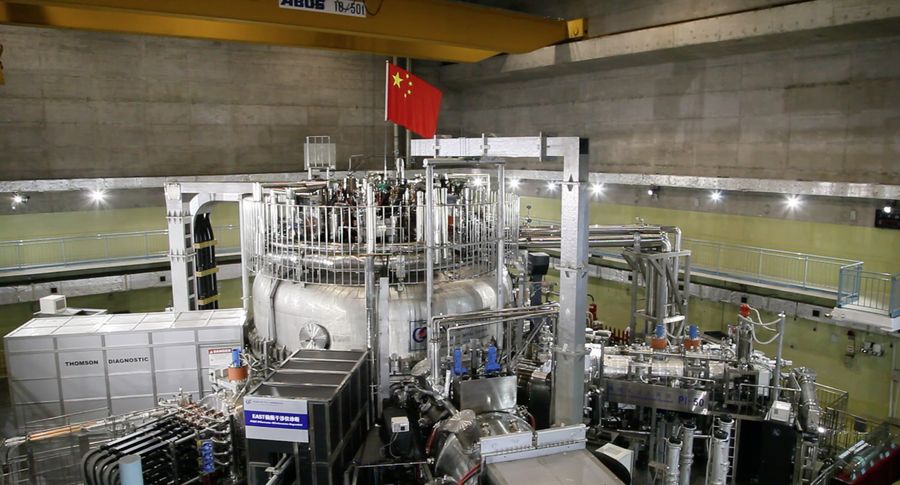
This undated photo shows the Chinese-designed and -developed Experimental Advanced Superconducting Tokamak (EAST) at the Hefei Institutes of Physical Science of the Chinese Academy of Sciences (CASHIPS) in Hefei, east China's Anhui Province. (CASHIPS/Handout via Xinhua)
The facility is believed to help pave the way for other major fusion experiments around the world.
Located in Hefei, capital of east China's Anhui Province, the doughnut-shaped device aims to create all the extreme conditions needed for hydrogen atoms to fuse, a process that will release tremendous amounts of energy similar to what takes place inside the Sun.
One such condition is extremely high temperatures. After a four-month experiment, EAST became the world's first facility in November 2018 to generate an electron temperature of over 100 million degrees Celsius in its core plasma, nearly seven times the temperature of the Sun's interior. This is a key step toward the test running of a fusion reactor.
"I was studying abroad in 1998 when EAST was under construction. When I mentioned EAST to my professor, he shook his head and said it was impossible for China to build it," said Song Yuntao, executive deputy director of the Institute of Plasma Physics of the Chinese Academy of Sciences (ASIPP), where EAST is based.
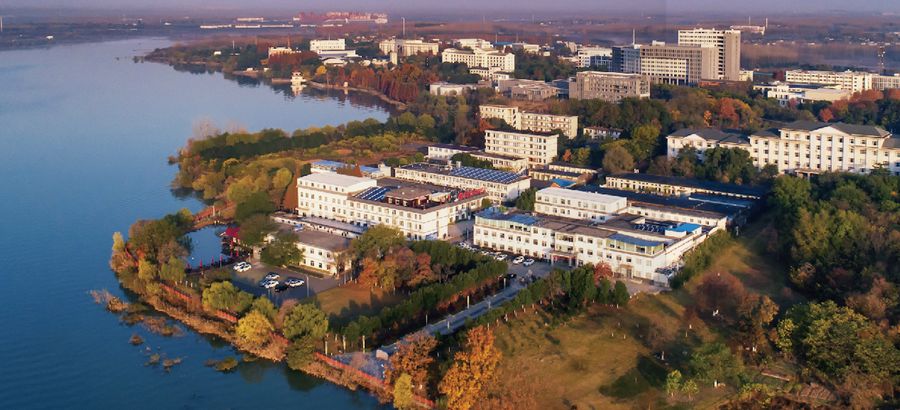
This undated aerial photo shows the Hefei Institutes of Physical Science of the Chinese Academy of Sciences (CASHIPS) in Hefei, east China's Anhui Province. (CASHIPS/Handout via Xinhua)
Fusion energy is one of the greatest frontiers of today's physics, and requires not only the top scientific research ability, but also massive experimental instruments.
Alain Becoulet, director of the Institute for Magnetic Fusion Research under the French Alternative Energies and Atomic Energy Commission, has been a long-term ASIPP partner.
Becoulet has visited Hefei more than 30 times to participate in various workshops, assessment groups, and later lab-to-lab negotiations and agreements. He has also paid a number of visits to the Southwestern Institute of Physics in Chengdu, southwest China's Sichuan Province, to encourage cooperation between Chinese and French labs.
This helped lead to the creation in 2018 of the Sino-French Fusion Energy Center, a platform that not only allows Chinese and French scientists to develop and validate key components and technology for magnetic confinement fusion devices, but also supports the International Thermonuclear Experimental Reactor (ITER), one of the most ambitious energy projects in the world today.
In southern France, 35 nations are collaborating to build the world's largest tokamak, a magnetic fusion device that has been designed to prove the feasibility of fusion as a large-scale and carbon-free source of energy based on the same principle that powers the Sun and stars, according to the ITER organization.
Thousands of engineers and scientists have contributed to the design of ITER since the idea for an international joint experiment in fusion was first launched in 1985. China officially joined the ITER program in 2006 as the seventh member.
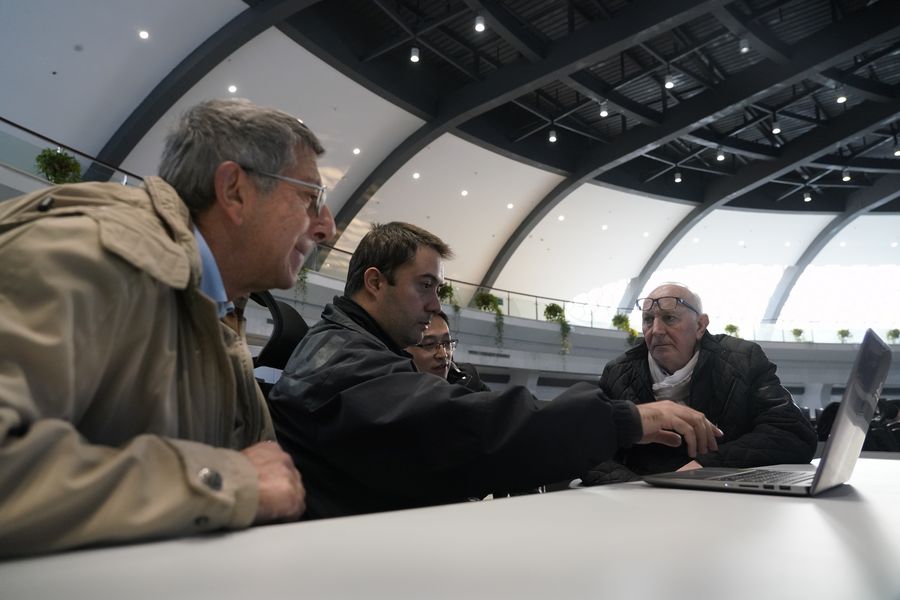
Three Italian scientists discuss with researchers of the Institute of Plasma Physics of the Chinese Academy of Sciences (ASIPP) at central control hall of the Experimental Advanced Superconducting Tokamak (EAST) in Hefei, east China's Anhui Province, Dec. 5, 2019. (Xinhua/Qu Yan)
China, India, Japan, Russia, the Republic of Korea, the European Union and the United States are now engaged in a 35-year collaboration to build and operate the ITER experimental device and together bring fusion to the point where a demonstration reactor can be designed.
According to the agreement, China is responsible for about 9 percent of the project's construction and operation. China has even gone further to help other members.
In 2013, the European Union was looking for an industrial partner to manufacture one of the five poloidal field coils (PF6) initially under its responsibility. In May that year, the EU reached a collaboration deal with China to outsource the work to China, a sign of the recognition of China's manufacturing capability from the world fusion community.
After six years of work, the coil that weighs 400 tonnes and measures about 10 meters in diameter was completed by ASIPP in September this year and will be transported to France in December.
"Through participating in the ITER program, China has not only made contributions to the world, but also made considerable progress in its manufacturing, scientific research ability, and managerial experience. We are also learning from other countries during the cooperation," said Qin Jinggang, a researcher at ASIPP, who is also responsible for the superconducting cables of ITER.
Since its founding in 1978, ASIPP has always attached great importance to international cooperation. It has established close relations with more than 30 countries and regions, including Japan, Russia, the EU and the United States.
"Fusion study is a big project and we need hundreds of scientists, so cooperation is far more important than competition," said Shigeru Morita from the National Institute for Fusion Science of Japan. Being a frequent visitor to China, he conducts scientific research on the EAST machine.
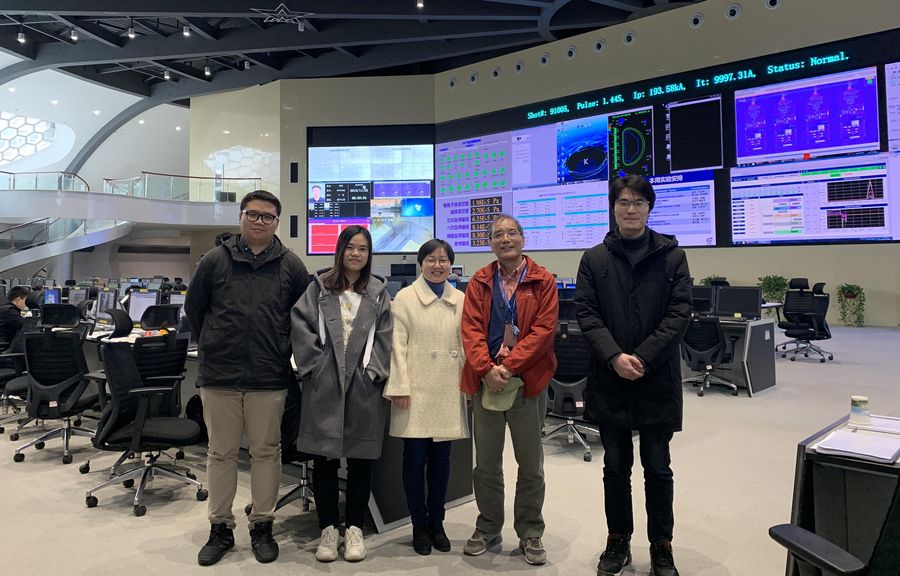
Shigeru Morita (2nd R), a professor from the National Institute for Fusion Science of Japan, poses for a group photo with staff members of the Institute of Plasma Physics of the Chinese Academy of Sciences (ASIPP) at the Hefei Institutes of Physical Science of the Chinese Academy of Sciences (CASHIPS) in Hefei, east China's Anhui Province, Nov. 25, 2019. (Xinhua/Qu Yan)
In fact, fusion study is a mirror of China's attitude toward scientific cooperation. The country is extending its arms to embrace scientists and engineers from all over the world regardless of the economic and political climate.
In 2018, China's spending on scientific research and development reached 2.18 percent of its GDP, or around 280 billion U.S. dollars, an increase of 11.8 percent compared with the year before, according to the National Bureau of Statistics.
"China has opened wide to international cooperation in scientific programs. My suggestion is a simple blessing: let China carry on along this path," said Becoulet.
(Reporting by Wang Shengzhi, Yang Yuhua, Liu Fangqiang, Yang Dingmiao, Li Baojie; Video reporters: Liu Meizi, Shui Jinchen, Qu Yan, Liu Fangqiang; Video editor: Ma Ruxuan)■
