



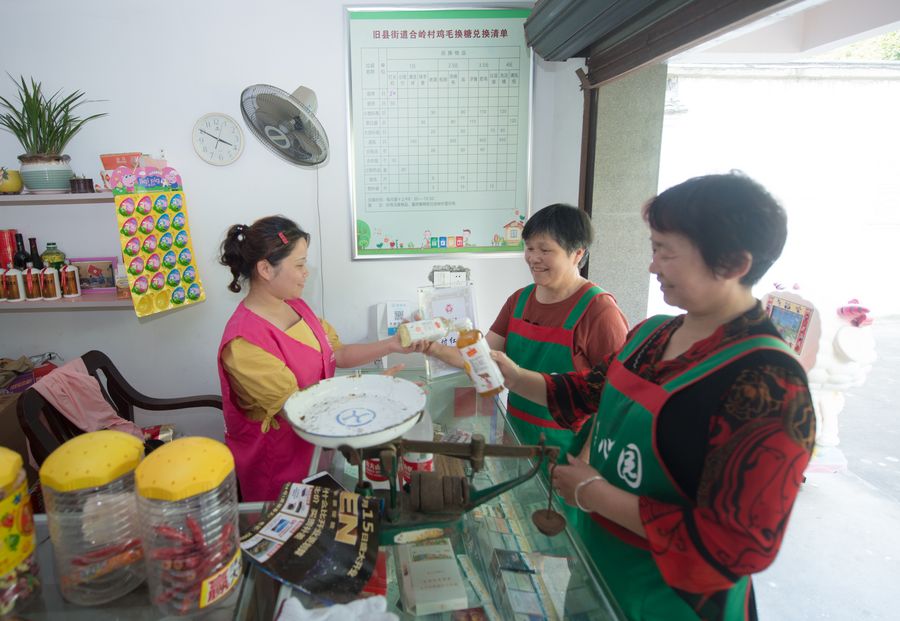
Farmers trade waste for beverage at a waste recycling point in Tonglu County, east China's Zhejiang Province, June 10, 2019. Farmers in five villages of Tonglu County can trade waste for books and daily necessities, as a way to promote garbage resorting and protect rural environment. (Xinhua/Weng Xinyang)
In Chinese townships and villages, the garbage trade-in scheme has encouraged local residents to get involved in environmental protection.
HEFEI, Dec. 11 (Xinhua) -- At 5 a.m., Yao Dongmei, an 83-year-old woman living in Qiankou village in eastern China's Anhui Province, left home with garbage bags to join a line in front of a shop.
She greeted and chatted with her fellow villagers while waiting. Moments later, they left with daily necessities. "Exchanging garbage for daily goods" is what Yao and her fellow villagers line up for each week.
China pledged to realize a utilization rate of 35 percent in household garbage recycling by 2020, and 46 Chinese cities piloted the mandatory classification of residential waste.
Metropolises are in the forefront of the campaign. Shanghai implemented a regulation on mandatory waste management on July 1, while Beijing announced it would follow suit on mandatory household garbage sorting.
Meanwhile, townships and villages are also exploring ways to achieve these goals.
Qiankou township, Yao's hometown, began piloting a garbage trade-in scheme in six villages last year.
Yao's village has set up a room for the exchange, and locals named it "Shengtaimei Supermarket," which means a supermarket for beautiful environment.
Each Monday, Yao and her fellow villagers bring their sorted garbage to the supermarket in exchange for credit points that can be exchanged for products.
On the walls of the supermarket are the illustrations of garbage sorting and the rules for trading credits. "Fifty plastic bags, 35 plastic bottles or a paper cup of cigarette butts amounts to one point," Yao said. "Two points can be traded for a bag of salt, and seven points can get me a bottle of soy sauce."
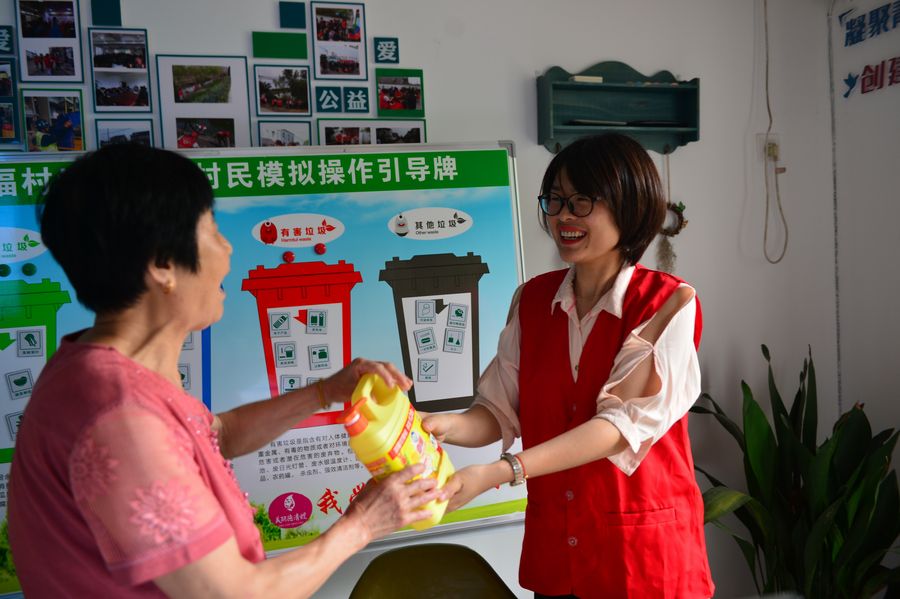
Cai Lijia (R) gives a gift exchanged by credits through garbage sorting to a villager in Qianyuan Township of Deqing County, east China's Zhejiang Province, July 4, 2019. An all-rounded system dealing with garbage has been established in Deqing to sort, transport and dispose garbage. Collection rate of perishable garbage has been on steady growth. (Xinhua/Yin Dongxun)
Benefits like this have encouraged villagers to get involved in environmental protection. According to Yin Tongsheng, a civil servant in the township, since the scheme began, more than 1,700 households have opened credit accounts, accounting for almost half of the township's population.
"There has been nearly 20,000 times of exchanges, and villagers have traded more than 20 tonnes of garbage for daily goods worth over 100,000 yuan (around 14,000 U.S. dollars)," Yin said.
In the beginning, Yao, like many others, was too embarrassed to pick up garbage. But now, as she sees more people do it, she carries a refuse bag everywhere she goes.
"We have come to realize that there is no shame protecting the environment," she said. "With more and more senior people joining us, it's hard to find any litter in our village now."
Fan Lili, who offers guidance for sorting garbage in the supermarket, said that people are not just enthusiastic about garbage collecting, they are also active in garbage sorting.
"Most villagers learn the garbage categories quickly and can identify different kinds of garbage bins by patterns and colors," Fan said, adding that adults' behavior has influenced their children, who have become more aware of environmental protection and garbage sorting.
For those who live far from trading supermarkets, tricycles are sent to their homes on a weekly basis for garbage pickup.
"It's really convenient for me, and collecting garbage has become my hobby now," said 62-year-old Xu Yuchuan, who benefits from the tricycle service as she lives 5 km away from the closest trade-in supermarket.
"In our township, we still face challenges such as how to secure fundings for daily commodities and how to promote the methods to other less populated villages," Yin said. "We are still making explorations." ■
