



China's traditional hog farming industry is facing challenges posed by African swine fever. However, the disease also accelerates shift of hog production from backyard pigpens to large-scale, standardized and eco-friendly enterprises.
by Xinhua writers Lu Yun, Zheng Jingxia and Niu Shaojie
ZHENGZHOU, Dec. 8 (Xinhua) -- In the Year of the Pig, China's traditional hog farming industry is undergoing tremendous changes as both big and small farms revamp themselves to combat one of the world's worst animal diseases.
Hit by outbreaks of African swine fever, China's pig herd shrank by some 40 percent year on year in recent months, causing pork prices to increase and pushing authorities to take measures to stabilize supply.
While the disease has posed challenges to farmers, it also accelerated the shift of China's hog production from backyard pigpens to large-scale, standardized farms with better biosecurity measures and environmental treatment facilities, analysts said.
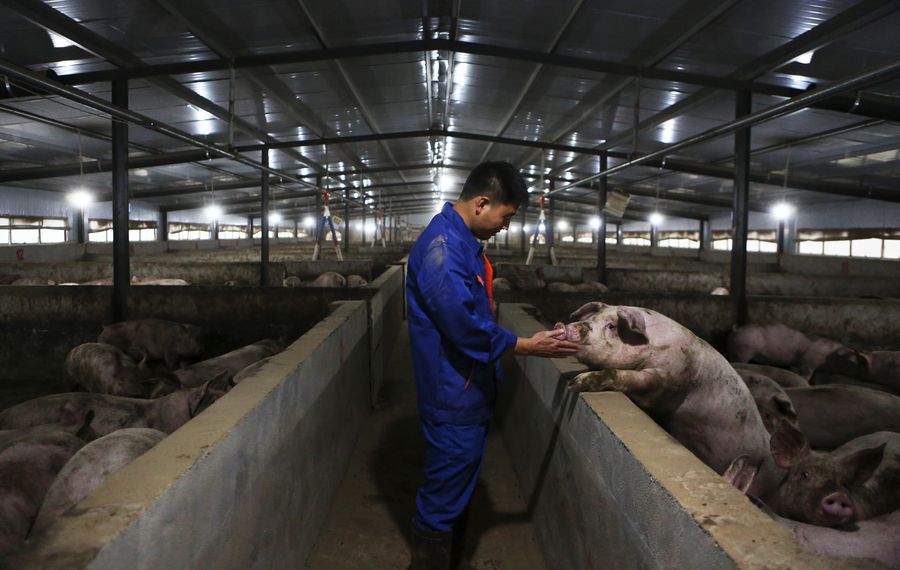
A staff member checks a pig's condition at a pig farm in Zhongjiang County, southwest China's Sichuan Province, Nov. 28, 2019. (Xinhua/Li Mengxin)
SCALING UP
While cyclical fluctuations of pork supply and prices are a worldwide phenomenon, such volatilities are especially high in China, partly because the majority of the country's pigs are produced on family farms.
Last year, the country's top 10 listed companies with pig farming businesses produced less than 7 percent of the country's hogs for slaughter, data from a research institute under property developer Evergrande showed.
The lack of standardized scale farming not only drags down productivity but also increases market volatility, as small-scale farms often lack the technology and facilities to control diseases, according to Zhu Zengyong, a researcher with the Chinese Academy of Agricultural Sciences (CAAS).
The government has been stepping up efforts to scale the sector up, with the State Council releasing guidelines in September that aim to raise the ratio of hogs produced by scale farms to 58 percent by 2022 and 65 percent by 2025 from roughly 49 percent in 2018.
In an action plan to restore hog production released Friday, the country vowed to add 120 pilot hog farms with standardized operations in the next three years, which could serve as examples to boost industry standardization.
"Large-scale farms can provide stable supply across cycles, reducing price volatilities," said Qin Jun, vice general manager of Henan-based Muyuan Foods Co., Ltd., one of the country's largest hog producer.
Thanks to soaring pork prices, Muyuan reported an almost 300 percent year-on-year surge in net profit in the first three quarters.
The fat margin will allow the company to upgrade its facilities and invest in cutting-edge technologies, Qin said, adding that the company has invited programmers and algorithm and mechanical engineers to join its research team to cut labor costs and better control diseases.
"While the disease is a big challenge to the pig farming sector, it also leads to opportunities for corporate champions to build new production capacity and increase their competitiveness," Qin said.
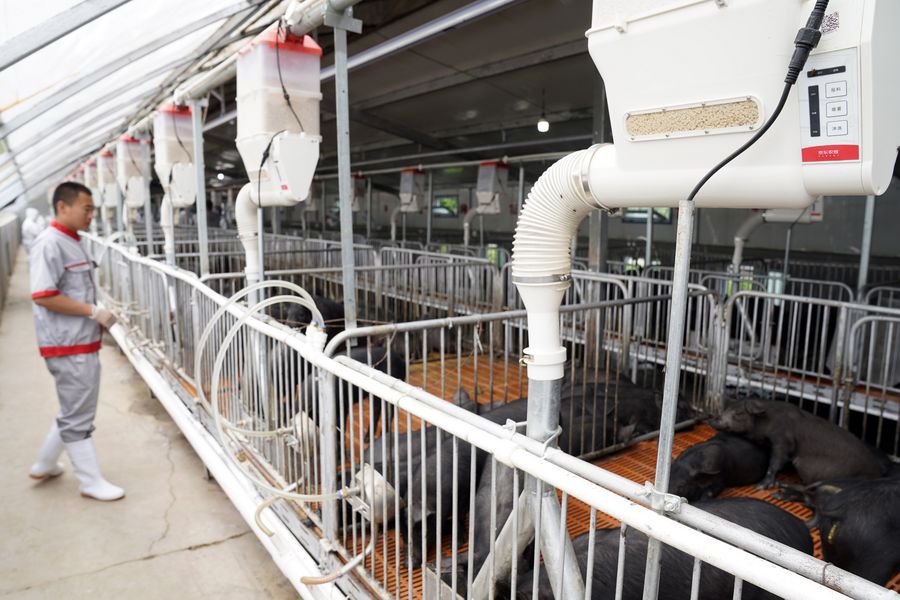
Photo taken on June 13, 2019 shows pig-feeding facilities at a pig farm in Fusong County, northeast China's Jilin Province. (Xinhua/Jin Liangkuai)
GOING GREEN
Raising pigs in an environmentally friendly way has been a thorny problem, but farmers and firms are scrambling to embrace this new trend as the government has stepped up efforts to make the industry greener.
"We recycle swine waste by turning swine waste into fertilizer," said Wang Shijie, chairman of Henan Kanglong Industrial Group, an agricultural firm.
On a piece of land as big as 10 football fields, the firm can raise 2,000 pigs per year while growing crops. After it is processed, swine waste can satisfy the fertilizing demand of that land, said Wang, adding that this method can effectively utilize waste, achieve zero emissions and boost soil fertility.
The pro-environment approach mirrors a new trend of pig farming promoted by the government. In 2016, China issued a five-year plan to steer its hog production. The plan called for efforts to accelerate the green development of pig farming in a bid to expand its overall hog production capacity and build up its international competitiveness.
The new action plan released Friday also vowed policy support for waste utilization, aiming for a comprehensive animal waste utilization rate of over 75 percent by the end of 2020.
To meet the higher green standards, pig farmers and firms are also turning to technologies. Chang Xianyun, a pig farmer who has 1,900 pigs in stock, believes that her heavy investment in waste treatment equipment is the right strategy.
The 54-year-old spent 500,000 yuan (about 70,000 U.S. dollars) on upgrading her facilities, with the bulk of the money used on a wastewater treatment system. Chang said that no wastewater would be discharged from the farm if the new system is used.
"I believe the money is worth it because this is good for the farm, the environment and the people in the village," she said.
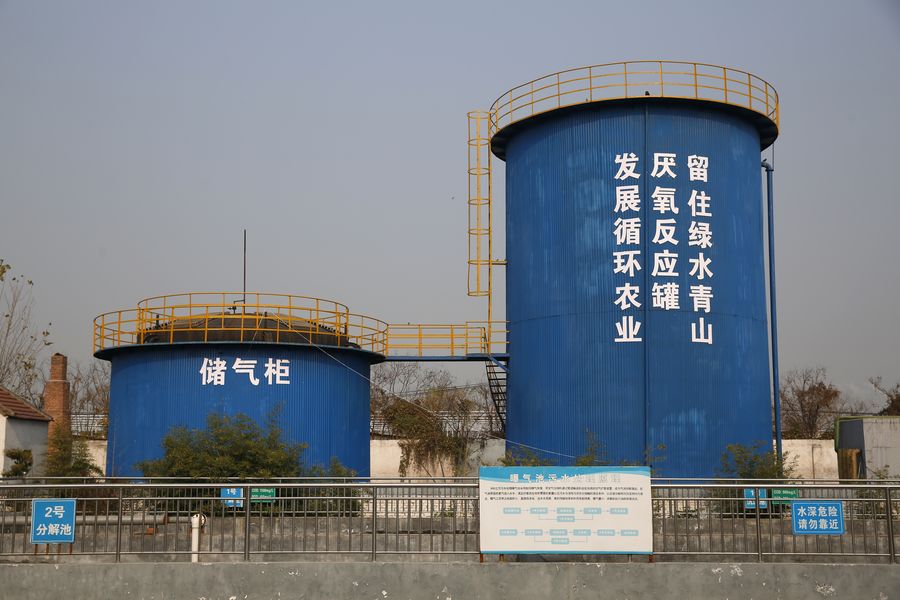
Photo taken on Nov. 28, 2019 shows the swine waste treatment equipment at Henan Kanglong Industrial Group in Baofeng County, central China's Henan Province. (Photo by He Wuchang/Xinhua)
Keeping farms clean is the key to raising healthy hogs, and using waste treatment facilities can reduce viruses and also strengthen disease prevention and control, said Wang Zuli, another researcher with the CAAS.
Industry giants have fat wallets to fare better. According to Qin, Muyuan spends some 10 million yuan on environmental protection facilities in every farm with 100,000 pigs, and installs a central ventilation system in every pigpen for disinfection and deodorization.
The improvement in the living environment of pigs also helped the company counter African swine fever, Qin said, adding that the company has so far managed to keep the impacts of the disease on its costs under control.
(Video reporter: Ren Zhuoru; Video editor: Peng Ying)■
