




A farmer harvests highland barley in the fields at Kaduo Village in Linzhou County, southwest China's Tibet Autonomous Region, Sept. 3, 2018. (Xinhua/Purbu Zhaxi)
Chinese online food delivery and ticketing services platform Meituan Dianping has leveraged its platform to work with local governments, farmers, produce suppliers and restaurants to buy highland barley from the plateau and then turn them into food and promote them online.
BEIJING, Oct. 17 (Xinhua) -- In Shigatse of China's Tibet Autonomous Region, highland barley is the primary produce and income source for local people. However, the unique and nutritious grain species was a remote delicacy for many people living in other places.
It is now served in some popular restaurants in big cities like Beijing and Shanghai thanks to an anti-poverty project.
Chinese online food delivery and ticketing services platform Meituan Dianping has leveraged its platform to work with local governments, farmers, produce suppliers and restaurants to buy highland barley from the plateau and then turn them into food and promote them online.
"A sound industrial chain has been introduced, which might invigorate the whole highland barley sector," said Zhang Yi, an official in Shigatse.
The project has covered produce from poor regions in Tibet, Xinjiang Uygur Autonomous Region and Yunnan Province, according to Mao Fang, the company's vice president. "It's a win-win approach. Consumers can enjoy more delicacies. Restaurants will have enhanced branding, and farmers will see stronger sales."

A farmer picks walnuts in Hotan County, northwest China's Xinjiang Uygur Autonomous Region, Sept. 6, 2019. (Xinhua/Ding Lei)
Meituan's practices are part of Chinese internet firms' efforts to use their expanding network and industrial know-how to aid the poor in seeking their way out of poverty.
Most of China's impoverished regions are in far away places with poor access. The Internet, however, is helping break geographical barriers, help extend the anti-poverty campaign's reach and expedite the drive to eradicate absolute poverty by 2020.
China unveiled an action plan in 2016 to use internet technologies and platforms in reducing poverty, with a string of projects to expand internet presence and promote e-commerce in rural regions, offer online training and information service to the needed, and pool support from the public via online platforms.
Now about 99 percent of the country's poor villages have broadband internet access. A specific online platform has been set up to pool public help for the needed, with over 47 million users registered by end-June.
The country's e-commerce players, big and small, are helping farmers sell produce by playing "matchmakers" between them and consumers.
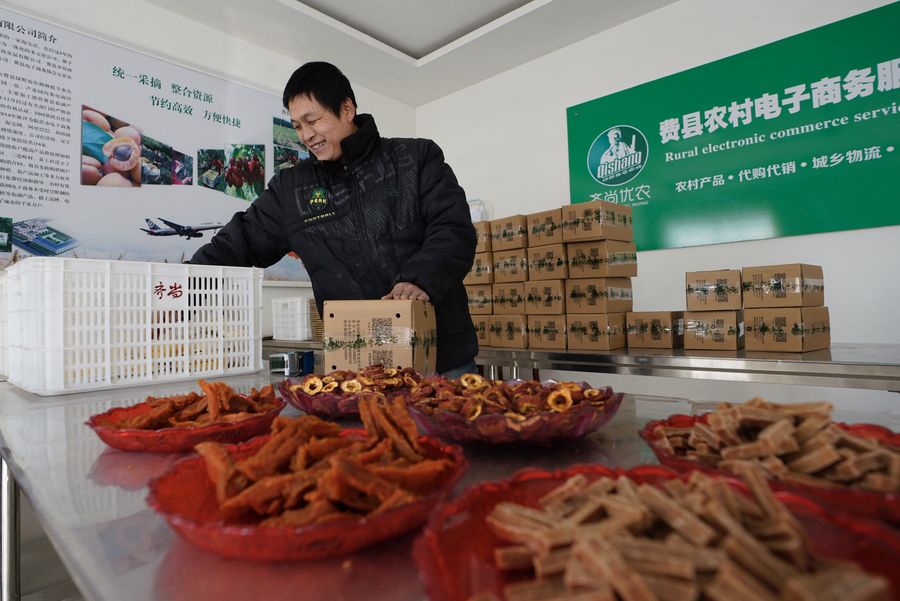
A villager Wang Yiping distributes goods through e-commerce platforms in Datianzhuang Village of Feixian County, east China's Shangdong Province, Jan. 23, 2018. (Xinhua/Xing Guangli)
Sales of produce and products from poor counties on Alibaba's platforms top 110 billion yuan (about 15.49 billion U.S. dollars) from December 2017 to June 2019, data from the Alibaba Research Institute showed. The company initiated the Taobao Village Live project this year, a live streaming platform that allows farmers to tout their products online. It is likely to bring in sales of over 3 billion yuan this year.
Online travel agencies such as Ctrip are working with local governments to develop and promote rural tourism, while online education firms like Hujiang have designed tailored classes to improve literacy and professional knowledge in poor areas.
Chinese authorities rolled out a document in September calling for enhanced efforts in internet-empowered poverty reduction by expanding IT infrastructure, promoting e-commerce and increasing education and medical services via online platforms.
"Internet firms and organizations are new yet increasingly important forces in poverty alleviation," said Ren Xianliang, director of the China Federation of Internet Societies. "More efforts should be made to develop a sustainable anti-poverty mechanism via a partnership with other parties." ■
