



The files, uncovered recently by Xinhua in historical archives in Villa Huegel and elsewhere in Europe, bear the witness to the journey of a nation rising from close-mindedness and humiliation, to opening up to the world and embarking on a path towards national rejuvenation.
LONDON/BERLIN/PARIS, Oct. 4 (Xinhua) -- In the rural western German city of Essen, Villa Huegel, a Prussian style mansion built by German industrialist Alfried Krupp between 1870-1873 as his main residence, holds some precious documents attesting to a difficult chapter in Chinese history.
The files, uncovered recently by Xinhua in historical archives in Villa Huegel and elsewhere in Europe, bear the witness to the journey of a nation rising from close-mindedness and humiliation, to opening up to the world and embarking on a path towards national rejuvenation.
FLOUNDERING NATION
Villa Huegel's "China Hall," opulently decorated with oriental carved beams and painted rafters, keeps a series of documents about sales by the Krupp family, once the largest arms manufacturer in Europe, to China over the past century. A folder with a grey cover lists the Krupp guns sold to the Qing government from 1847 to 1912.
"In its self-strengthening period, China was the biggest client outside Europe. And the Qing government could purchase the most advanced cannons, guns and other equipment," said Daniel Droste, a historian with the Alfried Krupp von Bohlen und Halbach Foundation.
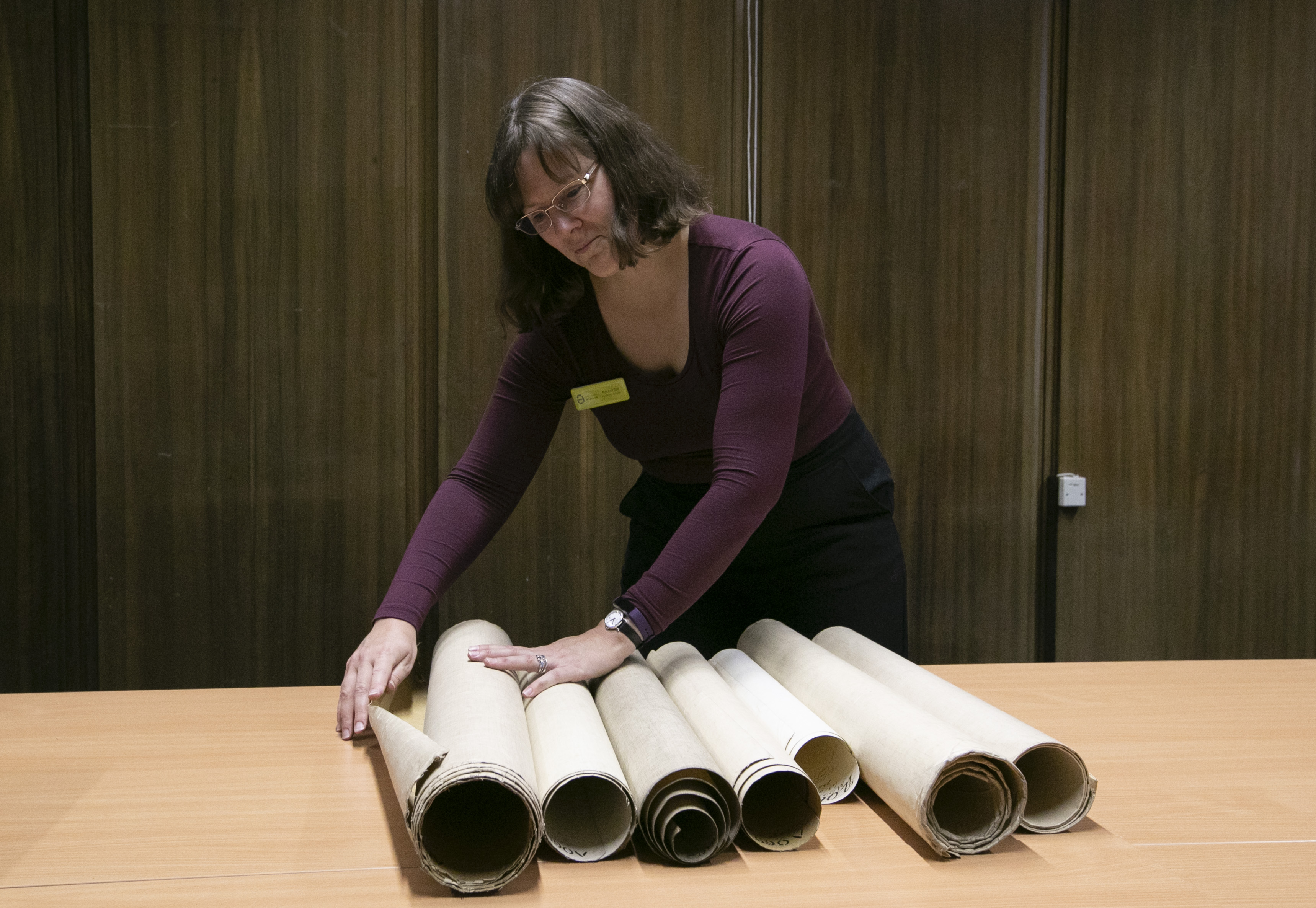
Rachel Gill, an archivist, introduces the plans of Zhiyuan, one of the most renowned and heroic military vessel in Chinese history, at the Tyne & Wear Archives in Newcastle, Britain, Nov. 2, 2018. (Xinhua/Han Yan)
Since the Opium War in 1840, the pride and complacency of the Qing government in being the "Middle Kingdom" was shattered. The government spared no efforts to purchase the most cutting-edge weaponry from Europe in hopes of rivaling the cannons and guns that helped Western imperialists thrash open the doors of China.
The guns and cannons purchased from Krupp, to no avail, were deployed in the strategic areas along the coast of China to fend off foreign invasions. Some of them were mounted to the cruisers of the Beiyang Fleet, a landmark modernized Chinese navy created by the Qing government vying for sea power.
At the Tyne & Wear Archives in the British city of Newcastle, plans of Zhiyuan (also known as Chih Yuen), one of the most renowned and heroic military vessel in Chinese history, were recently discovered by Xinhua.
Built by a manufacturer in Newcastle between 1885 and 1887 as a member of the Beiyang Fleet, Zhiyuan was sunken in 1894 during the First Sino-Japanese War commonly known in China as the Jiawu War.
Nevertheless, the cruisers, along with the cannons, were among the most advanced during that time. The Army and Navy Gazette, a London-based newspaper, said at that time that the vessels as "superior in certain novelties of construction to any of our own vessels ... In point of speed they cannot be touched by our swiftest cruisers."
Cord Eberspaecher, historian and sinologist at the Heinrich-Heine-University Duesseldorf, said that China's defeat in the First Sino-Japanese War in 1895, marked as a national humiliation to the country, exposed the weaknesses of the whole political system of the Qing Dynasty.
But neither advanced weapons nor a simple copy of the Western system had succeeded in rescuing China from the upheavals. Due to complex historical and social reasons, a revolution in 1911 led by Sun Yat-sen overthrew the Qing Dynasty and briefly created a republic, but failed to lift China out of misery.
While the struggles to find a path to development continued in China, the seeds of hope were found in Europe.
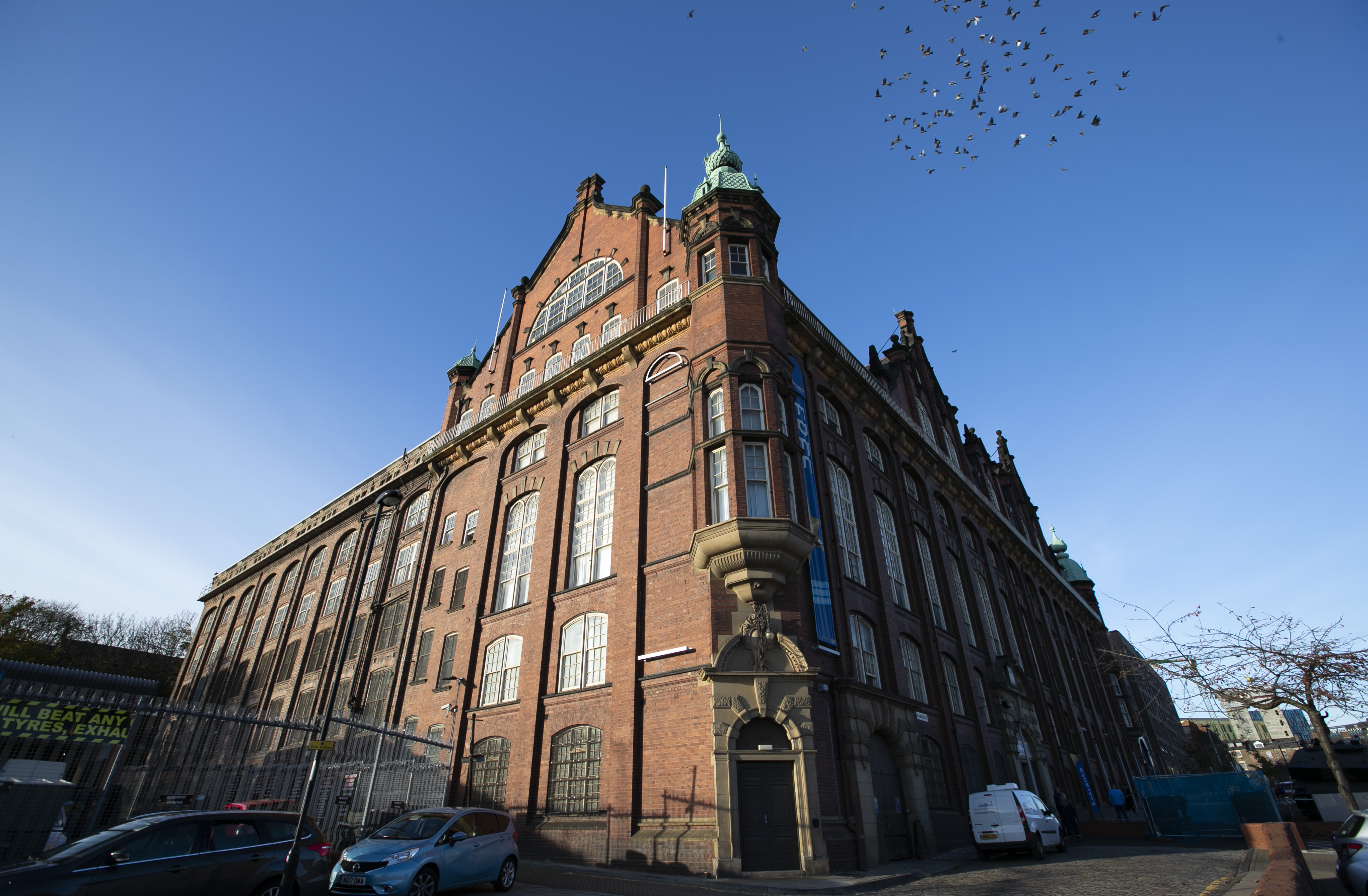
Photo taken on Nov. 2, 2018 shows the exterior of the Tyne & Wear Archives in Newcastle, Britain. (Xinhua/Han Yan)
PURSUING IDEALS
Unlike the vibrant Avenue des Champs-Elysees, the street of Rue Godefroy in Paris is usually serene and quiet. Only a commemorative plaque near an obscure hotel draws the attention of the passers-by: Zhou Enlai lived in this building during his stay in France from 1922 to 1924.
Since 1919, thousands of progressive young Chinese went to France, where they worked in factories in Paris, Lyon and Montargis to earn money for their studies in the country. Among these prominent figures were late Chinese leaders Zhou Enlai and Deng Xiaoping.
Many of those young Chinese became interested in Marxism, and they established a communist party group in France.
In the street of Rue Raymond Tellier in Montargis, a 300-year-old building, once the residence of some Chinese students and now the Historical Museum on Franco-Chinese friendship, keeps files documenting that part of history.
A faded picture shows that Cai Hesen, an early leader of the Communist Party of China (CPC), was delivering a speech to a dozen students sitting or standing at a corner of Durzy Park, not far from their residence. Their blurry faces were hard to recognize but their passion to save their homeland was apparent.
Among the collections, a copy of a deportation order issued in 1926 shows that Deng, the chief architect of China's reform and opening-up, was deported under his previous name -- Deng Xixian, for organizing Chinese students and workers in France in support of a workers' movement in China.
Despite all the adversities, the seeds of hope started to sprout in China in 1921 when the CPC held its first national congress and announced the founding of the party.
With the fundamental purpose of "serving the people wholeheartedly," the CPC garnered immense support from the masses and powered through grueling and difficult times.
After the arduous Chinese People's War of Resistance Against Japanese Aggression and the War of Liberation, the People's Republic of China (PRC) was founded on Oct. 1, 1949, opening a new chapter in Chinese history.
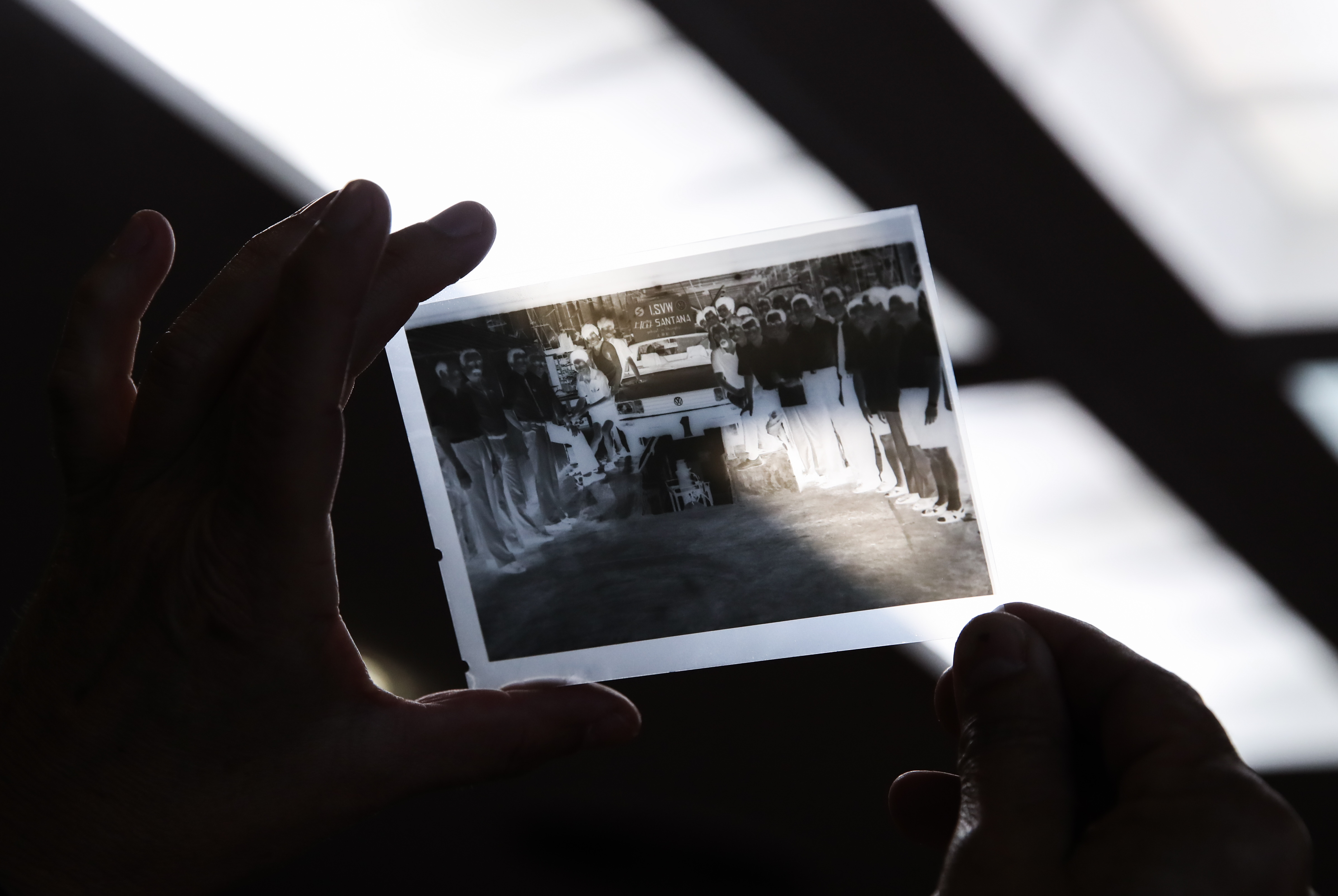
Photo taken in September of 2019 shows a staff member displaying a negative of a file photo showing a Santana car in China at the Volkswagen archives in Wolfsburg, Germany. (Xinhua/Shan Yuqi)
NATIONAL REJUVENATION
The Volkswagen archives in the German city of Wolfsburg contains a photograph shot in 1978, showing a group of "unexpected" Chinese visitors taking notes in front of a sand table in the Volkswagen car factory.
Dieter Landenberger, director of the Historic Communications Volkswagen, told Xinhua that the Chinese delegation from the First Ministry of Machine Industry of the PRC did not make any appointments before knocking on the door of Volkswagen.
"It was said it was their decision made at the moment when they saw Volkswagen cars on the streets during their visit to Germany. It was a great coincidence and was extremely lucky that W.P. Schmidt, the director in charge of the international business, was at the office," said Landenberger.
This encounter led to the introduction of foreign investment into China's fledging auto industry, a crucial part of China's reform and opening-up which started in 1978.
According to Volkswagen, some 10 million Volkswagen cars were sold all over the world in 2018. Among them, more than 4.2 million were delivered to Chinese customers.
In the western German city of Duisburg, in front of the Chamber of Industry and Commerce stands the statue of Werner Gerich, China's first foreign factory director hired after the reform and opening-up policy. The statue was a gift from the central Chinese city of Wuhan.
In 1984, in an unprecedented move, 65-year-old Gerich was appointed director of the Wuhan Diesel Engine Factory, a state-owned enterprise.
A photo kept by Gerich's son Bernd shows that his father, wearing a peaked cap and factory uniform, was discussing salary reform plans with his colleagues.
During his two years in office, Gerich reinvigorated the old enterprise, including setting up a system that tied pay to performance. High-quality diesel engines produced by the factory have since been exported to Southeast Asia, earning Gerich the nickname "Mr. Quality" for his rigid quality control and strict management.
From manufacturing to many other areas, through continued reform and opening-up efforts, China has tapped its potential, transforming itself into the world's second largest economy, the largest manufacturer, and the largest trader in goods.
Only a limited number of historical records in Europe on China's revolution has been uncovered so far, but the implications of what China has achieved are self-evident.

Photo taken on Sept. 5, 2019 shows an exterior view of Villa Huegel in Essen, western Germany. (Xinhua/Shan Yuqi)
Seventy years since the founding of the PRC, the country has embarked on the path to achieve its two centenary goals.
By the time the CPC marks its centenary, the goal is to finish building a moderately prosperous society in all respects.
By the time the PRC celebrates its centenary, the goal is to build China into a great modern socialist country that is prosperous, strong, democratic, culturally advanced, harmonious and beautiful.
An even brighter picture of China pursuing a dream of national rejuvenation scrolls on.
(Xinhua reporters Zhao Yuchao, Han Yan, Han Qian, Gao Jing, Lian Zhen, and Shan Yuqi also contributed to this story.)
(Video reporters: Jin Jing, Zhao Yuchao, Han Chong, Lian Zhen, Ying Qiang, Han Qian; Video editor: Li Ziwei)
