



Xinjiang's progress was made possible by the peaceful liberation of the region, the 70th anniversary of which will be celebrated Wednesday.
The region has seen improved living standards for its people and as proof of the general stability and sound development momentum, not a single terrorist attack has occurred in Xinjiang over the past three years.
URUMQI, Sept. 24 (Xinhua) -- The city of Shihezi is a sprawling green area home to 670,000 people. As September ends and the harvest season arrives, farmers are ready to reap the large cotton fields in the city's suburbs.
Shihezi, about 150 km northwest of Urumqi, is a young city established in the 1950s in Xinjiang Uygur Autonomous Region. It is one of the nine bustling cities that has risen from the bleak Gobi Desert.
While about 1,600 km away in the southwest, Kashgar, an ancient Silk Road city, maintains the charm and authenticity of a 2,000-year-old town.
The contrasting landscape marks the vastness of Xinjiang, which covers about one-sixth of China's land territory, and epitomizes how Xinjiang has progressed both economically and culturally.
This progress was made possible by the peaceful liberation of the region, the 70th anniversary of which will be celebrated Wednesday. In 1949, the liberation struggle gained momentum across the country and the revolutionary struggle of the people of all ethnic groups surged forward in Xinjiang, Tao Zhiyue, garrison commander of Xinjiang, and Burhan, chairman of the Xinjiang Provincial Government, renounced their allegiance to the Kuomintang and welcomed in the First Army Group of the First Field Army of the Chinese People's Liberation Army (PLA), led by General Wang Zhen.
From then on, Xinjiang embarked upon a journey of increasing prosperity, unity and stability.
As proof of the general stability and sound development momentum, not a single terrorist attack has occurred in Xinjiang over the past three years.
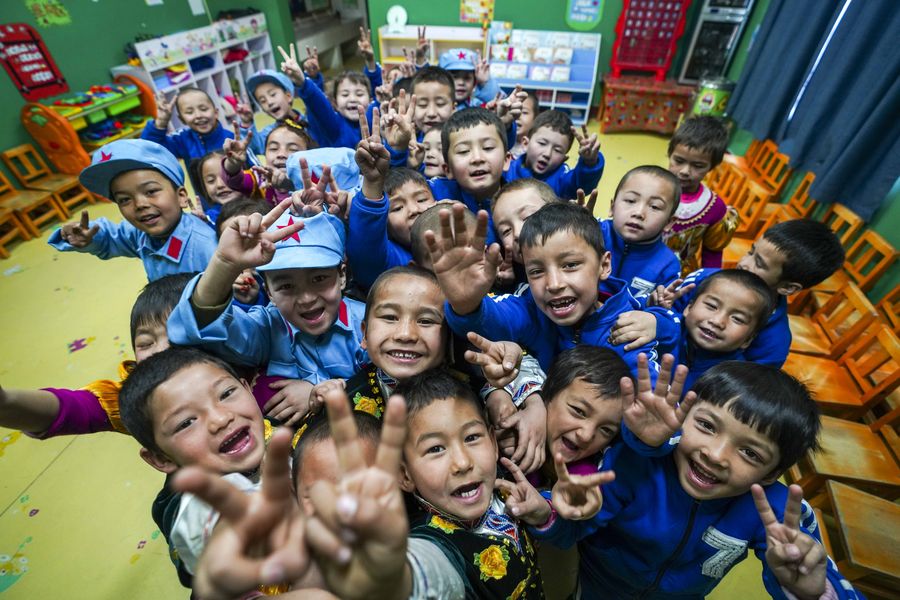
Children pose for a photo at a kindergarten at Liangzhongchang Village in Yutian County of Hotan, northwest China's Xinjiang Uygur Autonomous Region, Feb. 13, 2019. (Xinhua/Zhao Ge)
SOCIAL DEVELOPMENT
In the years that immediately followed the peaceful liberation, Xinjiang's average life expectancy was 30 years. The figure reached 72.35 years in 2018. Now 25 million people live in 14 prefectures and cities in the region.
Before the liberation, most arable land in Xinjiang was seized by a handful of landlords, leaving very little to the majority of farmers. Serfdom existed in southern Xinjiang, where overlords owned their serfs from head to toe.
Samsak, a herder in Kashgar, owned nothing more than the clothes he was wearing when PLA soldiers liberated him. His name, meaning "garlic" in Uygur language, was given by his master. From the age of 17 to the age of 60, he had done nothing but herded sheep, yet he owned none of them.
Through a democratic reform that toppled the old system, ordinary people like Samsak received their own land and sheep and became masters of their own fate.
In 1955, the system of regional ethnic autonomy was implemented in Xinjiang, offering a further guarantee to the people of Xinjiang in exercising their right as masters of the country.
In 1950, Xinjiang only had 3,000 ethnic minority cadres. By 2018, the ethnic cadres made up 50.3 percent of the total in Xinjiang to reach 428,000, of whom over half are women.
Xinjiang has seen improved living standards for its people over the past seven decades. Public services, such as free health checkups for all, critical illness insurance, free preschool education for rural children, and housing projects for herders and farmers, have increased people's sense of fulfillment. Tap water, stable power supply and roads have been made accessible to herders who live in the most remote border areas.
During an inspection tour to Xinjiang in 2014, President Xi Jinping called for steadfast efforts to attain leapfrog development, while stressing efforts must be made to improve people's livelihoods and win the support of the people.
Living on the edge of Taklimakan Desert in Hotan, Tursuntoht Jume, 61, cherishes the tap water supply that was only recently installed in his home. "For half of my life, I had been drinking from the pond. Drinking directly from the tap, this makes me happier than anything else," he said.
Safe drinking water, among other things, is one criterion to gauge poverty relief efforts in Xinjiang. From 2014 to 2018, Xinjiang lifted over 2.3 million people above the poverty line, defined by a per capita annual income of 2,300 yuan (around 333 U.S. dollars) at 2010 prices. The poverty rate in the region is 6 percent. By next year, these remaining people are expected to be taken off the impoverished list.
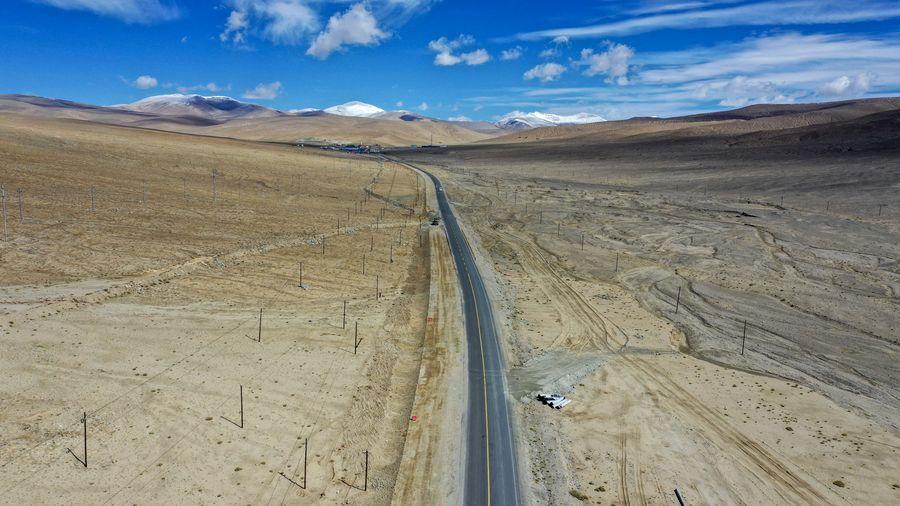
Aerial photo taken on June 14, 2019 shows the construction site of a highway linking Bulungkol with Kunjirap in northwest China's Xinjiang Uygur Autonomous Region. (Xinhua/Hu Huhu)
VIBRANT ECONOMY
Spotless packaging lines are in full operation at a plant in Xinjiang Fruits Products Group Co., Ltd., based in Urumqi, the regional capital. Dried dates, walnuts and raisins produced in Xinjiang are sold across the country and overseas.
Thriving fruits, grain, cotton, and animal husbandry industries make Xinjiang the main agricultural region in China. It is the country's largest cotton production base.
The tourism, trade and manufacturing industries are also booming in the region. From January to August, Xinjiang received about 150 million tourists, which is close to the full-year figure for 2018. The region is expected to welcome over 200 million tourists this year, said Erkin Tuniyaz, vice chairman of Xinjiang.
Xinjiang's gross domestic product (GDP), which was 791 million yuan in 1952, soared to 1.2 trillion yuan in 2018, an annual growth rate of 8.3 percent. Per capita GDP was 49,000 yuan in 2018, yearly growth of 5.7 percent compared to 1952, statistics showed.
Since 2014, Xinjiang has seen 2,451 westbound trains, reaching out to 26 cities in 19 countries, exporting mechanical parts and laptops while importing products such as wine and grain. In 2018, Xinjiang's foreign trade volume was 20 billion U.S. dollars, 1,481 times the figure in 1950.
"Xinjiang plays an irreplaceable role in building the Silk Road Economic Belt. It must seize the historic opportunity, and integrate regional opening-up strategy into the country's efforts to build the Silk Road Economic Belt and open up to the west," President Xi said.
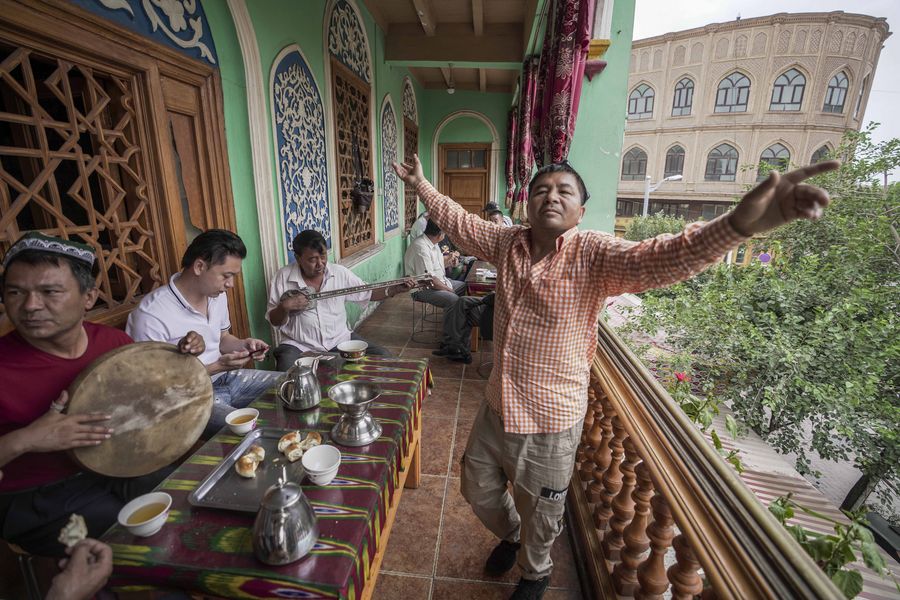
A local resident dances to the music at a tea house in the ancient city of Kashgar, northwest China's Xinjiang Uygur Autonomous Region, July 7, 2019. (Xinhua/Zhao Ge)
PRESERVATION OF CULTURE, HERITAGE
Abudubek Eskan, 42, often thinks of his teacher Jusup Mamay, a legendary singer of the Kirgiz epic Manas, who passed away in 2014 at the age of 97 in his hometown of Akqi County in Xinjiang.
Epic Manas tells the story of the hero Manas and his seven descendants in more than 230,000 lines. Manas singers are highly regarded by Kirgiz people for their good memory and narrative skills.
"The passing down of Manas depended solely on one master telling another face to face. Once the master dies, it is very difficult to pass down the art," said Eskan.
The government of Kirgiz Autonomous Prefecture of Kizilsu has accredited 100 people, aged from 20 to 70, to be Manas singers. They receive monthly government stipends to carry on the art.
"I'm teaching my 7-year-old son to sing Manas, I hope young people can bring new life to the art," said Eskan.
Xinjiang is a multi-ethnic region. Across the region, there are 24,800 venues for religious activities, including mosques, churches, Buddhist and Taoist temples, with 29,300 religious staff. People in the region enjoy freedom of religious belief. Efforts have been made to boost ethnic unity so they could be united together "like seeds of a pomegranate."
The family of Kurban Tulum is well-known in Xinjiang for their roles in promoting ethnic solidarity.
Kurban Tulum, a farmer from Hotan, was twice received by Chairman Mao Zedong. Now the extended family of Tulum has over 100 members.
Tohtihan Kurban, the eldest daughter of Kurban Tulum in her 90s, has spent her lifetime continuing her father's efforts. "Having gold and silver does not make you rich, unity and harmony between people is the true treasure," she said.
(Video reporter: Su Chuanyi; Video editor: Zhang Yucheng)■
