



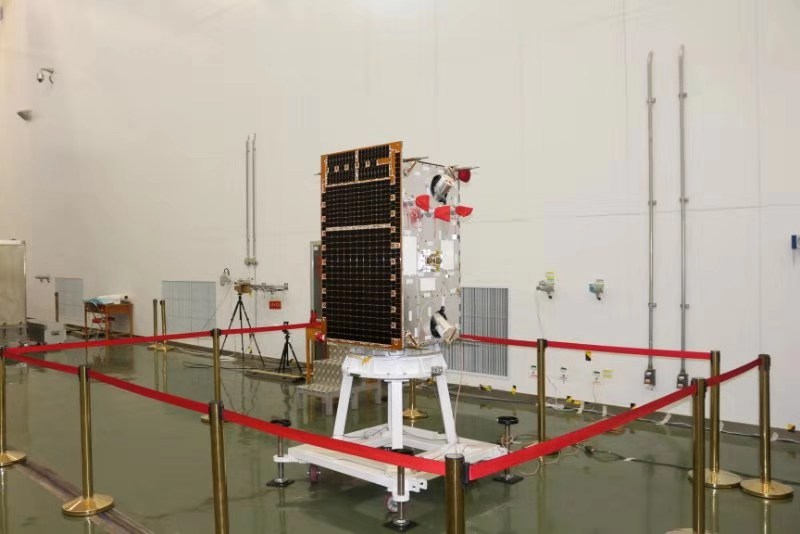
The Taiji-1 satellite is a recently-launched Chinese satellite that was sent into orbit on Aug. 31, 2019 to conduct in-orbit experiments on the key technologies related to space-based gravitational wave detection. (Xinhua)
China's Taiji-1 satellite, sent into orbit last month, has conducted in-orbit experiments on the key technologies related to space-based gravitational wave detection and has completed its first stage tests in orbit, laying a solid foundation for future gravitational wave observation in space.
BEIJING, Sept. 20 (Xinhua) -- A recently-launched Chinese satellite has conducted in-orbit experiments on the key technologies related to space-based gravitational wave detection, the Chinese Academy of Sciences (CAS) announced on Friday.
The satellite, sent into orbit on Aug. 31, is China's first such kind of satellite, and has completed its first stage tests in orbit, laying a solid foundation for future gravitational wave observation in space, said Xiangli Bin, vice president of CAS.
"This is the first step of China's space-based gravitational wave detection. But there is still a long way to go to realize detecting gravitational waves in space. Chinese scientists will continue to contribute Chinese wisdom to the exploration and human progress," Xiangli said.
The satellite has been named Taiji-1. As a Chinese term for the "supreme ultimate," Taiji is well-known as the black and white circular symbol representing yin and yang. The pattern of Taiji also resembles a binary star system composed by objects like neutron stars or black holes.
Gravitational waves are "ripples" in space-time caused by some of the most violent and energetic processes in the universe. Albert Einstein predicted the existence of gravitational waves in 1916 in his general theory of relativity.
The strongest gravitational waves are produced by catastrophic events such as colliding black holes, supernovae, coalescing neutron stars or white dwarf stars and possibly even the remnants of gravitational radiation created by the birth of the universe itself.
The first discovery of gravitational waves by the LIGO Collaboration in 2015 has opened a new window to observe the universe and encouraged scientists worldwide to accelerate their research.
CAS has announced the research program "Taiji" that will study gravitational waves from the merging of binary black holes and other celestial bodies.
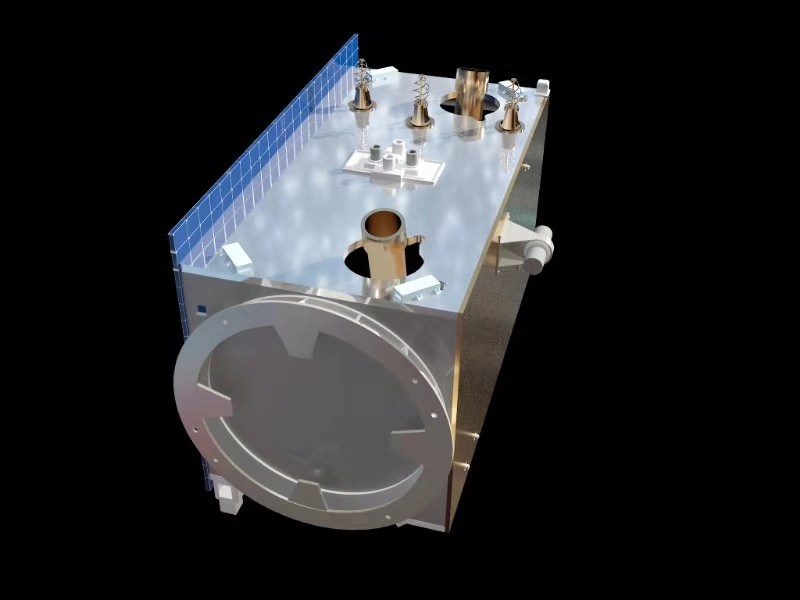
A simulated image of the recently-launched Chinese satellite Taiji-1. (Xinhua)
Unlike the LIGO research conducted from a ground-based observatory, Taiji will conduct space-based detection on the gravitational waves with lower frequencies to observe celestial bodies with greater mass or located farther away in the universe, said Wu Yueliang, chief scientist of the Taiji program and an academician of CAS.
However, the gravitational wave signals from those celestial bodies are extremely weak, posing great challenges for detection. Scientists need to break through the limit of current precise measurement and control technology, Wu said.
Taiji-1 aims to test the key technologies such as high-precision and ultra-stable laser interferometer, gravitational reference sensor, ultra-high precision drag-free control and ultra-stable and ultra-static satellite platform, according to Wu.
Taiji-1 has realized China's most accurate space laser interference measurement and the first in-orbit drag-free control technology test. It also carried out electric propulsion technology experiments, Xiangli said.
The first-stage in-orbit test showed that the accuracy of displacement measurement of the laser interferometer on Taiji-1 could reach a 100-picometer order of magnitude, equivalent to the size of an atom.
"The accuracy of the gravitational reference sensor on the satellite reached ten billionths of the magnitude of the earth's gravitational acceleration, equivalent to the acceleration produced by an ant pushing the Taiji-1 satellite," Wu explained.
The thrust resolution of the micro-thruster on the satellite reached a scale equivalent to one-ten thousandth of the weight of a sesame grain, Wu said.
However, the technological requirements for detecting gravitational waves in space are much higher, scientists say.
CAS set a three-step strategy to implement the Taiji program. It took the research team about one year to develop Taiji-1, the first satellite of the program. It is expected to launch another two satellites in the second step after 2023, and three more satellites in the third step around 2033, according to Wu.
Over the past few years, China has sent a series of space science satellites into space, including the DAMPE to search for dark matter, the world's first quantum satellite and the HXMT, China's first X-ray space telescope.
In the coming three to four years, China plans to launch new space science satellites including the Gravitational Wave Electromagnetic Counterpart All-sky Monitor (GECAM), the Advanced Space-borne Solar Observatory (ASO-S), the Einstein-Probe (EP) and the Solar wind Magnetosphere Ionosphere Link Explorer (SMILE) to study gravitational waves, black holes, the relationship between the solar system and humanity and the origin and evolution of the universe. ■
