KUNMING, Aug. 12 (Xinhua) -- Extending their trunks toward a giant table, a group of garlanded Asian elephants glutted themselves with fresh carrots, pineapples, dragon fruit and watermelons. They are celebrating their big day -- World Elephant Day -- which falls on Aug. 12 every year.
Visitors took pictures with these giant land animals at the Wild Elephant Valley scenic spot in Dai Autonomous Prefecture of Xishuangbanna, southwest China's Yunnan Province.
However, since June, 16 wild Asian elephants have occupied a farmland and unscrupulously munched unripe sugar cane and corn in Longzhupeng Village, Menghai County in Xishuangbanna, one of their primary habitats.
The incident is only a microcosm of the conflict between humans and wild elephants in recent years, with the latter walking into villages, gnawing on crops, damaging houses and threatening people's lives. The elephants, too, are facing new challenges that threaten their safety and lives due to human activities.
HUMAN VS ELEPHANT
The Asian elephants are under Class-A protection in China and are included in the International Union for Conservation of Nature Red List of Threatened Species as "endangered."
In China, wild Asian elephants, a flagship species in the rainforest, are mainly scattered in Yunnan's Xishuangbanna, Pu'er and Lincang.
Since 1958, Yunnan has established 11 nature reserves in the tropics, the elephants' main habitat, covering a total area of about 510,000 hectares. "They have become important shelters for Asian elephants," said Xiang Ruwu, head of the wildlife protection division of the Yunnan Forestry and Grassland Administration (YFGA).
YFGA data showed that the forest coverage rate in Xishuangbanna National Nature Reserve increased from 88.9 percent in 1983 to 97 percent in 2016, and the population of wild Asian elephants in Yunnan nearly doubled to about 300 over the past three decades.
Unfortunately, there is another side of the story. "The rising canopy density has changed the distribution of plants in the region, with woody plants gradually taking over the territory previously shared by wild banana and thysanolaena maxima, the elephants' main food sources," said Chen Mingyong, a professor with the Asian elephant research center in Yunnan University.
"Once they can't get their fill, some elephants will seek food outside the reserves, and conflicts are unavoidable when their activity range overlaps with that of humans," Chen said, adding that about two-thirds of the wild elephants are now living outside the reserves.
The behavior of wild elephants has changed over the past decades.
Take eating habits as an example. "The elephants only ate some crops in the beginning, but they now munch leisurely and stay in the fields," said Chen.
The 16 elephants have damaged over 20 houses and eight hectares of crops, according to Long Yunhai, deputy head of the bureau of forestry and grassland of Menghai County.
Zhang Zhalao, 56, has been sleeping on a temporary rooftop tent to evade attacks from these elephants.
"The elephants used to avoid humans, but now they feel at home here and often attack local residents," said Zhang.
Wild elephants have caused over 60 deaths and injuries since 2013, and the property damage was estimated at over 170 million yuan (about 24 million US dollars) from 2011 to 2018, according to YFGA.
At the same time, about 40 wild elephants were found dead due to electrocution, mistakenly eating poisonous crops or drowning in irrigation reservoirs since 2009.
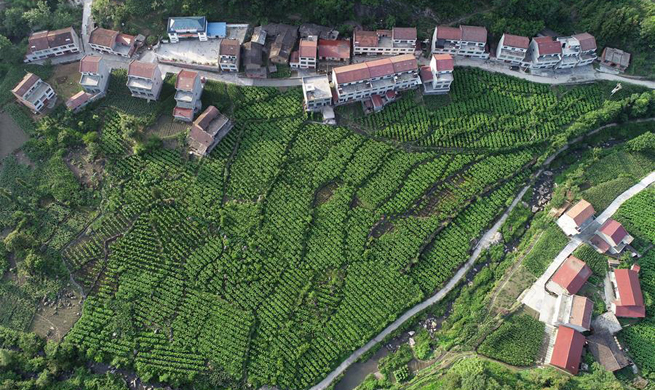
"A large number of fallow lands outside the reserves have been reclaimed to grow rubber, tea and coffee in the last two decades," Chen said. "Infrastructure projects such as highways and dams also intensified the conflicts between human and elephants."
PROTECTION AND HARMONY
Human-elephant conflicts are not unusual in Asian countries such as India and Thailand, and many countries including China are searching for win-win solutions to tackle the issue.
China's central and provincial governments have published a series of animal protection regulations to better protect the elephants, and Yunnan has purchased commercial wild animal insurance since 2014.
"When elephants cause trouble for us, we can get compensation from insurers," said Xu Deming, a villager in Guanping village where steel fences were built in 2017 to prevent the intrusion of wild elephants. "Now the villagers are safe at home," Xu said.
The monitoring system of early warning is also playing an effective role. The county of Menghai began to use drones to monitor the activities of the elephants in June 2016 and has avoided nearly 60 possible conflicts over the past three years, said Long Yunhai.