




*Since no sign of compromise can be seen or foreseen at the current stage, the digital tax dispute is likely to re-aggravate EU-U.S. trade tensions.
*Until now, only a few members, including Austria, Britain, Spain and Italy have plans for their own digital taxes. France became one of the first countries to impose a tax on digital giants in July.
*In retaliation, Trump threatened to impose tariffs on French wine, tweeting "we will announce a substantial reciprocal action ... I've always said American wine is better than French wine."
*It is widely believed that the solution to the digital taxation issues should be found in multilateral frameworks such as the Organisation for Economic Co-operation and Development (OECD).
FRANKFURT, Aug. 1 (Xinhua) -- Vowing to work together toward "zero tariffs, zero non-tariff barriers and zero subsidies on non-auto industrial goods," U.S. President Donald Trump and European Commission President Jean-Claude Juncker made a deal in July 2018, once considered the very first step toward easing a transatlantic trade conflict.
However, one year on, the sword of Damocles continues to hang over the trade relations between the European Union (EU) and the United States, as Trump delayed a decision to impose tariffs on imported cars and auto parts by up to six months.
Moreover, the U.S. Trade Representative (USTR) has initiated an investigation against France under Section 301 of the Trade Act of 1974, accusing the French government of "unfairly targeting the tax at certain U.S.-based technology companies," after the French Parliament legislated to impose digital services tax (DST) on internet companies, including American giants "GAFA," namely Google, Amazon, Facebook and Apple.
Since no sign of compromise can be seen or foreseen at the current stage, the digital tax dispute is likely to re-aggravate EU-U.S. trade tensions.
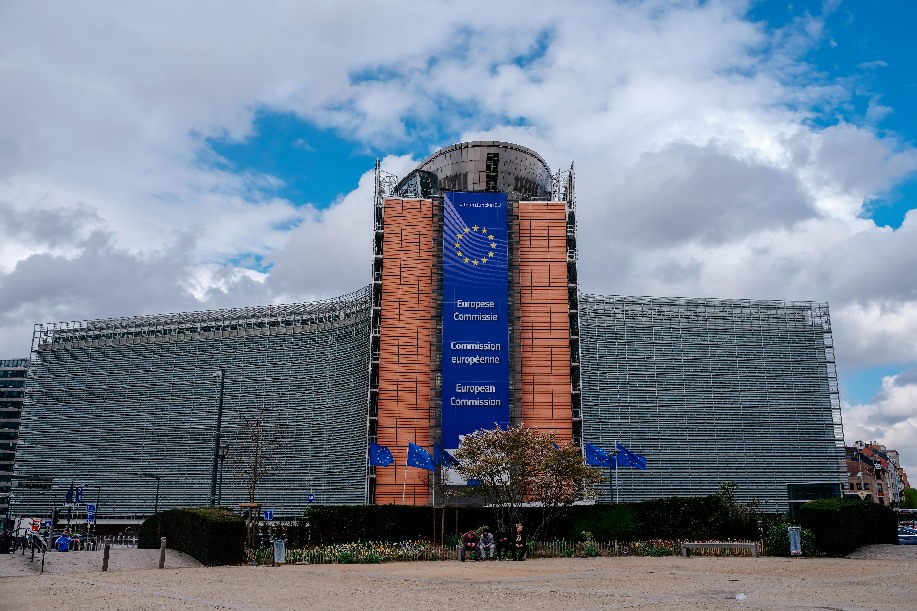
Photo taken on April 3, 2019 shows the exterior view of the headquaters of the European Commission in Brussels, Belgium. (Xinhua/Zhang Cheng)
CONTROVERSIAL DST
Pursuing so-called tax fairness, competitive economy and sustainable tax revenues, the European Commission initially proposed a 3-percent DST on certain revenue streams for these internet companies in March 2018, while member states could not reach any agreement on a concerted approach.
The DST issue has been debated for some time. One point of contention: internet giants can earn profits from several countries while basing their operations in low-tax countries such as Ireland.
As the European Commission proposed, the indirect tax would apply to revenues generated from digital activities, in which users play a major role in value creation, such as digital services to facilitate online advertising, e-commerce transaction and user-to-user interaction.
In addition, the European Commission proposed that tax revenues would be collected by the member states where users are located, and only apply to companies with total annual worldwide revenues of 750 million euros (828.8 million U.S. dollars) and EU revenues of 50 million euros (55.25 million dollars), in order to leave small start-ups unburdened.
Despite much cry in the bloc, member states have failed to agree on a union-wide digital tax, as Sweden, Denmark and Ireland opposed the proposal for various reasons, including the loss of revenue and retaliation from the United States.
Furthermore, the 28-member bloc is also divided on how to tax the digital firms' cross-border income.
Until now, only a few members, including Austria, Britain, Spain and Italy have plans for their own digital taxes. France became one of the first countries to impose a tax on digital giants in July.
"With the taxation of digital services, we are building the tax system of the 21st century, which should be fair and efficacious," French Finance Minister Bruno Le Maire said.
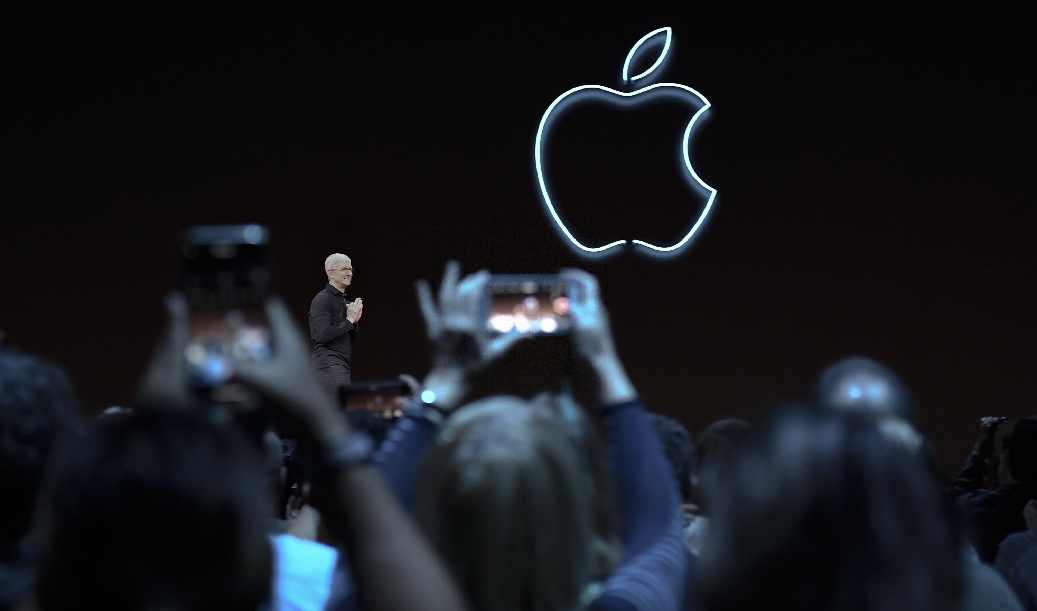
Apple CEO Tim Cook hosts Apple's Worldwide Developer Conference (WWDC) in San Jose, California, the United States, June 3, 2019. (Xinhua)
WASHINGTON'S RETALIATION
There is no doubt that the DST adopted by France will affect U.S.-based global giants like "GAFA" due to their revenue sizes, albeit Le Maire stressed the French DST aims to "reduce tax injustice" and target all multinationals.
In retaliation, Trump threatened to impose tariffs on French wine, tweeting "we will announce a substantial reciprocal action ... I've always said American wine is better than French wine."
Before that, a Section 301 investigation against France was initiated on July 10 and the USTR will hold a public hearing on August 19 following the probe.
Section 301 is part of a U.S. trade law adopted in 1974, which allows the U.S. president to unilaterally impose tariffs or other trade restrictions on foreign countries.
Defying Trump's threat, Le Maire insisted that the digital tax on internet giants was "a national decision" that the government would put on the ground.
For some French people, Trump's threat was simply a "threat."
"It's a tweet (threating to tax French wine) for U.S. voters a few months before elections, not to France," said Anthony Bellanger, general secretary of the International Federation of Journalists based in Brussels.
Trump had already threatened last November to tax French wine in retaliation for the taxes imposed on American wines, and his threats to tax the European car industry weren't yet implemented, he recalled.
However, some specialists remain alert.
"Trump is someone who works especially with the balance of power by showing his muscles; then we try to negotiate and find compromises. This is the idea," warned Thierry Vedel, political science researcher at the National Center for Scientific Research.
Concerned about a probable sales decline, Fernand Baixas, a winemaker from the eastern Pyrenees, said "it would be completely ridiculous if they increase taxes."

Exhibits of wines brewed by France-based Chateau Clinet are seen at the Prowein in Dusseldorf, Germany, on March 17, 2019. (Xinhua/Lu Yang)
MULTILATERAL SOLUTIONS
France hoped G7 leaders could bridge differences and forge a common front on a universal tax of digital activities during an upcoming summit at the end of August in the French coastal resort of Biarritz.
It is widely believed that the solution to the digital taxation issues should be found in multilateral frameworks such as the Organisation for Economic Co-operation and Development (OECD).
"It is in our collective interest to achieve a fair taxation of digital activities in the world," Le Maire said.
Striving for broader support for the digital taxation, France would lift the digital tax if there is an accord that includes all OECD countries by the end of 2020.
Similarly, the British government said it "still believes the most sustainable long-term solution to the tax challenges arising from digitalisation is reform of the international corporate tax rules and strongly supports G7, G20 and OECD discussions on the different proposals for reform."
Downing Street also emphasized that it is committed to dis-applying the DST once an appropriate international solution is in place.
"A new global agreement is the best long-term solution. But progress is painfully slow," said former British Chancellor of the Exchequer Philip Hammond.
It remains to be seen if the tensions between the United States and France will intensify or even extend to more European countries, as well as if the digital tax dispute would overshadow EU-U.S. trade negotiations before a multilateral agreement is reached.
(Video reporter: Shen Zhonghao; Video editor: Liu Ruoshi)
