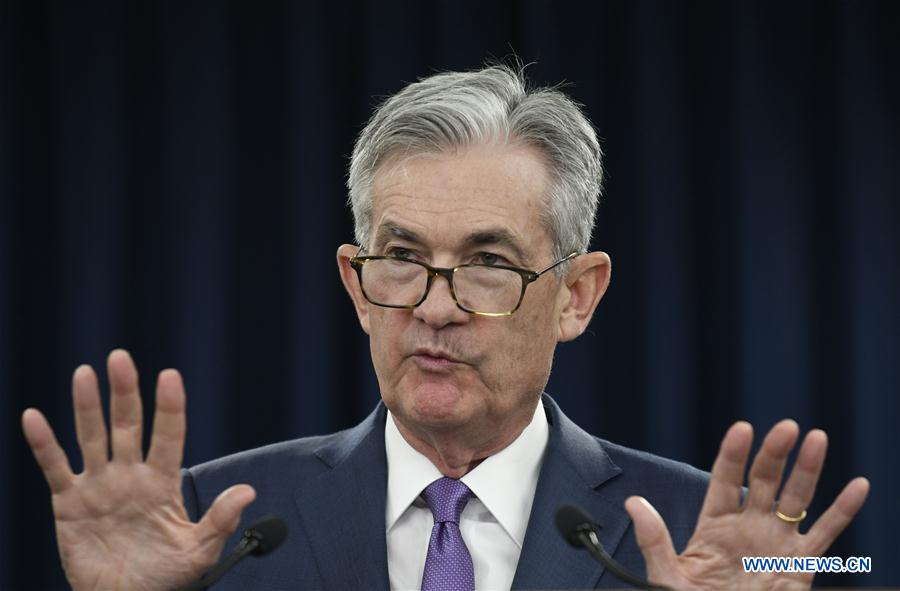
U.S. Federal Reserve Chairman Jerome Powell speaks during a press conference in Washington D.C., the United States, on July 31, 2019. U.S. Federal Reserve on Wednesday lowered interest rates for the first time since the 2008 global financial crisis, amid rising concerns over trade tensions, a slowing global economy and muted inflation pressures. The Federal Open Market Committee, the Fed's rate-setting body, trimmed the target for the federal funds rate by 25 basis points to a range of 2 percent to 2.25 percent after concluding its two-day policy meeting, in line with market expectation. (Xinhua/Liu Jie)
by Xiong Maoling, Gao Pan
WASHINGTON, Aug. 1 (Xinhua) -- U.S. Federal Reserve on Wednesday lowered interest rates for the first time since the 2008 global financial crisis, amid rising concerns over trade tensions, a slowing global economy and muted inflation pressures.
The Federal Open Market Committee (FOMC), the Fed's rate-setting body, trimmed the target for the federal funds rate by 25 basis points to a range of 2 percent to 2.25 percent after concluding its two-day policy meeting, in line with market expectation.
"Through the course of the year, weak global growth, trade policy uncertainty, and muted inflation have prompted the FOMC to adjust its assessment of the appropriate path of interest rates," Fed Chairman Jerome Powell said at a press conference Wednesday afternoon.
Despite strong job growth and solid consumer spending, the central bank chief pointed out that manufacturing output has declined for two consecutive quarters, business fixed investment fell in the second quarter, and domestic inflation shortfall has continued.
"The Committee moved from expecting rate increases this year, to a patient stance about any changes, and then to today's action," Powell said.
Calling it a "mid-cycle adjustment" to the central bank's monetary policy, Powell said the rate cut is "not the beginning of a long series of rate cuts." The stock market plunged after his remarks, with Dow Jones Industrial Average closing 333.75 points lower, or 1.2 percent, at 26,864.27.
"They provided much less than markets expected when it comes to additional rate cuts," said Diane Swonk, chief economist at Grant Thornton LLP. "This can be seen as a hawkish cut in rates."
Shortly after Powell's press conference, U.S. President Donald Trump lashed out at the central bank chief for not signaling the start of "a lengthy and aggressive rate-cutting cycle," saying on Twitter that Powell "let us down."
Trump has repeatedly voiced his criticism of the Fed's monetary policy over the past few months, and just earlier this week, the president demanded a larger rate cut. Powell, meanwhile, has stressed the Fed's commitment to independence.
"I do not believe that this precludes additional policy easing, but it does suggest that the FOMC's policy outlook is closer to being balanced," Krista Schwarz, assistant professor of finance at the Wharton School of the University of Pennsylvania, told Xinhua, adding that the Fed funds futures contract for December showed "at least one more rate cut" is priced in by the end of the year.
Schwarz said the newly announced rate cut can be characterized "as primarily an insurance move" against potential downside risks to the economy, while noting that the rate hike last December could be characterized as "precautionary tightening," insuring against risks at that time to "overly robust growth" in certain sectors.
Joseph Gagnon, senior fellow at the Peterson Institute for International Economics, however, told Xinhua last week that he thought the Fed regretted its last two hikes last year and "wants to chase it back basically."
Calling trade tensions "the main risk," Gagnon said if the U.S. administration "slaps on a lot more tariffs on a lot more countries," it would be a risk to the U.S. economy, and then to the world in the near future.
Two members of the 10-person FOMC dissented to the rate-cut decision. Esther George and Eric Rosengren, presidents of Kansas City Fed and Boston Fed, "preferred" to maintain the target range for the federal funds rate at 2.25 to 2.5 percent.
"The dissents are important because they underscore the Fed's independence from the White House and illustrate the tightrope it is walking between attempting to add a little heat to the expansion without further stoking asset price bubbles," Swonk said.
She added that the FOMC "delivered more than expected" by stopping the reductions in its balance sheet two months earlier, referring to the Fed's decision to conclude its balance sheet runoff on Aug. 1, instead of at the end of September as previously scheduled.
When asked whether the Fed would have limited policy space when a recession hits, Powell said that argument is based on the assumption that the Fed would never raise rates again, and he did not think that is right "as a matter of principle."
"In other long cycles, long U.S. business cycles have sometimes involved this kind of event where the Fed will stop hiking, will cut, and go back to hiking. I don't know whether that will happen here," said the central bank chief, adding that "we'll use our tools aggressively as we need to" when the next downturn comes.
"There is less scope for easing policy through the traditional mechanism of affecting real rates by lowering the Fed funds rate," said Schwarz. "However, the Federal Reserve has added to its arsenal since the crisis, and now has more tools through which it can affect the term structure of interest rates."
The Fed's preferred inflation gauge, the core personal consumption expenditures (PCE) price index, which excludes the volatile food and energy prices, grew 1.6 percent in June from previous year, lower than the central bank's 2 percent target.
U.S. economic growth slowed to 2.1 percent in the second quarter of this year, marking a sharp slowdown from the 3.1-percent expansion in the previous quarter. After revision, full-year 2018 GDP growth was 2.9 percent.
The Fed approved four rate hikes in 2018, continuing a move toward policy normalization that began in 2015, after holding rates near zero for seven years. Since the beginning of this year, the central bank has left interest rates unchanged.