




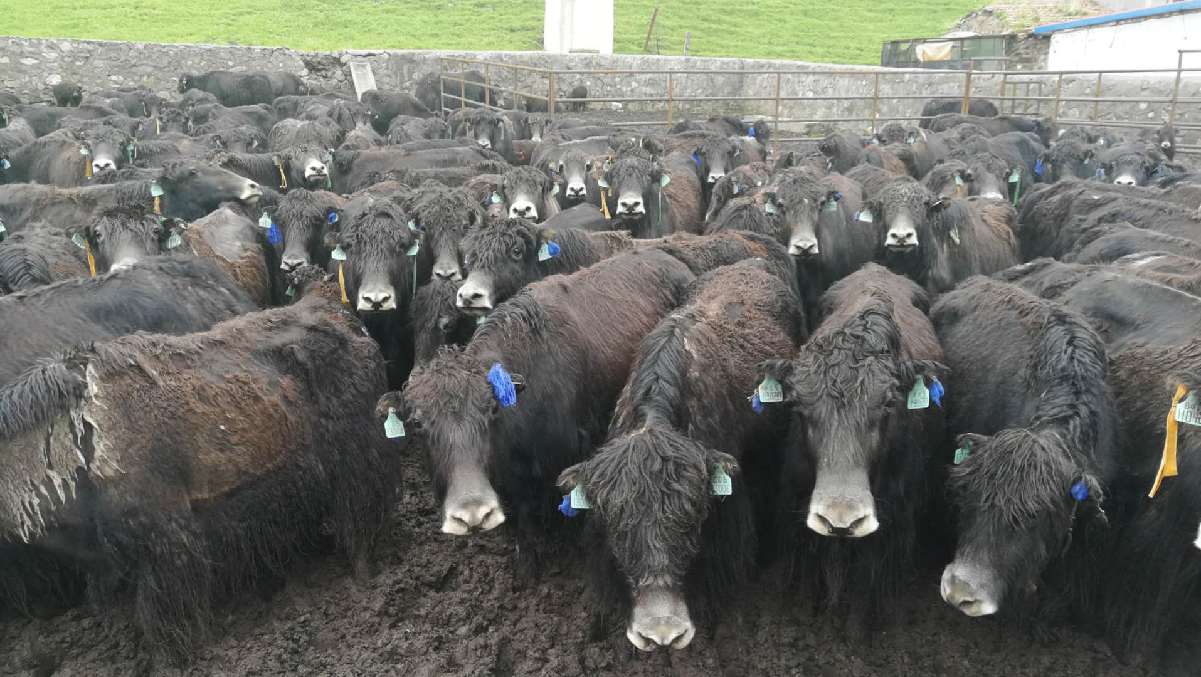
Ashidan yaks bred by researchers from the Lanzhou Institute of Husbandry and Pharmaceutical Sciences of the Chinese Academy of Agricultural Sciences (Photo by Yu Fei)
BEIJING, July 1 (Xinhua) -- Under the touch of the petite scientist Yan Ping, the tall and powerful black yak, weighing over 400 kg, is as obedient as a lamb.
Unlike other yaks, this one has no horns. It is a new breed cultivated by Yan and her team from the Lanzhou Institute of Husbandry and Pharmaceutical Sciences of the Chinese Academy of Agricultural Sciences. It is expected to help herdsmen on the Qinghai-Tibet Plateau, known as the "roof of the world," out of poverty.
YAKS WITHOUT HORNS
It took more than 20 years for Yan's team, working with Datong Yak Breeding Farm in northwest China's Qinghai Province, to breed the Ashidan yak, named after the 4,380-meter Ashidan Mountain that looms over the farm.
"The Ashidan yak has no horns and has a mild temperament, so it is easier to keep and feed in stalls," Yan said.
"It is better suited to large-scale intensive breeding in the cold and arid alpine areas of China. We can make full use of the feed resources in alpine and semi-agricultural and semi-pastoral areas of the Qinghai-Tibet Plateau."
Traditionally, yaks are grazed seasonally on the Qinghai-Tibet Plateau. Grazing, supplementary feeding and whole house feeding can be combined to increase yak production in all seasons, said Yan.
Naturally, about 6 percent or 7 percent of yaks in Qinghai have no horns and these were selected for the breeding program. Scientists identified the genes related to horns and cultivated the Ashidan using molecular breeding technology. Each Ashidan has a similar physique and appearance, and they are genetically stable, said Yan.
Under the same feed conditions, the average reproductive survival rate of the Ashidan yak is 59.98 percent, 11.72 percentage points higher than local yaks, and mortality is 1.24 percent, 4.32 percentage points lower, according to the research team.
The Ashidan yak was also bred to improve meat production. Almost 4,000 male Ashidan yaks have been introduced to Qinghai farms to improve the stock.
Statistics show that the average weight of the Ashisan at 18-months is 92.77 kg, 24.71 percent heavier than local yaks.
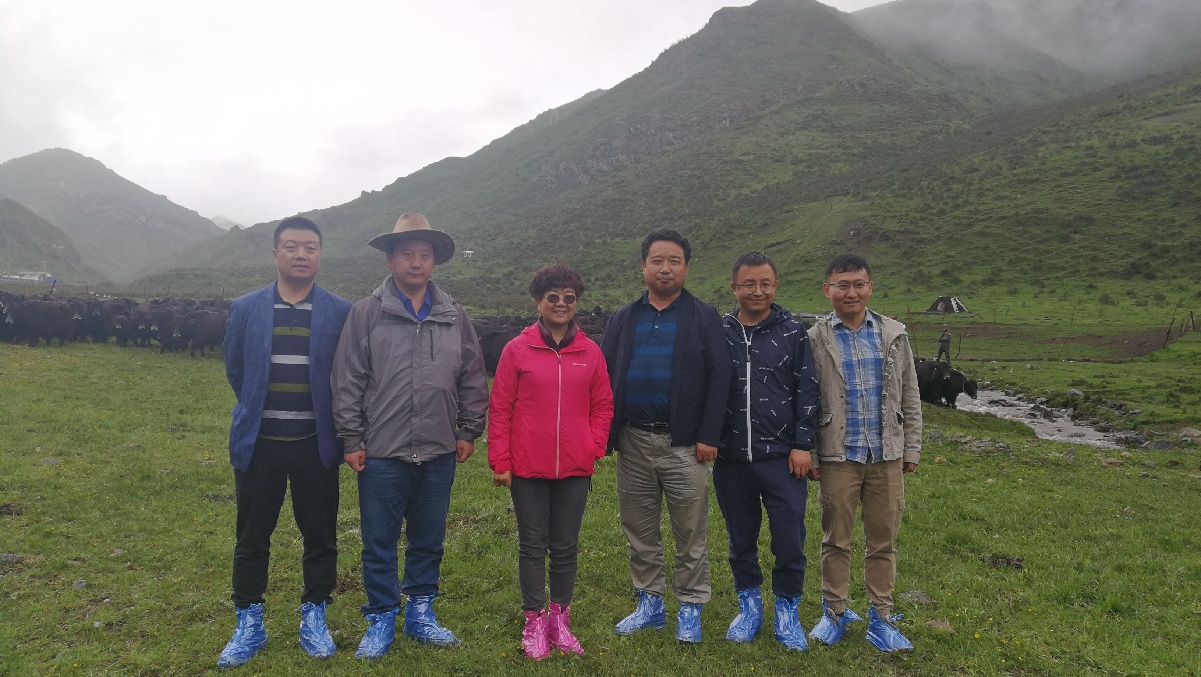
Yan Ping (3rd, left) leads her team to conduct the yak breeding research at Datong Yak Breeding Farm in Qinghai Province. (Photo by Yu Fei)
MOTHERLY LOVE
Yan, who has spent 35 years on the plateau studying yak breeding, looks on the Ashidan like a mother and says the animal is pretty.
"When the yaks walk, their long fur sways in the wind like a skirt," Yan said.
When Yan entered the Lanzhou Institute of Husbandry and Pharmaceutical Sciences in 1984, she was assigned to the yak research team. Her first research subject became her lifelong career.
On the Qinghai Datong Yak Breeding Farm, Yan saw yaks for the first time. During 1980s, conditions on the farm were hard, with no electricity or running water.
Yan would spend more than half a year at a time there, domesticating wild yaks and observing and measuring. She stayed with herding families, recording the yaks' growth. She often tracked yaks for hours at an altitude of 3,000 to 5,000 meters.
She lost count of how many times the yaks injured her, but she never gave up.
Over the past 35 years, her footprints have been left all over grazing areas in Qinghai, Tibet, Sichuan, Yunnan and Gansu.
Yan has also taught herders new techniques in building barns and replacing stud yaks, and explained the risks of over-grazing and over-milking.
In 2005, Yan led her team to cultivate the Datong yak breed, which contains the genes of wild yaks.
"Yaks lived on the Qinghai-Tibet Plateau before humans. Tibetans domesticated yaks 8,000 years ago. Yaks are the means of production and the totem of people on the plateau," said Yan.
"I study and love yaks because of their toughness, bravery and hard work, which are precious qualities. Yak-breeding on the Qinghai-Tibet Plateau is a long cycle of time-consuming and energy-consuming research. We need the spirit of the yak to respond to the difficulties and challenges in our research," she said.
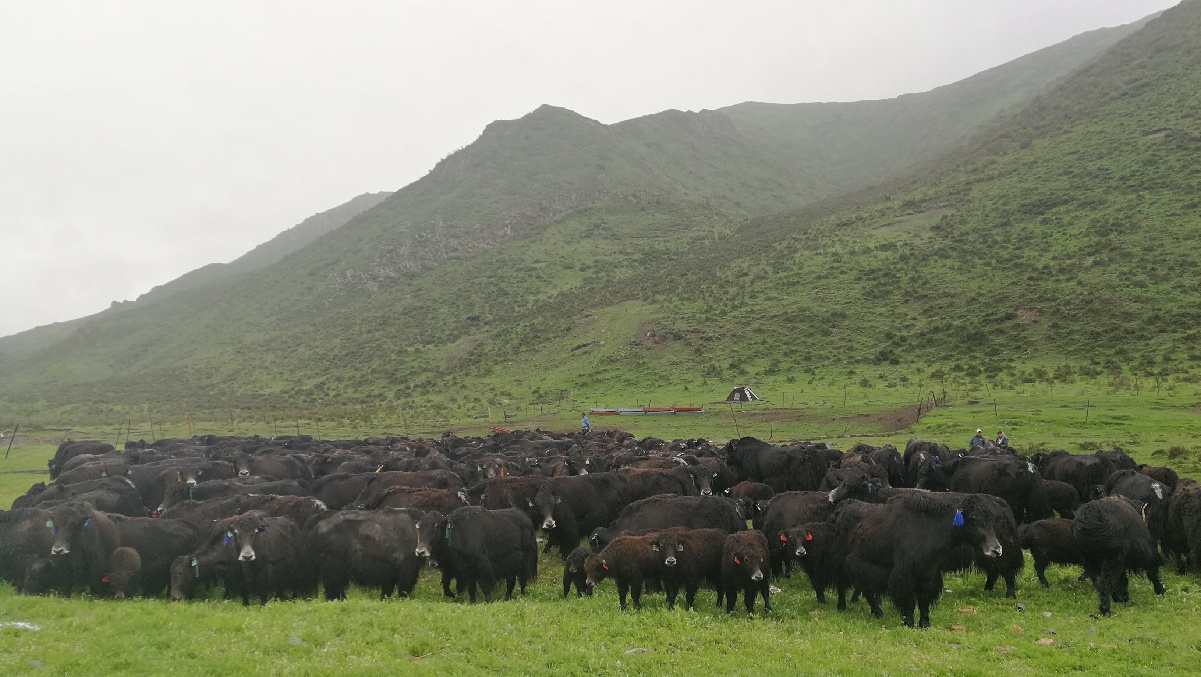
The newly-bred Ashidan yaks at Datong Yak Breeding Farm in Qinghai Province. (Photo by Yu Fei)
NEW HOPE
The Datong yaks have been introduced to many pastoral areas in Qinghai, Xinjiang, Tibet, Inner Mongolia and Gansu, covering about 75 percent of all the yak-producing areas in China, and played an important role in improving husbandry on the plateau.
The Ashidan yaks will be introduced to more pastoral areas to provide an alternative for herders, increase their incomes and help alleviate poverty.
Long Chunhua, a herder of the Tu ethic group in Qinghai, is raising more than 200 Ashidan yaks.
"My parents were herders. Most of the yaks they raised had long and hard horns. Those yaks were mainly raised free range, and were difficult to keep in stalls," said Long.
"But the Ashidan yaks are docile, grow faster and are easier to raise. Every year they can bring us an income of 120,000 to 130,000 yuan (about 18,917 U.S. dollars)."
At present, the number of Ashidan yaks cannot meet demand. "We need to use molecular breeding technology and new reproduction technology, excavate potential functional genes of yaks, and improve the efficiency of propagation," said Yan.
The breeding of new varieties can prevent yak degeneration, improve production, promote scientific husbandry, and help herders shake off poverty, she added.
