




by Xinhua writers Dan Ran, Xie Meihua
OSAKA, Japan, June 27 (Xinhua) -- Leaders of Group of 20 (G20) economies are gathering in Osaka, Japan for the annual paramount event of the group, as the world pins high hope on the high-stakes summit, scheduled for Friday and Saturday, to steer the global economy out of the current uncertainties and restore confidence in the multilateral system.
According to the host Japan, priority topics to be discussed at the summit include the global economy, trade and investment as well as innovation, among others. However, many expect the talks to heavily focus on ways to ease the current global trade tensions and pave the way for sustainable growth.
GLOBAL ECONOMY AT "DELICATE MOMENT"
The International Monetary Fund (IMF) in April lowered its global growth forecast for 2019 to 3.3 percent, down 0.2 percentage point from its January estimate, with IMF Managing Director Christine Lagarde saying that the global economy is at a "delicate moment."
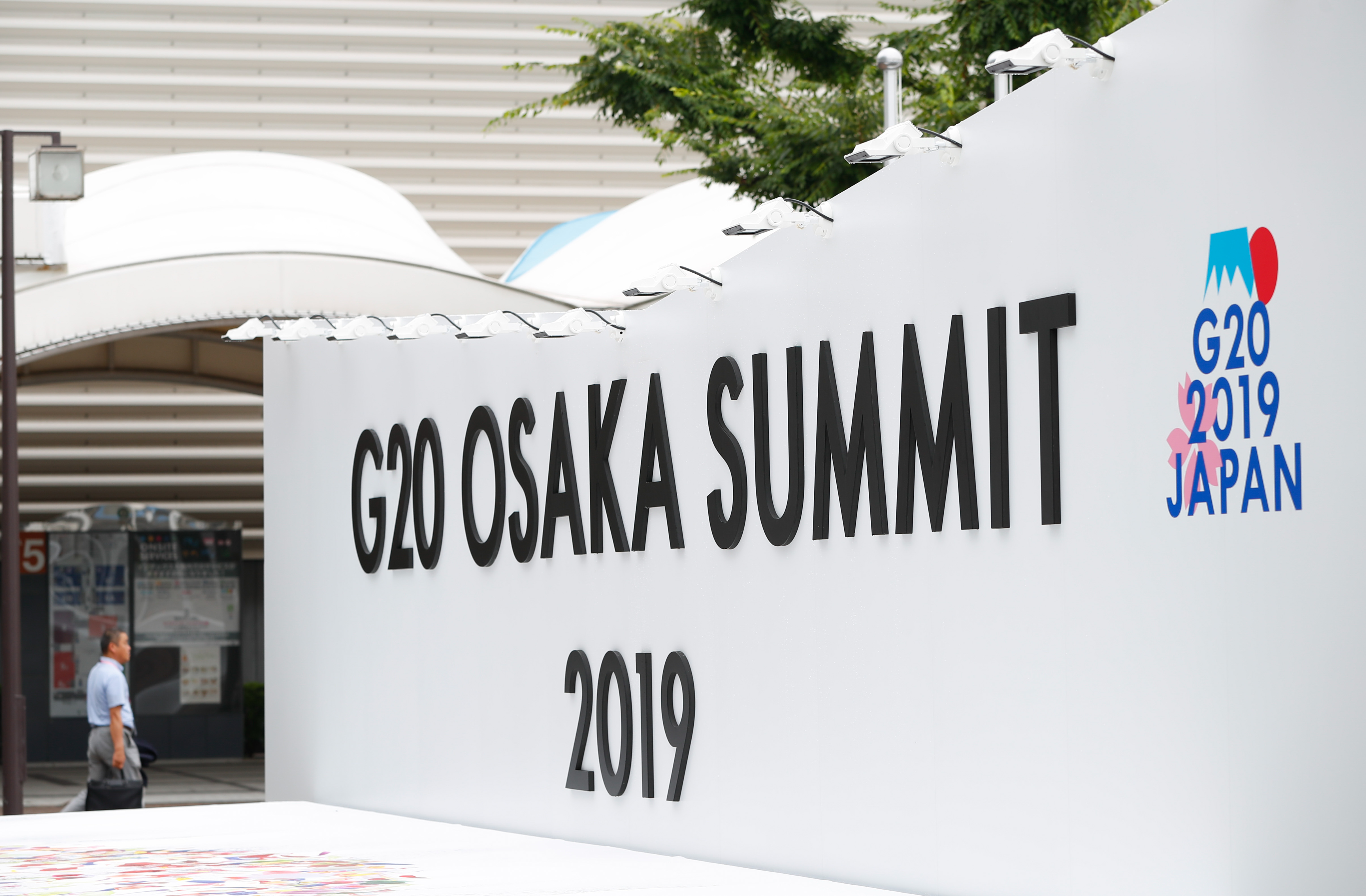
Photo taken on June 27, 2019 shows the sign at the entrance of the media center of the 14th Group of 20 (G20) summit in Osaka, Japan. (Xinhua/Wang Jingqiang)
Upon the conclusion of the meeting between G20 finance ministers and central bank governors earlier this month, Lagarde noted that trade conflicts are the "principal threat" to the global economic outlook.
The World Bank also expressed particular concern over "a slowdown in global trade growth to the lowest level since the financial crisis ten years ago."
Unilaterally escalating the trade tensions, the United States in May raised additional tariffs on 200 billion U.S. dollars' worth of Chinese imports from 10 percent to 25 percent, and threatened to levy extra duties on more Chinese products.
The global economy has been feeling the pain from the U.S.-China trade friction that was initiated by Washington. The recently announced tariffs between the two countries, combined with those implemented in 2018, could reduce global gross domestic product (GDP) by 0.5 percent in 2020, resulting in a loss of about 455 billion dollars, according to the IMF.
"The largest issue at the upcoming G20 summit would be the trade war between the United States and China, whose impacts have been felt by most economies in the world," said Fredy B. L. Tobing, dean of the international relations faculty at the University of Indonesia.
"Economic cooperation is now heavily disrupted by trade barriers, tariffs and so on," he said.
Chinese President Xi Jinping and U.S. President Donald Trump are expected to meet on the sidelines of the summit, with Xi saying last week that Beijing and Washington should jointly play a leading role in pushing for positive outcomes at the summit, so as to inject confidence and vitality into the global market.
"It would be very helpful if leaders of China and the United States could meet and discuss their differences," said Liu Hong, chair of the School of Social Sciences at Singapore's Nanyang Technological University.
"But the talks must be based on respect for a country's sovereignty and political system without interfering in domestic affairs. This is China's bottom line," Liu said.
MULTILATERAL SYSTEM AT "CRITICAL JUNCTURE"
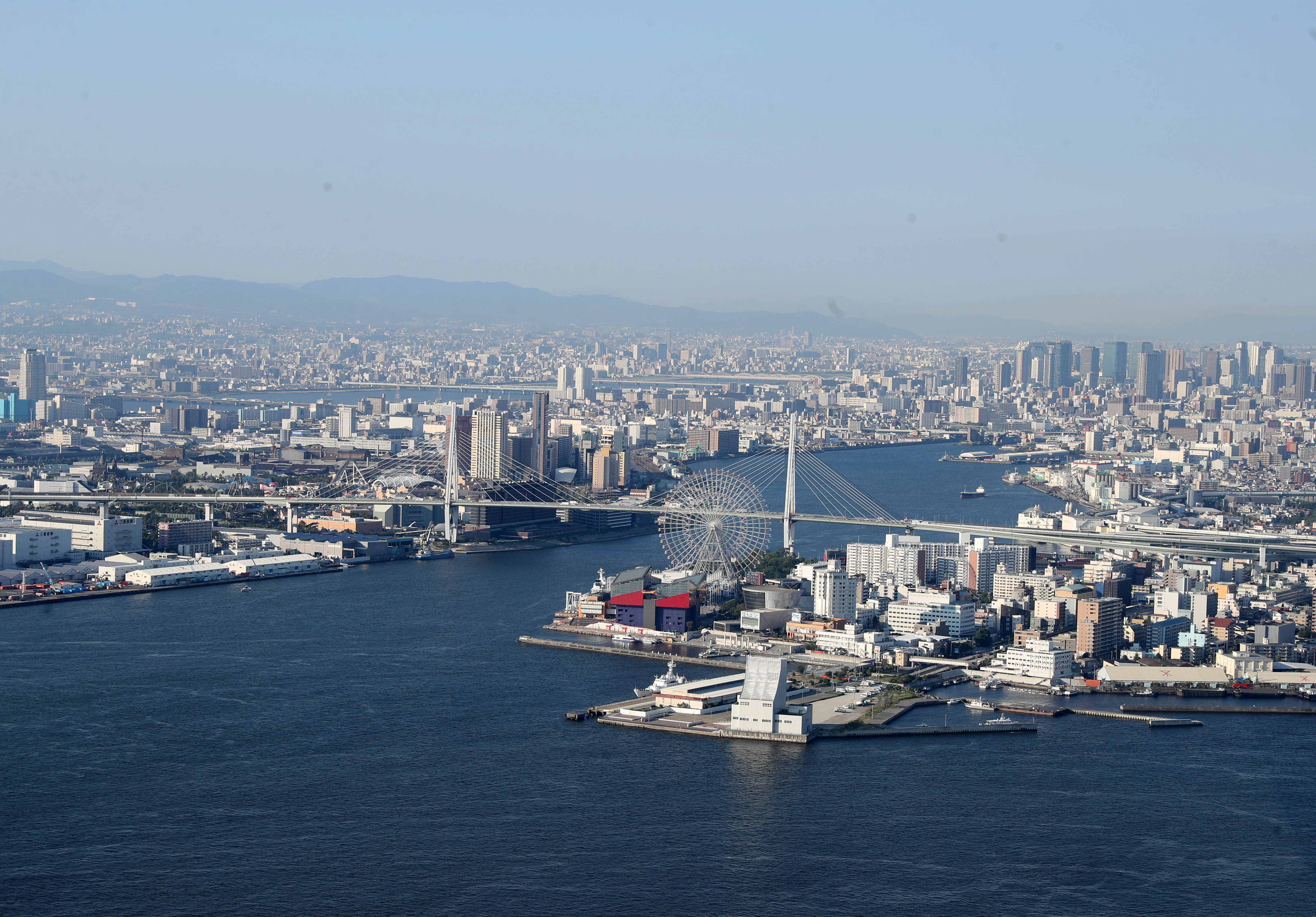
Photo taken on June 25, 2019 shows a cityscape of Osaka, Japan. (Xinhua/Li Gang)
Just like what Japan has put it on the official website of the Osaka summit, "the rule-based multilateral trading system is at a critical juncture."
G20, which accounts for some 80 percent of global trade and about 85 percent of global GDP, has been a major platform for working out multilateral solutions for many of the world's pressing challenges.
At a time when the long-standing multilateral system and globalization itself are at stake, whether G20 members will reach consensus and keep the ball rolling could make a real difference for the future.
"The G20 has never been more important since its inception than it is today," said Peter Drysdale, head of the East Asian Bureau of Economic Research at the Australian National University.
Noting that the United States is "attacking the multilateral system," the expert saw the G20 as "the best hope of protecting the multilateral system on which both global prosperity and security have been built."
Since 2013, President Xi has attended six G20 summits, offering China's wisdom in improving global economic governance, safeguarding the multilateral trade system, developing an open world economy and boosting strong, sustainable, balanced and inclusive global growth.
At last year's G20 summit in Buenos Aires, Xi highlighted the danger of unilateralism and protectionism in his speech, and called on G20 members to "stay committed to openness and cooperation and uphold the multilateral trading system."
"Rapidly developing economies with China in the lead have become the new flag-bearers of free trade and globalization," said Swaran Singh, a professor with the School of International Studies at the New Delhi-based Jawaharlal Nehru University.
"That same trend is likely to continue at the 2019 G20 summit in Osaka," he said.
Japan, which has assumed the G20 presidency for the first time, is expected to urge countries to resolve tensions within a multilateral framework, said Masatsugu Asakawa, Japan's vice minister of finance for international affairs.
"Japan will continue to take a multilateral approach in promoting free trade," he said earlier this month.

Photo taken on June 24, 2019 shows the signs of the 14th Group of 20 (G20) summit at the Kansai International Airport in Osaka, Japan. (Xinhua/Du Xiaoyi)
CHINA'S BID FOR COMMON DEVELOPMENT
The IMF in April revised up the 2019 growth projection for China to 6.3 percent, a recognition of the resilience of the Chinese economy amid global headwinds.
Despite the gradual slowdown, China is expected to account for more than 30 percent of global growth this year, said Changyong Rhee, director of the IMF's Asia and Pacific Department.
In fact, with the launch of the G20 meeting in 1999, China's active participation in globalization has brought about one of the biggest changes in the world economy, said Lee Hee-ok, a professor of political science at Seoul-based Sungkyunkwan University.
China's GDP has grown exponentially for the past 20 years through innovation that created leading industries in certain areas, resulting in a significant improvement in the quality of people's lives, he noted.
But China's contribution to the global economy goes beyond growth data. Lee pointed out that the Beijing-proposed Belt and Road Initiative offers an open platform and an opportunity for every country to enjoy shared prosperity.
He said the initiative, which allows every party to join in rather than excluding a certain party, is an open and multilateral idea that goes against unilateralism and isolationism.
Apart from trade and economy, the Osaka summit will also see leaders touch upon issues including the digital economy, inclusive and sustainable growth, infrastructure, climate, energy and the environment.
Finance ministers and central bank governors from G20 economies said in a joint statement after their gathering in June that they are committed to using all policy tools to achieve strong, sustainable, balanced and inclusive growth, and safeguard against downside risks by stepping up dialogues and actions to enhance confidence.
They also put emphasis on quality infrastructure as an essential part of the G20's efforts to close the infrastructure gap, stressing the importance of maximizing the positive impact of infrastructure to achieve sustainable growth. Enditem
(Xinhua reporters Liang Hui and Abu Hanifah in Jakarta, Cai Shuya in Singapore, Hao Yalin in Sydney, Hu Xiaoming in New Delhi, and Geng Xuepeng and Yoo Seungki in Seoul contributed to the story. Video reporters Jiang Chao in Islamabad, Guo Xinhui in Bangkok, Guo Wei in Hong Kong; Video editor Yin Le.)
