




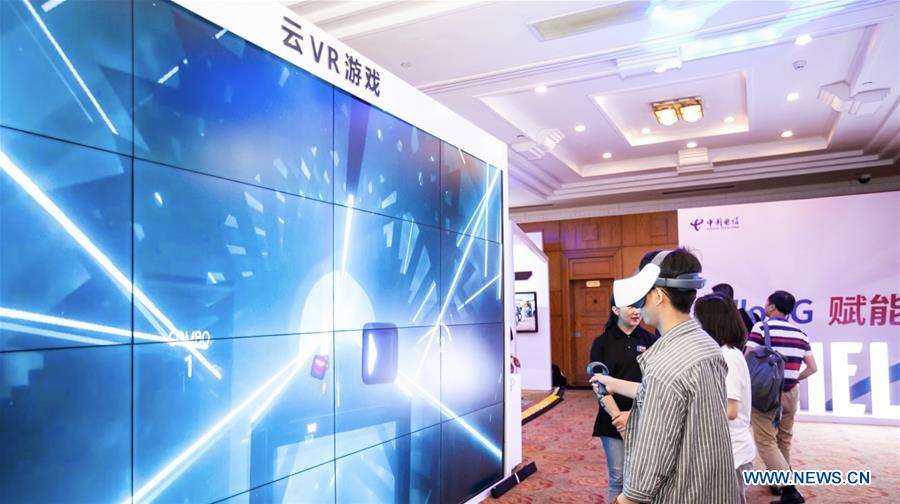
People experience a Cloud VR game in Shenzhen, south China's Guangdong Province, April 26, 2019. (Xinhua)
BEIJING, May 24 (Xinhua) -- The ongoing International Horticultural Exhibition 2019 Beijing, situated at the foot of the Great Wall, is covered by 5G network provided by Huawei.
With data transferred in real-time via 5G technology, visitors can wear VR glasses to see a bird's-eye view of the 503-hectare park provided by camera-carrying drones.
VR projects are mushrooming in China. Huawei believes that 5G technology will provide its customers with unprecedented experience with new products and services.
Among the 10 5G application cases the Chinese tech giant released earlier in a report titled "5G unlocks a world of opportunities," VR pops up as the first as a "killer" technology.
5G, GAME CHANGER
VR is not a new concept for Chinese. VR arcades and kiosks have been springing up in cities all over the country.
In Beijing, one can spend 100 yuan (about 14.8 U.S. dollars) to play the latest VR game Beat Saber for three rounds at VR kiosks in many department stores.
However, latency, a delay in the network, is by far the major obstacle for stable VR experience. Rendering, the process in which a computer processes data to produce and display an image, is another vexing bottleneck in VR projects.
Under 5G, the overall latency is 5 to 8 milliseconds, much shorter than the 20 milliseconds benchmark for rendering a nausea-free VR experience, said Jin Yuzhi, president of Huawei Transmission Network Product Line.
Meanwhile, a VR system renders the scene on a remote server and stream it to the headset, eliminating the need for a powerful CPU and making the VR experience more affordable, Jin said.
Ren Zhengfei, founder and president of Huawei, recently reiterated his confidence in the company's leading position in 5G development and its faith in supporting 5G-based applications.
The U.S. restrictions will not affect Huawei's high-end products, particularly in the 5G sector, said Ren in an interview with Chinese media.
Ren said Huawei should not be restricted just because of its leading technology position. "Our work is to benefit the whole of humankind," he said.
VR ECOSYSTEM
China is trying to build a new industry ecosystem with concerted efforts to boost the development of VR, as one of the key application scenarios in the 5G era.
The Chinese authorities have noted that scientific and technological innovation holds the key to development, and VR will be part of the picture.
Mobile carriers, content providers and developers are expecting to make VR more accessible to the public.
Last year, all China's three major mobile carriers, namely China Mobile, China Unicom and China Telecom, said VR is expected to be among the first 5G services, hoping to incorporate VR into many aspects of daily life like health care, schools, public services, entertainment and more.
In January, Huawei released the 5G Cloud VR in China.
"On the eve of the exponential growth of 5G, this service can nurture a large number of Cloud VR applications," said Peter Zhou, chief marketing officer for Huawei Wireless Solution.
POTENTIAL UNLEASHED
A report by the Global System for Mobile Communications Association said China would become the world's largest 5G market, with 460 million users of the 5G networks by 2025.
China's VR market expanded 164 percent year on year to reach 16 billion yuan in 2017. The market is likely to exceed 90 billion yuan by 2020, according to the Ministry of Industry and Information Technology.
Sun Wenbo, chief executive officer of LetinVR, a VR company based in Beijing, believed 5G will be a game changer as the technology provides users with stable high quality VR experience, and makes application of VR more easier in such fields as education, eSports, live broadcast, and remote business collaboration, among others.
In April, surgeons in the city of Gaozhou in Guangdong Province successfully conducted cardiac surgery with help from experts 400 km away who monitored the process with a VR model of the patient's heart on a live feed via a 5G network.
In Sichuan Province, some hospitals plan to have VR broadcast in the newborn intensive care unit, allowing anxious parents to "stand by" their babies anytime they want.
Reliable high-speed 5G networks enable complex inter-platform coordination, giving all participants in the ecosystem the ability to deploy innovations and service updates in a continuous cycle, Sun said.
"In VR, if mobile carriers, content providers and developers are a team, Huawei is our team leader," Sun said.
(Video reporters: Wang Pan, Bai Yu, Zhou Ziyang; Video editor: Zheng Xin)
