




?
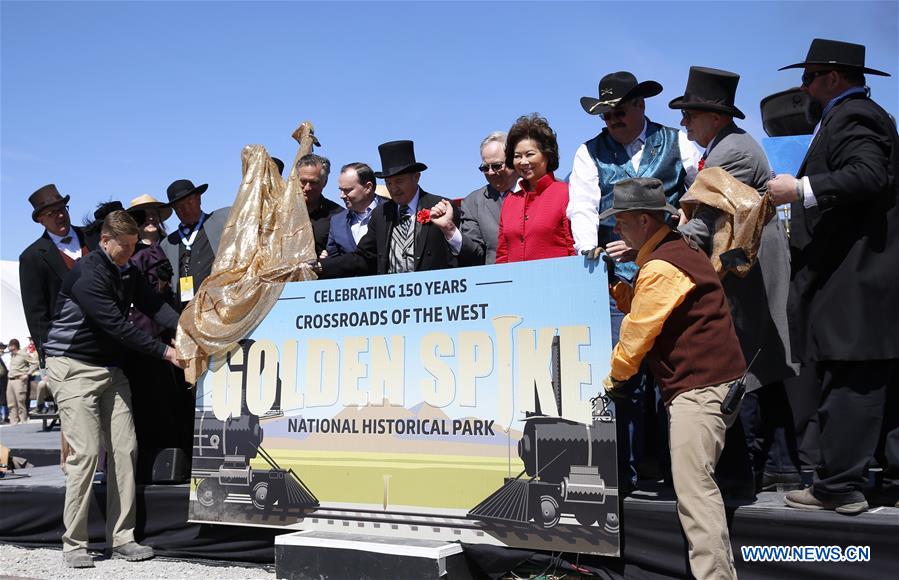
Guests launch the opening ceremony during the celebration for the 150th anniversary of the completion of the first U.S. transcontinental railroad at the Golden Spike National Historical Park at Promontory Summit, the United States, May 10, 2019. (Xinhua/Li Ying)
by Xinhua writers Sun Ding, Tan Jingjing, Xia Lin
SALT LAKE CITY, the United States, May 13 (Xinhua) -- One hundred and fifty years ago, the completion of the United States' first transcontinental railroad drew attention of the whole nation and marked the start of an economic boom that lasted for generations.
One hundred and fifty years later, as people in the state of Utah, where the eastern and western segments of the engineering feat connect, and the rest of the nation celebrate the historic moment, they also honor thousands of Chinese workers who made great contribution and sacrifice to make the project possible.
The transcontinental railroad could not be completed without the sacrifice of Chinese workers, as local residents, politicians, and researchers told Xinhua. More importantly, that part of history, shared by both China and the United States, shows that the two peoples can cooperate to do great things, even make the impossible possible.
TRANSFORMING UTAH
The first U.S. transcontinental railroad, originally known as the Pacific Railroad, was completed on May 10, 1869, when the last spike, praised as the Golden Spike, was ceremonially driven in at Promontory Summit, an area of high ground roughly 100 km northwest of Salt Lake City, the capital of Utah State, to join the tracks of the Central Pacific and Union Pacific lines.
The Central Pacific Railroad, which broke ground on the railroad in 1863 and worked eastward out of Sacramento, California, hired 12,000 or more Chinese migrant workers, who became the backbone of the Central Pacific Railroad Co.'s labor force.
The working conditions were unimaginable. One example repeatedly cited is how Chinese workers blasted and chiseled their way through the rugged Sierra Nevada mountains.
"Using manual hammer drills, pick axes and explosives, they dug 15 tunnels through hard granite," U.S. Secretary of Transportation Elaine Chao told a commemorative event at Promontory Summit's Golden Spike National Historical Park on the 150th anniversary of the transcontinental railroad's completion.
"Snow fell so deeply in the mountains that they had to build roofs over 37 miles (roughly 60 km) of track so supply trains could make it through," Chao said. "The conditions were merciless, dangerous and harsh. An estimated 500 to 1,000 Chinese workers lost their lives."
Their contribution and sacrifice made the transcontinental railroad a reality, which reduced the travel time to cross the United States from months to about a week and allowed goods, including produce and natural resources, to move more quickly and cheaply from coast to coast, as the nation and its economy recovered from the Civil War.
"In the years that followed, this tremendous engineering feat helped revolutionize interstate travel and commerce," according to a presidential message released by the White House.
"The completion of the transcontinental railroad catalyzed our country's development, empowered greater settlement of the American West, and expanded prosperity from the Atlantic to the Pacific," it stressed.
Gary Herbert, governor of Utah, said the railroad had transformed Utah from an isolated post to a crossroads of the West.
HONORED, REMEMBERED
On the transcontinental railroad's 100th birthday, the Chinese workers were not honored. Fifty years later, many highlighted their role so that the mistake would not be repeated.
"They were quiet and paid less, and the American society knew little about them back then," Val Potter, member of the Utah House of Representatives, told Xinhua at Promontory Summit, who was among tens of thousands of people attending a three-day celebration at the Golden Spike National Historical Park, with many dressed in clothing from the period.
"Chinese workers were so dedicated and hardworking, focused to get their work done," said the lawmaker. "It is important to celebrate their great accomplishments."
The celebration, which started on Friday, included speeches, music and a historical re-enactment of 1869's ceremonial driving of the Golden Spike, as well as two full-size working replicas of the two steam engines seen facing each other, nose to nose, in an iconic picture from that day, with crewmen around the locomotives toasting the occasion with whiskey.
Scholars and historians previously believed that there were no Chinese workers in this photo, but researchers from San Francisco-based Stanford University identified two of them in the crowd, who were part of the crew that laid the transcontinental railroad's last rails.
"Without the Chinese migrants, the transcontinental railroad would not have been possible," Gordon Chang, co-director of the Chinese Railroad Workers in North America Project, a Stanford research program, and professor of history of the Center for East Asian Studies at the renowned university, recently told Xinhua.
As part of a state-wide commemoration in Utah, Stanford curated a photo exhibition, captioned both in English and Chinese, to tell the story of the Chinese railroad workers whose life details had remained largely unknown until Chang and other scholars launched the project in 2012.
The exhibition is now running in Park City, east of Salt Lake City, and will travel to other parts of Utah.
"People from all over the country and even the world have stopped in to see this exhibit," said Kate Mapp, a librarian of the Park City Library. "It aims to highlight the contributions of Chinese railroad workers, and let the public know more about that history."
BEYOND THE RAILROAD
In a video-recorded speech, Chinese Ambassador to the United States Cui Tiankai called the transcontinental railroad "a telling example of how the Chinese and American people can come together to get things done, and make the impossible possible."
Besides forging a path through and over the West's mountain ranges, a team of workers consisting mainly of Chinese set a record by building 10 miles (16 km) of track in a single day.
"While we reflect the impact of the railroad, we should also look to the future," said Governor Herbert, while urging people of Utah to dream big, and remember that great things can be envisioned and accomplished even in difficult times.
Howard Stephenson, former member of the Utah State Senate, said he thinks the Golden Spike celebration can have a profound effect on expanding the state's substantial cooperation with China.
"It is a wonderful incubator for greater win-win results," said Stephenson, adding that he thinks "China is perhaps the most important nation for Utah's future and America's future."
According to the World Trade Center Utah, China is one of Utah's most important trading partners and the state's trade with China totaled about 4 billion U.S. dollars in 2018. Chinese tourists bring more than 140 million dollars into Utah's economy each year, while Utah is a pioneer in Chinese language education in the United States.
"Strong people-to-people ties are important all the time," said Miles Hansen, president and CEO of World Trade Center Utah. "Policymakers in national capitals make trade policy, while citizens across countries build the relationship that make it easier for commonsense solutions to be found for the challenges that exist."
"China-U.S. relations are at a critical juncture and it is important that we remember that our two countries always stand to gain from cooperation and lose from confrontation," Ambassador Cui said in a message to the Utah-China Trade and Investment Forum, which concluded in Salt Lake City at the past weekend.
"There is no better option than continued cooperation. We need to work together to ensure the sound and steady development of China-U.S. relations continues along the right track," he added.
(Xinhua reporters Zhang Yongqing and Ye Zaiqi also contributed to the story.)
(Video reporters: Zhou Saang, Xia Lin, Zhang Yongqing, Sun Ding, Tan Jingjing; Video editor: Zhao Xiaoqing)
