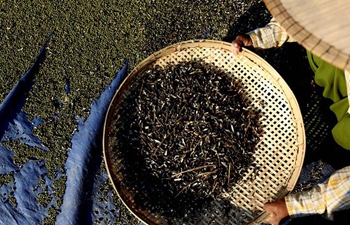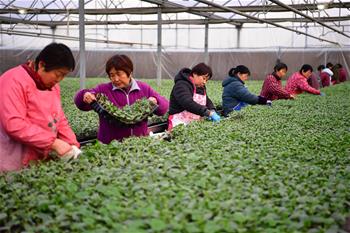
URUMQI, March 2 (Xinhua) -- Farmers at a small village in western Xinjiang hardly had any days off this winter. Production at a walnut processing factory is going full throttle to meet demand.
Yusup Tursun and his wife are walnut farmers in Kupchi Village in Yecheng County on the edge of the Taklimakan Desert. The couple has been hired by a new walnut processing facility in the village, with the husband a quality inspector and his wife working part-time cracking nuts.
As a main base for walnut production, Yecheng has over 38,000 hectares of high-quality thin-shell walnut groves.
"It used to be quite difficult to sell the walnuts. The factories, with so many products, have made it easier for the sales," Yusup said.
Seven companies make products from the nuts -- walnut milk, walnut candies and edible oil. The shells are made into coloring agent and pollutant-absorbing carbon.
Diversity in the walnut products pushed the industry output to a new high of 2 billion yuan (about 299 million U.S. dollars). Three in every five people work in the walnut industry in Yecheng, where 550,000 people live.
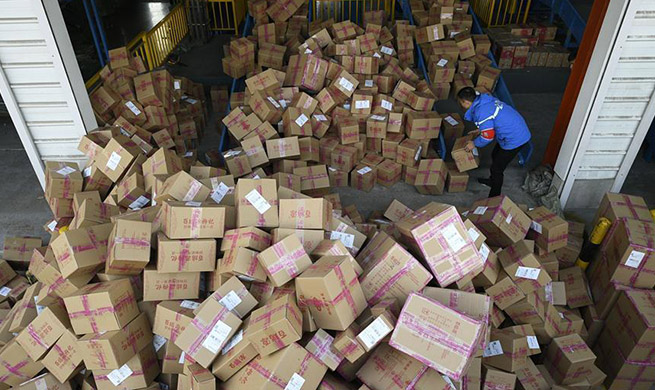
Across Xinjiang, processing facilities are established to add value to agricultural products. Transport and logistical services are improved to boost the sales of Xinjiang's signature agricultural products such as Hami melons, Korla pears and Turpan grapes.
UP THE VALUE CHAIN
Xinjiang is also moving up the value chain in two of its traditional industries -- cotton and coal.
As one of the main cotton production bases in China, Xinjiang holds sway in the textile industry. By making full use of its cotton resources and geographical advantages as a portal for opening up, the region no longer sees itself as just a production base for raw materials. Starting from 2014, China's leading garment and apparel makers including Ruyi Group, HoDo Group, and Huafu Fashion Co. Ltd invested in the region and built factories.
These factories have produced added benefits and created jobs for the local people. Xinjiang produces 1.5 million tons of yarn and over 40 million ready-made garments every year. More than 400,000 people work in the industry.
In the eastern part of the coal-rich Junggar Basin, workers have found that the snow is cleaner than before. The Zhundong Economic Technological Development Park, about 200 km west of Urumqi, is home to China's largest coal field.
A stringent environmental requirement is applied to the park, said Ren Jianpin, director of the management committee of the park. Coal enterprises are required to control coal dust, install equipment to recycle water and coal slags are processed into construction materials, he said.
The park is focused on boosting high-end industries in aluminum and silicon materials, which generate more value and have less impact on the environment, he said.
GOING HI-TECH
Last year, a large-scale bio-based plant went into operation in Usu City to turn corn into nylon. The Cathay Industrial Biotech, a Shanghai-based biotech company, is the investor.
Nylon is usually made from petroleum, and the use of crops such as corn and wheat to make recyclable and environment-friendly nylon has promising business prospects, said Wang Hongbo, vice general manager of the company's Usu branch.
The Usu branch will have an annual output of 100,000 tons of bio-based polyamide, and it is expected to boost the development of downstream industries in the future, he said.
The oil-rich city of Karamay has also received a hi-tech boost as cloud computing firms eye the dry and cold weather in the area. Karamay is home to many key state-level projects and IT-industry leaders, including a global cloud service data center for Huawei, data centers for the China National Petroleum Corp. (CNPC) and China Mobile.
Xinjiang is making new breakthroughs in precision machining, new materials, manufacturing and textiles.
Data from the regional statistics bureau show that the value added of the hi-tech manufacturing in Xinjiang rose by 32.1 percent year-on-year in 2018.
FURTHER OPENING UP
As a core area on the Silk Road Economic Belt, Xinjiang has maintained solid growth momentum in foreign trade. Foreign trade volume between Xinjiang and 36 countries and regions along the Belt and Road (B&R) totaled about 291.5 billion yuan (43.5 billion U.S. dollars) in 2018, up 13.5 percent year on year.
Economic observers say that there is still much room for Xinjiang to scale up its processing trade to raise the level of imports and exports.
Xinjiang will further develop an export-oriented economy in 2019 and participate in economic exchanges with neighboring countries, according to the regional government's work report released in January.