




BEIJING, Feb. 26 (Xinhua) -- An increasing number of Chinese pet lovers are turning towards exotic animals including birds, reptiles or even insects other than cats and dogs, partly driven by easier transnational trade and logistics.
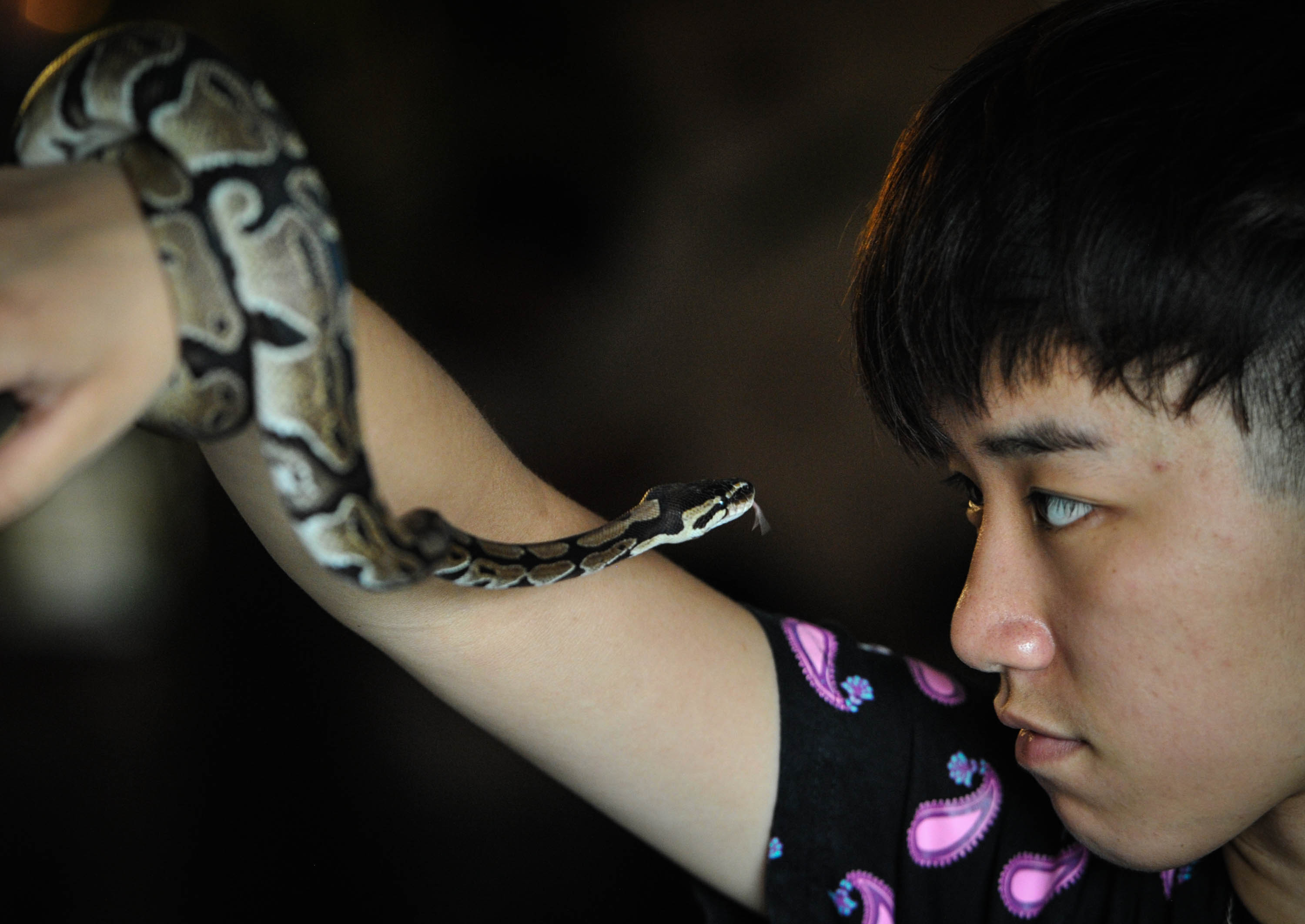
Photo taken on July 30, 2014 shows an employee at a pet shop plays with a snake in Xi'an, NW China's Shaanxi Province. (Xinhua/Ding Haitao)
Experts however warned that the exotic pet trade presents a grave threat to wildlife conservation as well as potential risks for human health.
On one side, the public is advised not to capture, purchase or keep wildlife as pets to decrease the demand for the trade; on the other, the efforts in battling wildlife poaching and smuggling should be intensified, experts said.
EXOTIC PET BOOM, RISKS
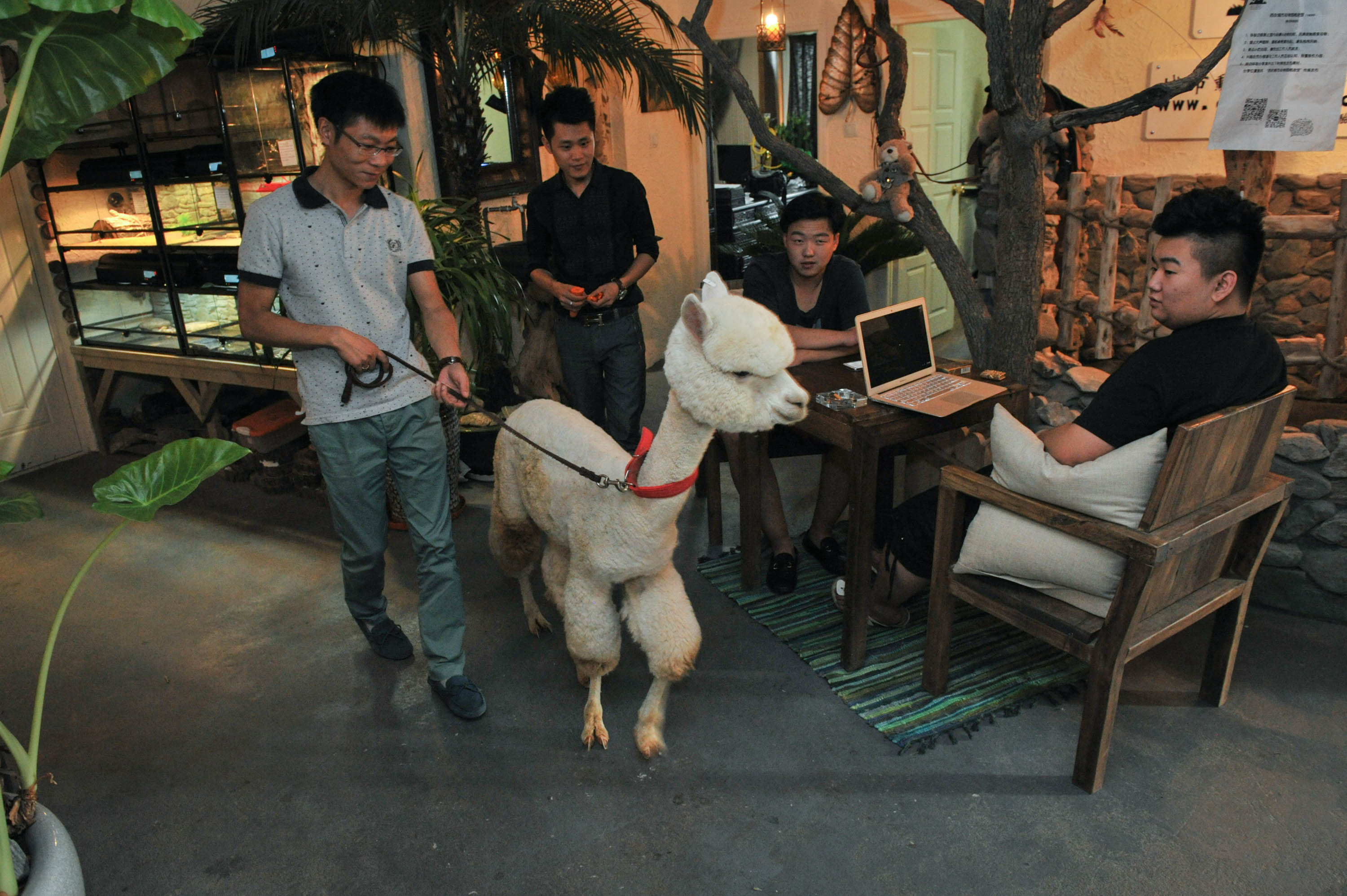
Photo taken on July 30, 2014 shows employees at a pet shop play with an alpaca in Xi'an, NW China's Shaanxi Province. (Xinhua/Ding Haitao)
In a recent report focusing on the cruelty and consequences of the booming exotic pet trade, the World Animal Protection (WAP), a United Nations general consultative institution, revealed the cruel practices in the poaching, breeding, transport, trade and even ownership of wild animals.
Exotic pets, unlike domesticated animals, are still wild animals and suffer in captivity, according to the WAP report, "Wild at heart: The cruelty of the exotic pet trade."
Today, these animals are caught up in a multibillion-dollar global industry that has threatened and impacted the conservation of the species, the welfare of the animals and human health, it says.
Currently, the annual value of the wildlife trade stands at 30-42.8 billion U.S. dollars, and up to 20 billion dollars are estimated to be illegal, of which a substantial proportion is in endangered and protected species being traded as pets, according to the latest research.
Over 500 species of birds and 500 species of reptiles are traded across the globe at a high mortality rate.
"At least three quarters of the exotic pets will die within a year in captivity due to the lack of proper living conditions, food, space, temperature or humidity," said Guo Jinghui, project manager of WAP's China office.
On the other hand, the exotic pet trade has led to animal poaching on an industrial scale at the expense of millions of deaths every year, endangering some wildlife species or even causing some to go extinct.
Steve McIvor, CEO of WAP, pointed out that the transnational commercial air transport and global internet connectivity are two big factors that help drive both the desire for and availability of exotic pets.
Sun Quanhui, a science officer with WAP, said there is an increasing risk of highly contagious illnesses being spread as the exotic pet trade continues to grow.
It is estimated that as much as 70 percent of new or emerging infectious diseases are zoonotic in origin, and zoonotic diseases - diseases that can transmit between humans and animals, including Ebola, SARS and avian flu - are responsible for a billion cases of human illness and millions of deaths each year and can have large-scale, lasting and permanent health impacts.
"In effect, an exotic animal may harbor a raft of potentially infective microbes and microparasites making any animal a possible Trojan Horse of infection and infestation," says the WAP report.
STRONGER WILDLIFE PROTECTION

A young Chinese plays with his chameleon pets in Guangxi Zhuang Autonomous Region on June 18. 2013. (Xinhua/Zhang Cunli)
Given a long history of pet-keeping culture, in recent years China has risen as the world's third-biggest pet-related consumption market (live animal trade excluded) after the United States and Japan.
By 2016, among 1.3 billion Chinese, one out of every thirteen owned a pet. The Chinese pet market is expected to surpass 300 billion yuan (44.67 billion U.S. dollars) by 2023, according to a report by Shenzhen-based Qianzhan Industry Research Institute.
Apart from mainstream choices of cats and dogs, turtles, rodents and other waterborne creatures represented 6.38 percent, 5.06 percent and 3.02 percent respectively, with a 2.2 percent "others" that included other reptiles (snakes, crocodiles, lizards), arthropods (spiders, scorpions) and even stranger pet choices such as primates, according to a survey by Beijing-based Linkip Technology.
Fueled by the rapid popularization of social media and live streaming platforms, the minority has seen continuous growth.
"We call on the public not to capture, purchase or keep wildlife as pets, and not spread videos regarding sales or entertainment of exotic pets, in hopes of reducing the market demand through stronger public education and guidance," said Guo Jinghui of WAP.
In China, more efforts need to be made to change the role played by key platforms of the wildlife trade, which includes e-commerce platforms, social media, airlines and logistics service providers, she pointed out.
Chinese Customs have played a major part in cracking down on the exotic pet trade, with help from the maritime police and public security forces.
In January, 27 live spiders and five boxes of spider eggs were confiscated by the customs in Luohu, between Shenzhen and Hong Kong, while last October, a gang suspected of smuggling 14,000 endangered parrots was busted by joint forces in Xiamen.
For the IT sector, in March 2018, a dozen Chinese companies including Baidu, Alibaba, Tencent, and their international counterparts such as Google, eBay and Microsoft announced in San Francisco the establishment of a "Global Coalition to End Wildlife Trafficking Online," committing to an 80 percent decrease of wildlife trade on each of their platforms.
Alibaba, who operates several major e-commerce platforms, told Xinhua that, apart from including over 3,000 species of wild flora and fauna in the forbidden list on its platforms, it has supported a volunteer team of 2,000 people to conduct manual inspections of the merchandise online.
As the Chinese public becomes more aware of the illegal online trade, many people have joined in and volunteered to supervise and report suspicious cases to relevant public departments.
"The best way to love and protect wild animals is to let them be in nature, where they belong," said Sun. "We should not imprison them as pets or hurt them in the name of love." Enditem
