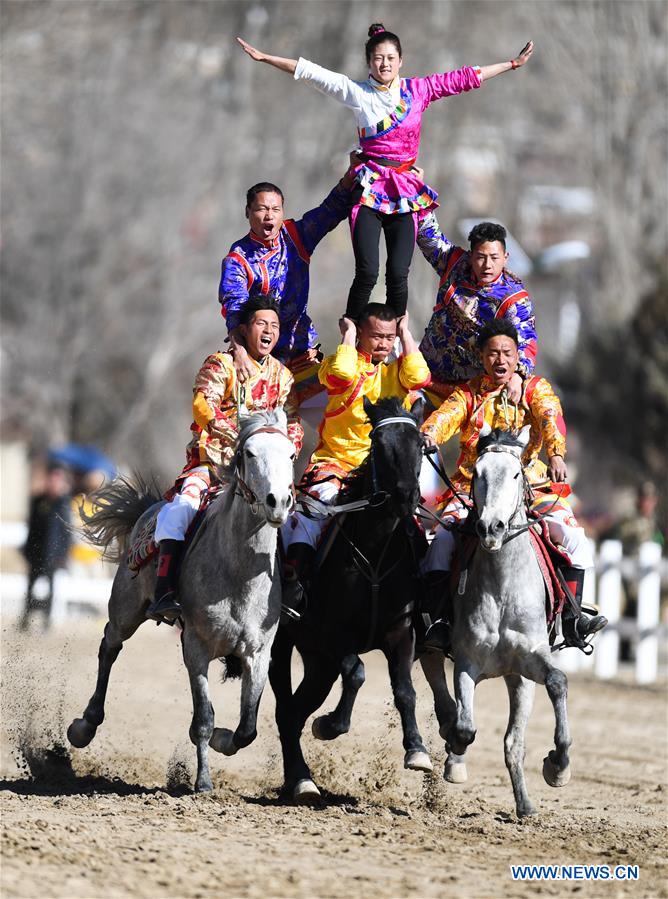
People perform on horses in Lhasa, capital of southwest China's Tibet Autonomous Region, Feb. 7, 2019. Since 1990, horses have been drifting away from plateau life, as most villages are connected to modern road networks these days. In some places, however, horses have regained their status as a mode of transport. Gyumey Dorje lives at the foot of Mt. Gang Rinpoche, a sacred mountain for Tibetans and a hot tourist attraction. There, villagers offer tourists services such as horseback riding or transferring goods up and down the mountain. "The horse is no common livestock," said Ngawang Tenzin from the local culture authority. "The changing status of horses reflects the development of Tibet." (Xinhua/Purbu Zhaxi)
LHASA, Feb. 11 (Xinhua) -- In ancient times on the Tibetan plateau, as one folk epic describes it, any tribe member who won a horse race would be perceived worthy of being named chief.
That is not the case in modern times. However, Urgyen, in his auspicious hat, green blouse and red trousers, was surrounded by hundreds of congratulating villagers after winning a horse race in Ngari Prefecture, southwest China's Tibet Autonomous Region.
"The Epic of King Gesar" tells the story of an 11th century Tibetan demigod who defeated enemies on horseback, helping save his people. It has been passed down by word of mouth from singers and often by illiterate herders and farmers.
This story is well-known among Tibetans and believed to be the reason why horse racing competitions are still held across Tibet today.
"I'm wearing the same outfit as described to be worn by the demigod in the passed-down epic," said 32-year-old Urgyen.
After his win, he went on to become the pride of his hometown and one of the most respected people among villagers.
Living on the "roof of the world," Tibetans used to rely heavily on horses to get by. Urgyen can still clearly remember that during his childhood people "couldn't go anywhere without a horse."
"Back in the 1970s, we rode horses for so long that no one could walk when they finally got off," said Darlha, an official with the local government.
Since 1990, horses have been drifting away from plateau life, as most villages are connected to modern road networks these days.
"Everyone has motorbikes and cars now. We don't travel on horseback anymore," Urgyen said, adding that he even drives to the racetrack with his horse pulled in a trailer behind his pickup truck.
"It used to take days, but now only hours."
Urgyen's family used to own a dozen horses. Now they just have four, and they are used only for racing.
Chogyal Sangmo lives in a neighboring village and said she has been riding horses since before she can even remember. She cried the whole night her father decided to sell all of their horses when she was a teenager.
A few years ago, she became the first woman in the village to obtain a driver's license.
When Sangmo drove all the way back from Lhasa, Tibet's capital, located over 1,000 kilometers away, villagers offered her hada (traditional Tibetan ceremonial scarf) to show their admiration and blessings.
"They thought it was incredible!" she said.
Those who own strong racehorses are widely respected on the grasslands, as they are a symbol of great wealth. Urgyen's winning horse is worth 30 yaks or 300,000 yuan (about 44,774 U.S. dollars). But he always turns down offers for purchase.
In some places, however, horses have regained their status as a mode of transport.
Gyumey Dorje lives at the foot of Mt. Gang Rinpoche, a sacred mountain for Tibetans and a hot tourist attraction. There, villagers offer tourists services such as horseback riding or transferring goods up and down the mountain.
"I make more than I've ever earned before," said Dorje, who believes riding horses again could bring about a better life for Tibetans.
"The horse is no common livestock," said Ngawang Tenzin from the local culture authority. "The changing status of horses reflects the development of Tibet."