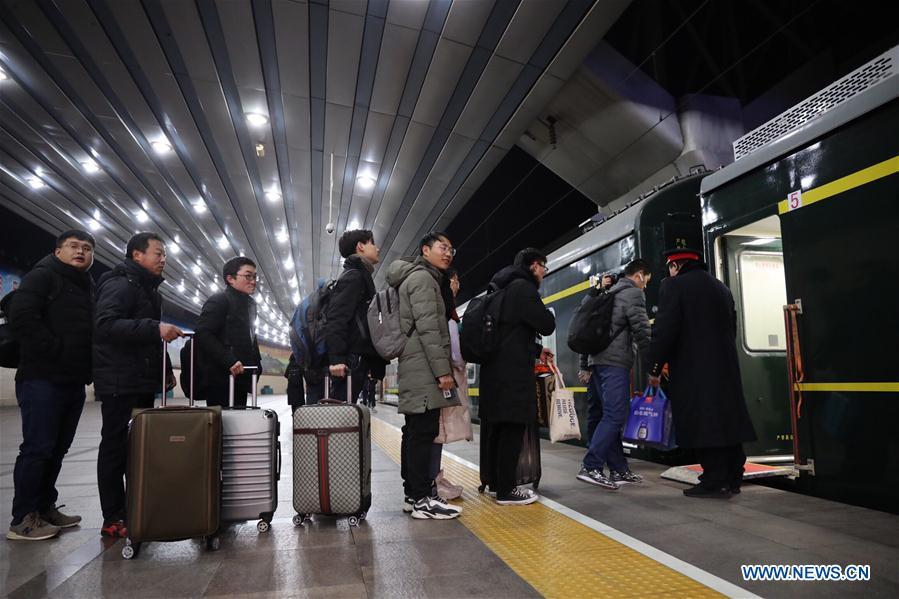
Passengers prepare to board the train K4051 to Nantong City in east China's Jiangsu Province, at the Beijing Railway Station in Beijing, capital of China, Jan. 21, 2019, the first day of the 2019 Spring Festival travel rush. Hundreds of millions of Chinese return to their hometowns every year for the Lunar New Year, or Spring Festival, family reunions, thus forming the Spring Festival travel rush. The Spring Festival, or the Year of the Pig in the Chinese lunar calendar, will begin on Feb. 5 this year. The 40-day 2019 Spring Festival travel rush started on Jan. 21, with 3 billion trips expected to be made. (Xinhua/Xing Guangli)
BEIJING, Jan. 21 (Xinhua) -- Spring Festival travel rush started Monday, unleashing China's largest seasonal migration of people as families reunite for the most important traditional holiday.
The travel rush began 15 days ahead of the Spring Festival, or Chinese Lunar New Year, which falls on Feb. 5 this year.
From Jan. 21 to March 1, nearly 3 billion trips are to be made via China's transport system, as people set off for family gatherings or tours.
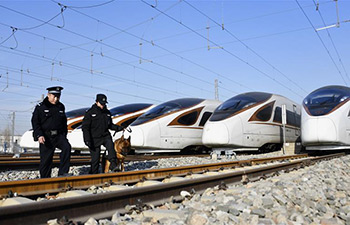
China launched 10 new railways at the end of 2018, expanding its operational length of high-speed railways to 29,000 km.
The country's aviation authority plans to schedule 532,000 flights during the travel rush, an increase of 10 percent year on year.
MORE CONVENIENT
China's public transport system has introduced new technologies to increase efficiency during the travel rush.
In southern province of Guangdong, some railway stations pioneered "ticketless travel."
Starting on Monday, passengers can simply swipe their smart phones to board the inter-city high-speed railway connecting the provincial capital of Guangzhou and the technological powerhouse of Shenzhen.
Instead of buying tickets online and collecting them at the stations, travelers can pass ticket checks by scanning QR codes using their phones and pay afterward.
Huang Xiaozhong, deputy chief of the East Guangzhou Railway Station, said passengers can register the application via Alipay and get a QR code, which is valid for three hours.
"The QR payment only takes a few minutes, compared with 20 to 30 minutes for passengers to purchase, pick up the tickets and enter the station in the traditional way," said Wang Lihui, who is in charge of the station's ticket sales office.
Wang said the new payment method reduces crowding in front of ticket booths and ticket checking machines.
In Shanghai Municipality as well as Jiangsu, Zhejiang and Anhui provinces in eastern China, 464 ticket checking machines in railway and coach terminals allow swift passage with facial recognition technology to verify passengers.
TRAVEL RUSH TO THE WORLD
Ctrip, China's leading online travel agency, forecasts that some 7 million Chinese tourists will travel to over 500 tourist destinations in more than 90 countries and regions during the upcoming week-long Spring Festival holiday.
According to the China Tourism Academy (CTA), Chinese nationals made 5.5 billion domestic trips and 140 million outbound trips in 2018, marking a year-on-year increase of 10.76 percent and 13.5 percent, respectively.
Shanghai-based online travel agency Lvmama predicts that prices for domestic tours would surge by 30-50 percent during the Golden Week travel and those for outbound tours are to be 10 percent higher than off-season prices.
The CTA's latest report said Chinese spent 5.13 trillion yuan (755.8 billion U.S. dollars) on domestic travel in 2018, representing a year-on-year increase of 12.3 percent.
Agencies including Ctrip and Lvmama said 70 percent of Chinese would travel with families during the Spring Festival holiday, giving impetus to hotels to upgrade facilities and service for attracting family travelers.
On the first day of the travel rush, Hoang Tuyen, a Vietnamese doing business in southwest China's Guangxi Zhuang Autonomous Region, took the Nanning-Hanoi international train to go back to his home.
"The train service has become the first choice for Vietnamese traveling to China," he said.
The broadcasts on the train are made in both Chinese and Vietnamese. Chinese attendants on the train can speak Vietnamese and English.
The train service on the 396-km long railway that opened in 2009 was China's second international train service after the Beijing-Moscow train service. Wei Feng, the train conductor, said the train will add two more train cars to cope with the increased passenger flow during the travel rush.
Over 100,000 Vietnamese nationals are working in the border cities of Pingxiang and Dongxing in Guangxi, as manufacturing enterprises in the border areas offer many jobs.
TWO-WAY RUSH
The Spring Festival travel rush appeared in the 1980s after rural laborers flocked into cities to find jobs amid China's urbanization development. They could afford time and money to go back home once a year for the Spring Festival family reunion.
Wang Zhenghua, the founder of China's largest low-cost carrier Spring Airlines, remembered that people stood in a queue as long as one kilometer in front of the ticket booth in Shanghai's railway station, hoping to get a ticket home ahead of the festival.
"Few people lavished themselves with air tickets to go home when I set up the airline in 2004," he said.
However, tickets for two-way flights during this year's travel rush were booked up three to four months ahead, even though the airlines added 1,600 flights to cope with the travel rush, Wang said.
The travel rush used to refer to an exodus away from cities ahead of the festival and the post-holiday flood of workers into cities. The sharp demand drives up ticket prices.
However, a reverse trend has emerged with increasing family gatherings in big cities, as urban workers found tickets for trips from their hometown to big cities ahead of the festival are much cheaper.
Zhang Lan, who worked at a service center in Shanghai, said her parents will fly from southwest China's Chongqing Municipality to Shanghai to join her during the Spring Festival.
"If I fly back home to Chongqing, I would spend 3,500 yuan on tickets at least. But it only cost 2,400 yuan for both of my parents to come here," she said.
She plans to work during the holiday to save some days off for vacation later. In her spare time, she will take her parents sight-seeing in Shanghai.
FADING "MOTORBIKE FLEETS"
Currently, China's fast-developing transport system cannot satisfy all the demands of homebound travelers.
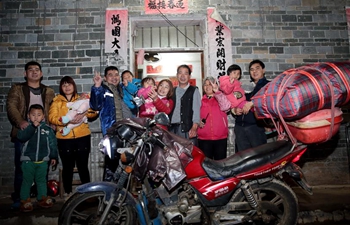
Wrapped up in a cotton-padded jacket, waterproof coat and carrying bulging bags through the pillion, Pan Nanxiong, 56, joined fleets of motorcyclists from the economic powerhouse of Guangdong to neighboring Guangxi on Monday.
This was his sixth trek on a motorbike to his hometown during the Spring Festival travel rush. His home in Yangmei Town is more than 400 km from where he works in Guangzhou.
"Neither bullet trains nor coach service can bring me home directly. The motorbike ride is still the cheapest way for me to go home and avoid transfers," Pan said.
After a brief break at a rest stop in Guangxi, where he was offered hot ginger soup and bread, he resumed his freezing and tedious journey.
The "motorbike fleets" emerged as more quality roads were built. But the number of fleets has reduced since last year. The rest stop where Pan stopped used to provide maintenance for 4,000 motorbikes a day as the travel rush began. This year, it only expected to receive a few hundred a day.