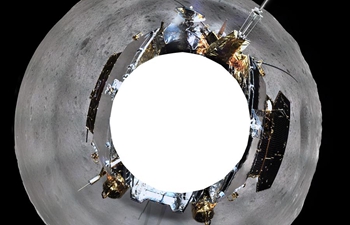
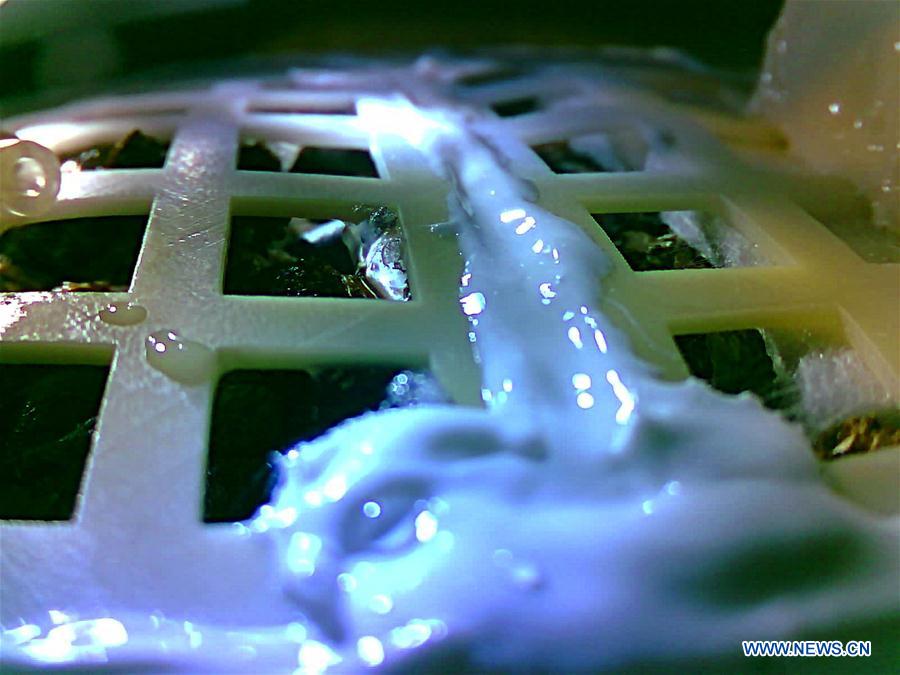
Undated image sent by China's Chang'e-4 probe shows one of the cotton seeds carried to the moon by the probe has sprouted on the moon. After making the first-ever soft landing on the far side of the moon, China's Chang'e-4 mission pioneered the first mini biosphere experiment on the moon. Professor Xie Gengxin, of Chongqing University and chief designer of the experiment, said a canister installed on the lander of the Chang'e-4 probe contained the seeds of cotton, rapeseed, potato and Arabidopsis, as well as eggs of the fruit fly and some yeast, to form a simple mini biosphere. Images sent by the probe showed that a cotton sprout had started to grow, though no other plants were found growing. (Xinhua)
by Xinhua writers Yu Fei, Gu Xun, Gao Shan
CHONGQING, Jan. 15 (Xinhua) -- One of the cotton seeds carried to the moon by China's Chang'e-4 probe is the first ever to sprout on the moon, according to scientists of a mini biosphere experiment Tuesday.
After making the first-ever soft landing on the far side of the moon, China's Chang'e-4 mission pioneered the first mini biosphere experiment on the moon.
Professor Xie Gengxin, of Chongqing University and chief designer of the experiment, said a canister installed on the lander of the Chang'e-4 probe contained the seeds of cotton, rapeseed, potato and Arabidopsis, as well as eggs of the fruit fly and some yeast, to form a simple mini biosphere.
Images sent by the probe showed that a cotton sprout had started to grow, though no other plants were found growing.
The cylinder canister, made from special aluminum alloy materials, is 198 mm tall, with a diameter of 173 mm and a weight of 2.6 kg. It also holds water, soil, air, two small cameras and a heat control system, Xie said.
More than 170 pictures have been taken by the cameras and sent back to Earth, according to the team.
Why were these species chosen?
Xie said potatoes could be a major source of food for future space travelers. The growth period of Arabidopsis, a small flowering plant related to cabbage and mustard, is short and easy to observe. Yeast could play a role in regulating carbon dioxide and oxygen in the mini biosphere, and the fruit fly would be a consumer of the photosynthesis process.
Researchers used biological technology to render the seeds and eggs dormant during the two months when the probe went through the final checks in the launch center and journey of more than 20 days through space.
After Chang'e-4 landed on the far side of the moon on Jan. 3, the ground control center instructed the probe to water the plants to start the growing process. A tube directs natural light on the surface of the moon into the canister to allow the plants to grow.
The Chang'e-4 probe entered a "sleep mode" on Sunday as the first lunar night after the probe's landing fell. The temperature could drop as low as about minus 170 degrees centigrade.
"Life in the canister would not survive the lunar night," Xie said.
The experiment has ended. The organisms will gradually decompose in the totally enclosed canister, and will not affect the lunar environment, said the China National Space Administration (CNSA).
Although astronauts have cultivated plants on the International Space Station, and rice and Arabidopsis were grown on China's Tiangong-2 space lab, those experiments were conducted in low-Earth orbit, at an altitude of about 400 km. The environment on the moon, 380,000 kilometers from Earth, is more complex.
"We had no such experience before. And we could not simulate the lunar environment, such as microgravity and cosmic radiation, on Earth," Xie said.
Researchers expect the experiment may help acquire knowledge for building a lunar base and long-term residence on the moon.
Xie said the experiment was aimed at inspiring young people's enthusiasm for space exploration, and popularizing science such as photosynthesis.
The public, especially young people, have been encouraged to participate in the Chang'e-4 mission. The CNSA, the Ministry of Education, the Chinese Academy of Sciences, the China Association for Science and Technology and other organizations launched a contest among students across China in 2015, collecting ideas on the design of the payloads. The "lunar mini biosphere" experiment was selected from more than 250 submissions.