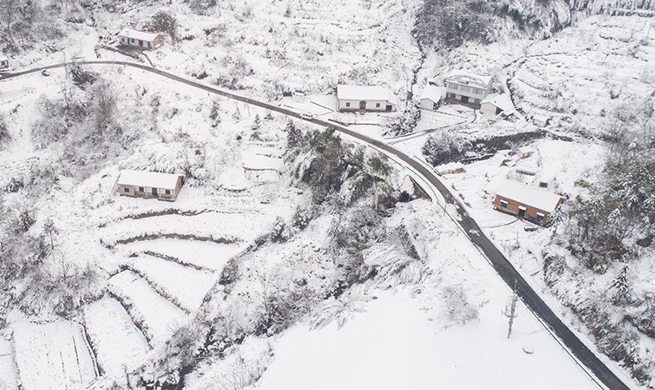
XINING, Dec. 10 (Xinhua) -- In the winter, the color of the Yellow River's headwater is dull, amid snow-capped mountains and dark wilted grass. People are rarely seen here, at an altitude of 4,500 meters above sea level, but small groups of men in fluorescent yellow vests can occasionally be spotted in this vast area.
They are park rangers, responsible for protecting the headwater region of China's second longest river.
The headwater of the Yellow River sits in Maduo County, Tibetan Autonomous Prefecture of Golog in northwest China's Qinghai Province, also home to the headwaters of the Yangtze and Lancang (Mekong) rivers.
With an average altitude of 4,200 meters and an average temperature of minus 4 degrees Celsius, the 25,000-sq-km county only has 15,000 residents and more than 90 percent of the entire population are ethnic Tibetans.
In the 1980s, husbandry was the pillar industry of the county. Every household farmed hundreds of goats and yaks. It was said that the average income of the herdsmen in the county was higher than the national average.
However, overgrazing and global warming led to the deterioration of the environment -- grassland was under threat of desertification, lakes disappeared and one of the largest lakes running along the headwater of the Yellow River was once cut off.
Without water and pastures, residents in the early 2000s quickly became poor, and the county became impoverished needing governmental support.
To restore the environment, the local government took a series of actions, launching ecological immigration to move herdsmen to the city, reducing herds and banning grazing in the headwater regions, as well as raising environmental awareness.
The situation has improved. Since the Sanjiangyuan (Three-River-Source) National Park started trial operation in 2016, local herdsmen have been recruited to help protect and improve the environment.
The operation aims to protect the headwaters of the three rivers as the environment had degraded due to human activity such as overgrazing.
"I start to work at 8:30 a.m. and finish work until 6 p.m.," said Sanggyae, a Tibetan herdsman-turned park ranger of the headwater of the Yellow River. "My work is to patrol the pasture, pick up trash, monitor and rescue wild animals and look out for poachers. This job is much better than being a herd. I used to get up at 6 a.m. to milk cows and ewes, and herd them。"
Urgyan Rigzin, another herdsman-turned ranger, said he earned around 10,000 yuan every year before, but now receives a governmental subsidy of 1,800 yuan every month.
The local government also gives him an "ecological bonus," so he can gain a total of more than 30,000 yuan per year.
"The work and income satisfy me. I want to do my best and I think the policy protecting the environment is good. I've seen no poaches or grassland damages over the past three years," he said.
According to Ma Gui, head of the environmental protection station of the Yellow River headwater, the number of park rangers in Maduo County has increased from around 670 in 2016 to 3,042 to date, meaning that almost every household in Maduo has a park ranger. Each is in charge of 800 hectares of land, looking after mountains, water, forest, grassland and lakes in the area.
Ma said significant improvements have been seen.
"Vegetation cover in the headwater of the Yellow River has clearly increased, and water and air quality have also been improved," Ma said.
A World Wildlife Fund project team found a rare black wolf for the first time in the area last month.
"It shows the varieties of wolf have increased and biodiversity is very rich in the region," Ma added. "Local herders originally had a long tradition of protecting animals and the ecological environment. Now the policy can get them to really engage in the activity."
To date, there are 17,211 park rangers in the national park.
"Among the park rangers, more than half of them come from poverty-stricken families. We encourage herdsmen to participate in the campaign in an effort to raise their environmental awareness and promote harmonious coexistence between man and nature, and also help impoverished herdsmen shake off poverty through protecting the ecological environment of the national park," said Li Xiaonan, director of the administration bureau of Sanjiangyuan National Park.
The provincial government has poured 434 million yuan into increasing park rangers' incomes, creating jobs, improving living standards and buying insurance.