
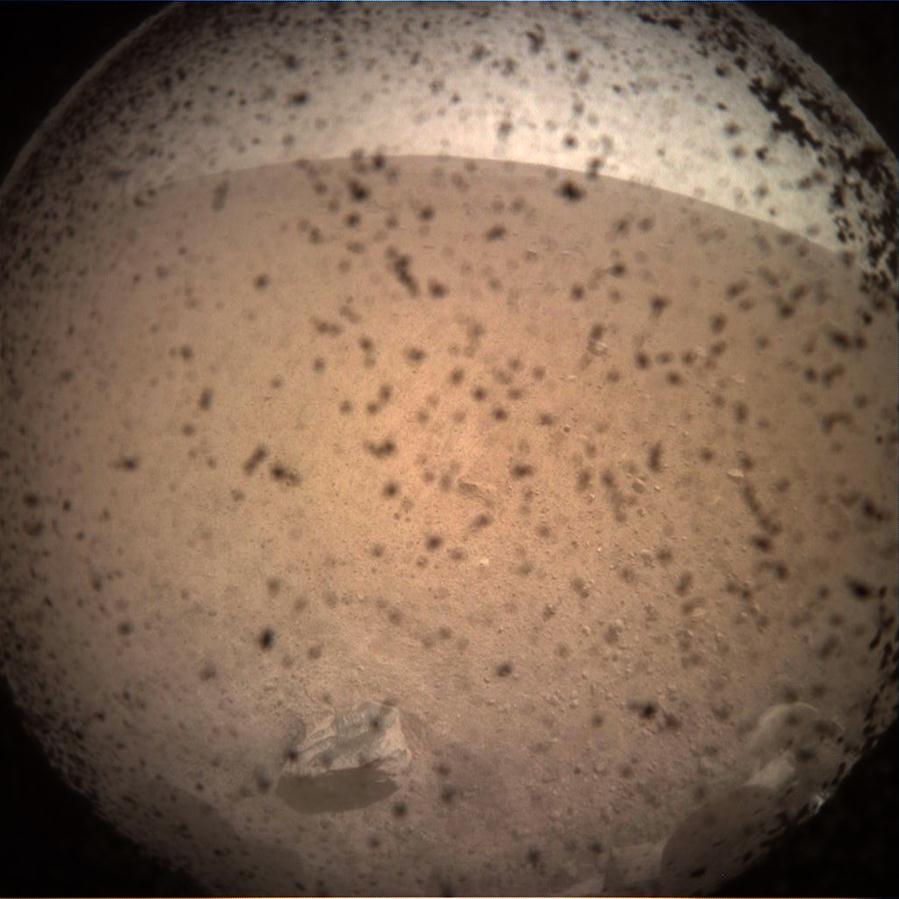
Photo provided by NASA on Nov. 26, 2018 shows the first image taken by NASA's InSight lander on the surface of Mars after its landing. NASA's InSight spacecraft touched down safely on Mars on Monday, kicking off a two-year mission to explore the deep interior of the Red Planet. (Xinhua/NASA/JPL-CALTECH)
by Tan Jingjing
LOS ANGELES, Nov. 26 (Xinhua) -- The National Aeronautics and Space Administration (NASA)'s InSight spacecraft on Monday touched down safely on Mars, kicking off its two-year mission as the first spacecraft designed to explore the deep interior of another world.
Launched on May 5, InSight marks NASA's first landing on Mars since the Curiosity rover in 2012 and the first dedicated to studying the deep interior of the red planet.
NASA's online live broadcast reported InSight's landing at approximately 2:54 p.m. EST (1954 GMT) on Monday, after a six-month, 300-million-mile (480 million km) journey.
The lander plunged through the thin Martian atmosphere at about 2:47 p.m. EST (1947 GMT), heatshielded first, and used a supersonic parachute to slow down. Then, it fired its retro rockets to slowly descend till landing on the smooth plains of Elysium Planitia.
The landing took just under seven minutes to complete, with InSight speed dropping from 19,800 to 8 km per hour, hence the nickname "seven minutes of terror."
InSight is being followed to Mars by two mini-spacecraft comprising NASA's Mars Cube One (MarCO), the first deep-space mission for CubeSats aiming to relay data from InSight as it enters the planet's atmosphere and lands.
At about 3 p.m. EST (2000 GMT), MarCO sent back the first picture of Mars.
The photo was peckled with black dots -- probably particles of dust picked up during InSight's harrowing descent through the Martian atmosphere, said Rob Manning, chief engineer at NASA's Jet Propulsion Laboratory (JPL).
Future InSight images will be much clearer, after the camera's dust cover is removed, he added.
Confirmation of a successful touchdown is not the end of the challenges of landing on the Red Planet. InSight's surface-operations phase began a minute after touchdown.
One of its first tasks is to deploy its two decagonal solar arrays, which will provide power. That process begins 16 minutes after landing and takes another 16 minutes to complete, according to NASA.
The InSight team expects a confirmation later Monday that the spacecraft's solar panels successfully deployed. Verification will come from NASA's Odyssey spacecraft, currently orbiting Mars.
That signal is expected to reach InSight's mission control at JPL about five-and-a-half hours after landing, according to NASA.
"After a ride like that, everything here is so...peaceful. I think I'm gonna like it here. Can't wait to feel the Sun on my solar panels, my next major milestone later today," NASA InSight tweeted.
InSight will detect geophysical signals deep below the Martian surface, including marsquakes and heat. Scientists will also be able to track radio signals from the stationary spacecraft, which vary based on the wobble in Mars' rotation, according to NASA.
InSight and MarCO flight controllers monitored and cheered for the spacecraft's successful entry, descent and landing from mission control at JPL in Pasadena, California.
"Today, we successfully landed on Mars for the eighth time in human history," NASA Administrator Jim Bridenstine said at a post-landing press briefing.
"InSight will study the interior of Mars and will teach us valuable science as we prepare to send astronauts to the Moon and later to Mars. This accomplishment represents the ingenuity of America and our international partners, and it serves as a testament to the dedication and perseverance of our team," he said. "The best of NASA is yet to come, and it is coming soon."
A number of European partners, including France's Centre National d' Etudes Spatiales (CNES) and the German Aerospace Center (DLR), have supported the InSight mission.
The CNES provided the Seismic Experiment for Interior Structure (SEIS) instrument, and the DLR provided the Heat Flow and Physical Properties Package (HP3) instrument, Bridenstine said.
It took the InSight team about four to five years to design and execute the mission, InSight project manager Tom Hoffman said.
The basic design of InSight was inherited from Phoenix spacecraft, which landed on Mars on May 25, 2008, he added.
To further explore Mars, the lander must be at a place where it can stay still and quiet for its entire mission. That's why scientists chose Elysium Planitia as InSight's home, according to NASA.
The red planet is comparatively easy to land on and is less likely to melt NASA's equipment than Venus or Mercury, the space administration said.