LANZHOU, Aug. 11 (Xinhua) -- Throughout his 15-year medical career, Tibetan doctor Kalsang Gyaco has spent almost every summer gathering herbs in the remote mountains of the Qinghai-Tibet Plateau, so he can prepare medicine for local herders.
Traditional Tibetan medicine prescriptions date back 2,500 years. In ancient times, Tibetan doctors collected animals, plants and ore to use as ingredients to cure diseases on the isolated plateau.
Although economic and transport conditions on the plateau have improved today, Tibetan doctors like Gyaco still follow their ancient practices to provide affordable medical services.
Gyaco, 41, works in the Tibetan Medical Hospital of Maqu County in northwest China's Gansu Province. The county is located on the eastern border of Qinghai-Tibet Plateau with a population of around 57,000, with more than 75 percent of them herdsmen.
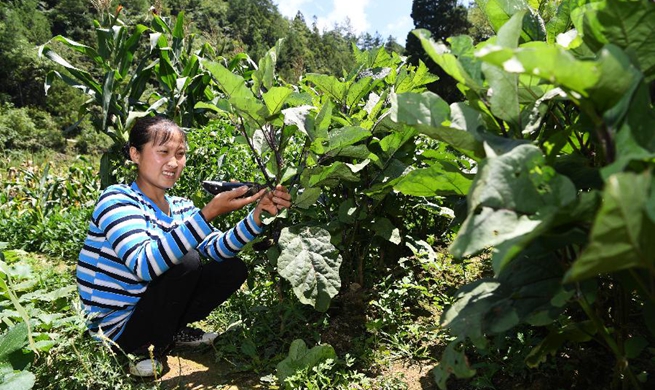
"To get rare herbs, I often have to climb to the top of snowy mountains with an altitude over 4,000 meters and sometimes stay there for a whole week," Gyaco said. "The sun is often scorching and wind howling on the mountain top."
Each time he carries more than 20 kg of herbs back to his hospital and then joins around 10 of his colleagues in a Tibetan medicine production line.
In Maqu, Tibetan medicines are produced using traditional methods. Raw materials are washed, sifted and crushed manually before being processed precisely following classic Tibetan recipes.
"We produce tablets from pomegranate and papaya for curing indigestion. One week's dosage sells at only 7.5 yuan (about 1.1 U.S. dollar), and patients are expected to recover within only three months," Gyaco said.
But in urban pharmacies, the same dosage of western medicines with similar effects would cost 40 to 90 yuan.
"Admittedly, it is convenient to buy medicine directly from the pharmacy, but the cost sharply increases, forcing some poor herders out of medication," Gyaco said. "Tibetan medicine is the invention of herders themselves. We hope that they can have access to high-quality but low-price medical services."
Born in a family of herdsmen, Gyaco knew from childhood experience how unaffordable medical treatment could be for poor families.
"I made up my mind to be a doctor as early as I could remember because I want to provide affordable treatment and medicine for herdsmen like my family," Gyaco said.
In 2000, Gyaco left home to study in a medical school in neighboring Qinghai Province, majoring in traditional Tibetan medicine.
"As I knew what the herders really needed, I had always been training myself to be a general practitioner who could not only cure diseases but also set a broken bone or deliver babies," Gyaco said.
In 2004, Gyaco graduated from college and returned to Maqu. In his early years as a doctor, he made house calls to herders in remote regions to prescribe medicine and treat illness.
"Transport was inconvenient at that time," Gyaco said. "Once I had to ride my horse for three hours to reach an isolated village around 150 km away from the county."
Despite the toil, Gyaco said he only accepted a fee for the medicine not the visit. "The doctor is a sacred profession in herders' minds. We should always keep that in mind."
In recent years, Gyaco and his colleagues have created 325 kinds of low-price Tibetan medicine prescriptions, and more than 70 of them have been made into pills, tablets and capsules for sale on the market.
In the past, herders often ignored their ailments and avoided going to the hospital in fear of the cost.
"As medicine has become affordable in recent years, herders are more aware of their health," Gyaco said. In 2017, his hospital received more than 33,000 patients.
Gyaco has always believed that this ancient Tibetan medical culture should be better preserved and developed.
"We will bring modern management into our Tibetan medical hospital, making medical services for herders even better," he said.