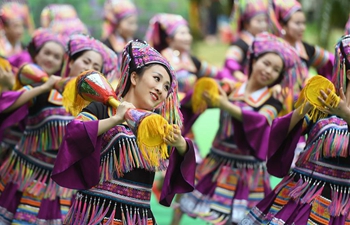
WEIFANG, Shandong, April 21 (Xinhua) -- The 35th Weifang International Kite Festival opened on Saturday in east China's Shandong Province, attracting kite fans from around the world.
Hans Jansen op de Haar, from the Netherlands, is the vice chairman of the International Kite Federation. This was his 13th time attending the Weifang festival. The 68-year-old was introduced to kites by his sister who once worked in a kite shop. He still designs and sometimes makes his own kites.
"At the festival I can see different kinds of kites," he said.
Hans Jansen op de Haar first came to Weifang in 2005. "The city has grown enormously, and there have been a lot of changes," he said.
Kim Hitchcock from the United States is visiting Weifang for the first time.
"Before coming here, I was expecting it to be a town," she said, adding that she was surprised Weifang is such a large city.
"The festival has brought big changes to Weifang," said Chen Yulin, vice president of the city's Folk Literature and Art Association, who has studied kites for over 20 years.
"Weifang has no famous tourist attractions. The festival has not only made Weifang better known, especially to foreigners, but also boosted the development of the city," he said.
Weifang's connection to kites can be seen in many ways. One of the city's main roads is named Yuanfei, which means "kite flying." Another important road has red lamps in the shape of butterfly kites.
Shandong has a long history of kite flying. According to Chinese records, in the Spring and Autumn period more than 2,000 years ago, a carpenter named Gongshu Ban invented a wooden kite.
In the following centuries, kite making thrived in China, while the enthusiasm for kites continued in Weifang. In the 1930s two kite festivals were held in the city before the Japanese invasion during WWII interrupted the event. Seventy-year-old Chen remembers that many elderly people in Weifang could make kites.
The first Weifang International Kite Festival was held in 1984. Zou Ligui, former mayor of the city, wrote in an article that the idea came from David Checkley, then chairperson of the Seattle Kite Association.
According to Zou, Checkley was invited to a kite show in Shanghai in 1983, and afterwards he visited several kite manufacturers.
"He found that kites made in Weifang were the best and suggested that an international event be held there," Zou wrote.
At that time, China has just started its reform and opening-up.
"Hosting an international festival was a requirement of the time," said Wang Shuhua, vice mayor of Weifang, adding, "It was a platform which appealed to both Chinese and foreigners."
The first festival, held six years after the beginning of the reform and opening-up, attracted kite fans from 11 countries and regions including the United States, Britain, Japan, the Netherlands, and Australia. At the fifth festival, Weifang was named "kite capital of the world." Trade volume during the ten days stood at one billion yuan, a significant amount at that time.
As the festival got bigger, Weifang developed as well, establishing economic and cultural bonds with more than 190 countries and regions.
In 1992, the city's GDP reached 21.6 billion yuan, becoming one of the earliest cities whose GDP exceeded 20 billion. Last year the GDP reached 585.9 billion yuan.
The festival also boosted the development of Weifang's kite-making industry. Today the city is home to more than 300 kite manufacturers, with their products sold to more than 40 countries and regions, making up 85 percent of the domestic market and 65 percent of the world market.
Daro Roeung from Cambodia came to the festival for the first time this year. His father is a kite maker who had attended the festival three times and donated one of his kites to the Weifang World Kite Museum.
"I would like to visit the kite factories here and look into sales opportunities," he said, adding that he would like to cooperate with local manufacturers in the future.
Hans Jansen op de Haar told Xinhua that he sometimes shares his ideas with kite factories in Weifang, and hopes that this can help them.
During the kite-making industry's growth, however, problems have occurred. "Now we have less traditional hand-made kites," Chen said.
"There is a lack of craftspeople," said Yang Hongwei, whose grandfather was once one of the best kite makers in Weifang.
"Many people who used to work with me have retired and the younger generation believe the job is difficult and less profitable," she said.
"Only through innovation can we achieve a bright future for traditional hand-made kites," said Zhang Xiaodong, 69, a master craftsman.
Zhang, who previously worked as carpenter and watch repairman, uses his varied skills to make kites. He not only created kites with moving fish and frogs, but also used a microphone to make the kites "talk" in the sky.
After China launched the Shenzhou-5 spacecraft, Zhang created a rocket-shaped kite.
"I have a controller and the two parts of the 'rocket' can separate in the sky just like the real one," he said proudly. His next goal is to use drones in kite making.
Yang continues to use traditional patterns and skills. "Only something classic can last," she said.
Since the 1990s, she has travelled to the United States, Germany, Australia, and South Korea to teach and attend exhibitions.
"As long as there are people who want to learn I will not stop teaching," she said.
Yang's nephew Xu Yang, 30, is now learning traditional kite making from her. Xu's son is just three and sometimes his mother brings him to the workshop. "I will teach him when he is older," Yang said.
Chen is drafting information about Weifang's traditional hand-made kites for school textbooks.
"Traditional culture should be passed on to children," he said.
"The vitality of our traditional hand-made kites will always be preserved, now and in the future," said Wang.