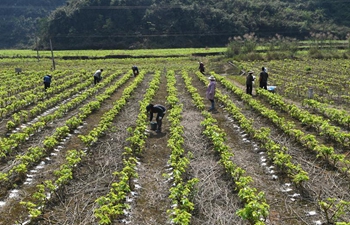
LHASA, March 14 (Xinhua) -- Herders who live at the foot of Mount Qomolangma are preparing for the coming mountain-climbing season in May.
About 7,500 people live in the Zhaxizom Township in Dingri County of Tibet Autonomous Region, at the foot of the world's highest mountain.
Renting tents, as well as providing logistical support and yak transport, villagers generally make handsome sums of money every season when climbers and tourists arrive.
Once an impoverished township, Zhaxizom has become a boom town.
"We earn 40,000 yuan (about 6,300 U.S. dollars) renting only one tent per year, and then we divide the profits among the people," said Chimed Tsering, Communist Party secretary of Qoizom village at the township.
More than 85 percent of the land in Tibet is located more than 4,000 meters above sea level. Harsh natural conditions have been part of the causes of entrenched poverty.
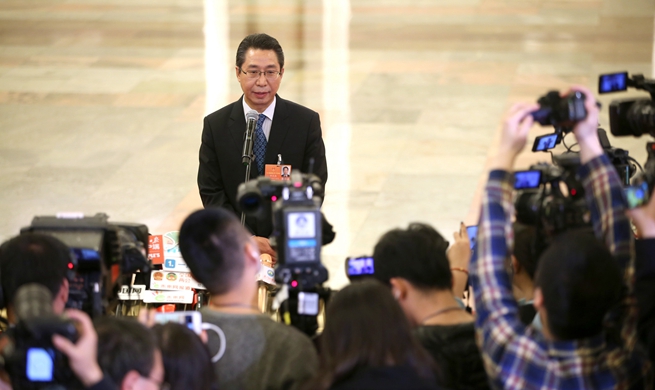
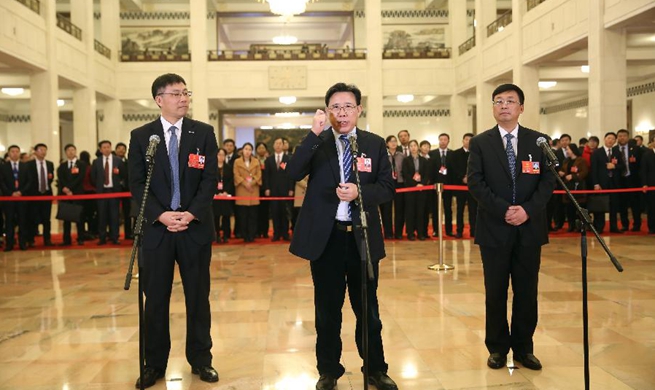
"Tibet is making the utmost efforts in fighting poverty," said Yin Fenshui, director of the poverty-relief office in the region.
From 2013 to 2017, a total of 530,000 people, about 16 percent of the regional population, had been lifted above the poverty line, with per capita annual income of 2,300 yuan, a standard set in 2011.
"The past five years witnessed strong push and robust investment, which was not seen in the region before," Yin said.
Tibet has around 3.2 million people. By the end of 2017, about 12.4 percent of the population lived below poverty line.
In 2018, Tibet aims to solve poverty problems for 150,000 people. "I'm confident of meeting the target," Yin said.
Poverty in Tibet has received attention from the central government, which gives many types of policy and fund support, according to Tibetan regional officials.
In 2017, over 12 billion yuan (about 1.9 billion dollars) was earmarked for developing industries and creating jobs in Tibet. The investment directly helped up to 70,000 people move above the poverty line, according to Tibetan government statistics.
Mima Tsering, 19, lives with his family at a village in the outskirts of Lhasa, capital of Tibet. He had barely finished junior middle school when his father fell ill and plunged the family into debt.
The young man then learnt mask-making techniques from old masters in a craftsmen's cooperative. Now he makes 2,500 yuan (400 U.S dollars) every month.
"With my monthly pay, my family did not have to live on minimum wage support," he said.
"Mask-making is a local cultural heritage. The government invested 1.8 million yuan and private investment was around 600,000 yuan in the cooperative. Most apprentices are young men like Mima Tsering," said Shilo, the cooperative manager. "After young people master the skills, they can help sustain their families while passing on ethnic culture. This is what we call using cultural projects for poverty relief."
For poor people living in uninhabitable areas, the solution is resettlement.
Sanyou village, at the bank of the Lhasa River, is the first such resettlement in Tibet. A total of 712 people moved there in July 2016 from infertile land and found jobs that could ward off poverty.
A park, a clinic, and a kindergarten were built in the neighborhoods.
"The new home has a living room, several bedrooms and a hall to worship Buddha. There is also cement road and running water, which we did not have at my old home in Dagar township," Tsamjo Tashi said.
Since the settlement was built, a cow farm, a Tibetan chicken farm and vegetable farms have been founded to create jobs.
Tashi makes 1,500 yuan feeding cattle each month and shares dividends from the cooperative at the end of every year.
According to the government plan, during the 13th Five-Year period (2016-2020), a total of 263,000 people will be resettled for better living.
In Tibet, poverty-relief efforts have been combined with environment conservation. A third of the area in Tibet is nature reserves. The regional government hires farmers and herders as part-time wildlife and forest rangers in the reserves.
By the end of 2017, 700,000 people were on the government payroll. Each employee receives an annual salary of 3,000 yuan (474 U.S. dollars) on average.
"People in Tibet will not be satisfied at only having enough to eat. The region will enter a moderately-prosperous society," Yin Fenshui said.
Tibet will continue to improve the living and working conditions for the people, raise education and medical quality.
"The lives of poor people will only get better," he said.