(Xinhua file photo)
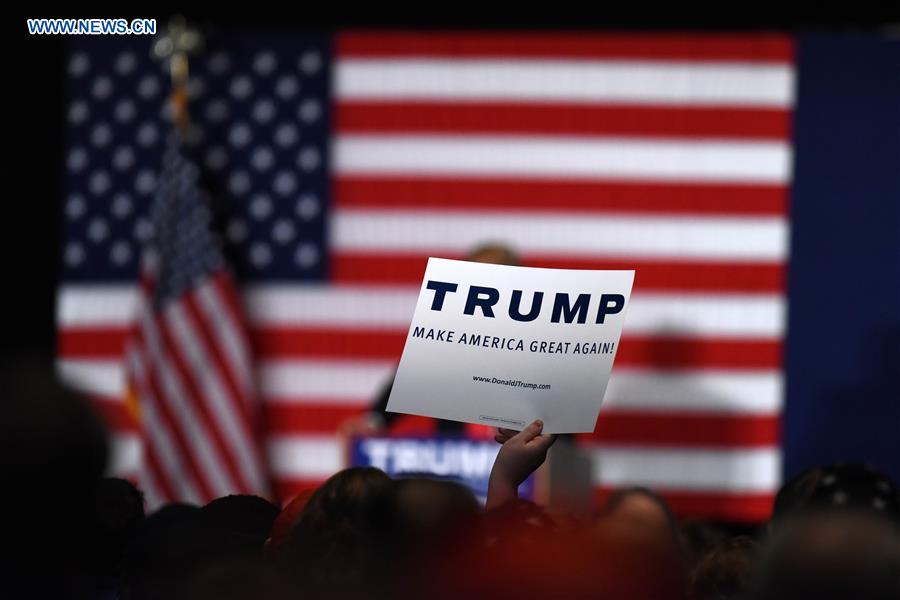
BEIJING, Jan. 19 (Xinhua) -- U.S. President Donald Trump will celebrate his first anniversary in office on Tuesday. Over the past year, his country has shown a severe allergy to Chinese investment, tossing aside international consensus on investment relations between countries.
Chinese digital payment company Ant Financial's acquisition of U.S. money transfer company Moneygram International was recently rejected, an outcome that has become all to familiar for Chinese companies.
For some time the U.S. government has blocked possible Chinese investment deals allegedly over national security concerns following a review by the Committee on Foreign Investment in the United States (CFIUS).
In 2017, U.S. veteran investment bank Cowen Group canceled a 275 million-U.S.-dollar investment from CEFC China Energy Company Limited, citing the failure to obtain CFIUS approval.
Meanwhile, China's largest aluminium extrusion producer China Zhongwang also gave up the acquisition of the U.S. Aleris Corporation for the same reason. Nor did China's Ocean Industry Group escape government talons when planning to merge U.S.-based Global Eagle Entertainment last July.
Two months later in September 2017, U.S. President Donald Trump rejected a Chinese state-backed company from taking over the U.S. chip manufacturer Lattice Semiconductor Corporation in response to CFIUS "suggestions."
Ant Financial's failure is one of several attempts by the U.S. government to block Chinese investment on national security grounds.
As some insiders have noted, CFIUS's national security review is like a "black box" with low transparency and a high likelihood of political interference. Today Chinese enterprises have obviously become the main focus of this incomprehensible process.
Since early 2016, 27 acquisitions by Chinese companies have failed in the U.S., which is close to the number of unfinished deals the U.S. has with Britain, France, Germany, Japan, Italy and Canada, according to industry figures.
The rapid growth of Chinese investment in the United States has been one of the highlights of China-U.S. economic and trade cooperation. However, the rising risk of political uncertainty is leading to a significant drop in Chinese enthusiasm for investing in the country.
Statistics showed that during the third quarter of 2017, Chinese enterprises completed a mere 28 purchases and transactions in the United States, with a value of 170 million dollars, hitting its lowest level in five years.
The continued increase in bilateral investment has long been a strong tie for China-U.S. economic and trade relations, playing a vital role in the steady development of the economy and job growth in both countries.
Studies by the U.S.-China Business Council showed that the China-U.S. economic and trade relationship supports over 2.6 million U.S. jobs.
Still, the U.S. government says it will actively attract foreign investment one minute, yet it undermines a healthy trade environment over flimsy national security grounds the next.
The excessive use of so-called national security review as a political tool would only pull back further cooperation between enterprises from the two sides.
The U.S. government has pushed the "back button" on its economic and trade policy with China, threatening a relationship where both sides stand to gain.
We await the day the United States stays true to its word, no matter how brief, to equally provide a fair and predictable environment for enterprises of different countries.
As the United States heads further down the path of unilateralism, it's high time for the super power to cure its allergy to Chinese investments. Protectionism in the guise of "national security" will eventually devastate its own interests.