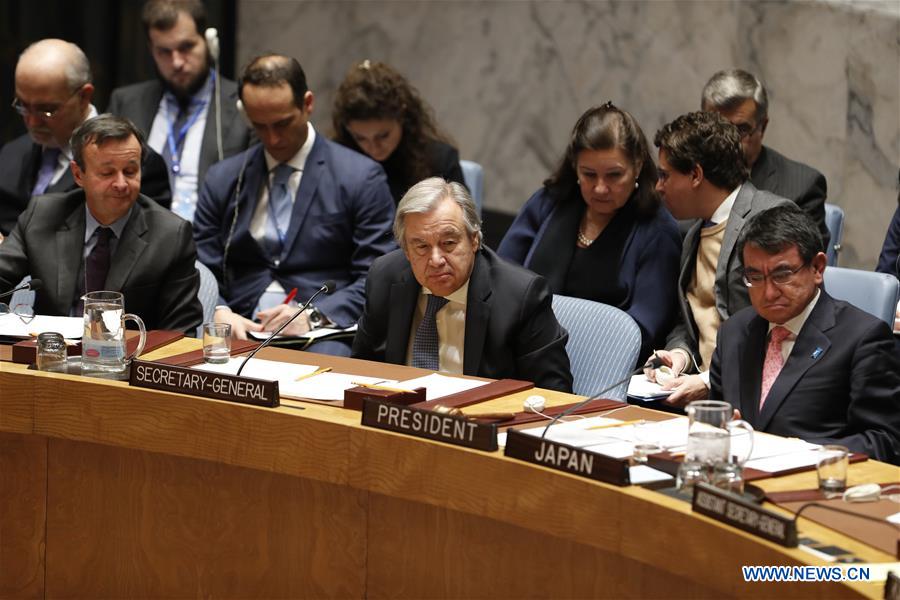
UN Secretary-General Antonio Guterres (C, front) attends a United Nations Security Council meeting on the situation on the Korean Peninsula at the UN headquarters in New York, on Dec. 15, 2017. UN Secretary-General Antonio Guterres on Friday expressed concern over risk of military confrontation on the Korean Peninsula and warned against any military action. (Xinhua/Han Fang)
By Xinhua writer Wang Jiangang
UNITED NATIONS, Dec. 30 (Xinhua) -- The year of 2017, which has witnessed snowballing grave challenges and threats to the world, has also seen the United Nations making strenuous efforts in defending multilateralism in all its endeavors of global governance.
MULTILATERALISM PREVAILS
Although unilateralism or isolationism has been sounding alarm during the year, it's a consolation that an increasing number of countries are realizing that no country can cope with unrivaled challenges and threats on its own because, as the United Nations Secretary-General Antonio Guterres put it, "the interconnected nature of today's global trends unequivocally demonstrates that countries cannot manage these risks alone."
"Acting together is the most effective way to fight climate change, global terrorism and the threat of new pandemics and is the only way to manage forced displacements and migratory flows in a humane manner," said the UN chief in his annual work report to the world body.
Throughout the year, while global governance has been once and again challenged by unpleasant noises, there has been a growing call across the world for multilateralism.
"Year One of America First: Global Governance in 2017," an article published on the website of the U.S. Council on Foreign Relations on Dec. 28, shows that after Donald Trump's win in the U.S. presidential election last year, many experts predicted that 2017 would be "a tumultuous year for international cooperation."
Since January, President Trump's "America First" policies have seen the United States abdicate its global leadership role. "Yet contrary to expectations, multilateral cooperation on pressing issues like climate change and migration has continued, as other states have stepped up to lead," it said.
Despite all the tumult, the world has recorded several important achievements for multilateralism alongside the setbacks, it added.
Noting that Trump's largest blow to international cooperation came in June when he announced his intention to withdraw the United States from the Paris Climate Accord, the author said that early reactions suggested that other countries might respond in kind, reneging on their commitments and stalling overall progress on environmental governance.
"Nevertheless, this November's climate conference in Bonn, aimed at finalizing aspects of the Paris Agreement, was a success. Participating states secured additional funding for climate initiatives and agreed to several objectives in the fields of agriculture, indigenous rights, and gender equality in climate governance," it said.
The author commended French President Emmanuel Macron for hosting a separate global climate conference this December, raising additional funds to meet Paris commitments.
"And while the Trump administration signaled its intent to abandon the agreement, many U.S. states, cities, and companies have stepped into the void, pledging commitments of their own. The successes in Bonn and Paris, combined with near-unanimous international support for the Paris Accord, indicate that multilateral cooperation on climate change will continue without U.S. leadership, even if the politics looks challenging."
The author also gave the thumb-up to the global community in achieving success in international trade although Trump has decided to pull the United States out of the Trans-Pacific Partnership (TPP) and threats to pull out of the North American Free Trade Agreement (NAFTA).
"Neither deal is dead yet," the author noted.
The author also extolled the international community on achieving success in migration, non-proliferation and upholding of international institutions.
PRACTISING, UPHOLDING MULTILATERALISM
During the 72nd session of the General Assembly in September, 196 statements were delivered from the podium of the General Assembly. It was the first time in 11 years that all Member States and Observers addressed the General Assembly.
There was an overwhelming support for multilateralism in the statements in such areas as promoting international peace and prevention, highlighting the needs of people all over the world, upholding Paris Climate Accord, preventing further escalation of nuclear crisis on the Korean Peninsula, and fighting terrorism and extremism, cyber crimes and trans-boundary crimes, etc.
"We need to rekindle faith in multilateralism and confidence in the United Nations as the place where States and civil society can come together to face the most pressing challenges in the world today," Guterres said in his work report.
Since taking office, the UN chief has time and again issued warnings, urging all people on the earth to heed the "unprecedented" challenges and threats to the mankind.
The new secretary-general defended on Jan. 3 the role of the United Nations as being the "cornerstone" of the multilateral approach to solving the worst problems affecting the international community.
"We need to recognize that only global solutions can address global problems and the UN is the cornerstone of that multilateral approach," he said.
The secretary-general promised to promote a dialogue with the organization's personnel and insisted that only working as a team can the United Nations' goals be accomplished
In fact, the world body has been working every day, trying to reach consensus on some of the thorny problems before relevant countries could get the ball rolling.
In 2017, the UN Security Council has called for more than 10 meetings on the Democratic People's Republic of Korea, most of which were emergency ones.
The Council members might argue to have their views stated explicitly while discussing details of resolutions or presidential statements, but they have, over the year, shown solidarity and unity in obtaining the final goal of denuclearization on the Korean Peninsula.
The Paris Climate Accord is another landmark global climate change agreement following the Kyoto Protocol. To curb global warming, almost every country in the world is getting involved.
On Nov. 8, the Syrian representative announced that it would sign the Paris Climate Accord as soon as possible so as to deliver its promises.
The Unite States, which announced in June to withdraw from the accord, has become the only country that has refused to be part of collective action of the international community.
French President Macron has on many occasions emphasized interdependence rather than independence. He stressed while attending the General Assembly session that "we are inextricably linked to each other in a community of destiny" and "planetary responsibility."
"There is nothing more effective than multilateralism in our current world because all our challenges are multilateral: war, terrorism, climate change, the digital economy."
The call for multilateralism has been gaining momentum over the year. Almost all countries, big or small, are zeroing in on the world body for solutions to problems of all sorts.
Some island countries, which are victims of deadly mega hurricanes, are in bad need of global cooperation in tackling the climate-warming related disasters, admitting that only the United Nations could coordinate international actions.
"As small island Pacific countries, we are no longer protected by our isolation," said Tuilaepa Sailele Malielegaoi, the Prime Minister of Samoa, while addressing the 72nd annual general debate, adding: "Climate change, like other global challenges, cross borders seamlessly. It has no respect for sovereignty and does not discriminate countries between rich or poor."
"Its dire consequences are real including (for) those who remain in denial," he underscored, urging global leaders to collectively prioritize the implementation of the Paris Agreement on climate change.
The prime minister urged all countries to join hands in order to better protect the planet by acting as one.
It is believed that the resounding call for multilateralism, on the one hand, indicates that there are more and more global problems that need to be solved. On the other, it also reflects the transformation of the thinking patterns of many countries in dealing with major challenges and threats.
Member States clearly recognized this commonality when they adopted the 2030 Agenda for Sustainable Development and the 2015 Paris Agreement on climate change, two landmark achievements all the more remarkable for coming in a period of stark division in international responses to other challenges.
CHINA: STRONG ADVOCATE, SUPPORTER
Nicholas Rosellini, United Nations Resident Coordinator and UNDP Resident Representative in China, said that China has been positioning itself as a champion for inclusive growth and peace at the United Nations, where Member States have pledged to "leave no one behind" with the 2030 Agenda for Sustainable Development.
Citing the fact that China has become the largest contributor of troops and second-largest contributor of funds to UN peacekeeping missions among the five permanent members of the Security Council, he said that China, through its new UN Peace and Development Trust Fund, has pledged one billion U.S. dollars to support multilateral cooperation.
"China is also committing to increasing its contributions to the UN development system by 100 million U.S. dollars by the year 2020," he said.
Aa a matter of fact, China is taking a lead on supporting implementation of the Sustainable Development Goals (SDGs), earmarking hundreds of millions to support global efforts to reduce poverty and improve education and health. And, to much relief, it is holding fast to commitments it made during the international climate negotiations to achieve the historic Paris Agreement and its concrete follow-ups.
Chinese Foreign Ministry spokesperson Hua Chunying said on Dec. 20, that the destabilizing factors and instabilities in the international landscape have been on the increase and new problems and new challenges have kept popping up.
"We stand ready to make concerted efforts with the international community to jointly address challenges, uphold peace and promote development," she concluded.