Xinhua Headlines: From history records to cultural icons, China's bamboo slips make a comeback

* Chinese museums and cultural institutions are turning the spotlight on bamboo and wooden slips, or jiandu -- the country's primary writing medium for thousands of years before the invention of paper.
* To date, Chinese archaeologists have unearthed more than 300,000 inscribed bamboo slips.
* Once buried underground as silent witnesses to China's history, these fragile artifacts are now being revived as sources of cultural inspiration and economic vitality.
WUHAN/CHANGSHA, Nov. 16 (Xinhua) -- Curator Hou Liming stands beside a replica of one of China's most remarkable archaeological discoveries -- a tomb where an official was buried with 1,155 word-bearing bamboo slips placed beneath his head, beside his hands and at his feet.
While ancient Chinese often took treasured items such as wine cups and silk garments into their tombs in hopes of accompanying them into the afterlife, this official, who served before and during the Qin Dynasty (221 BC-207 BC), chose instead to be buried with his carefully written work notes.
These slips record detailed laws on land farming, agriculture, currency and property from that time, said Hou at the newly opened archaeological site in central China's Hubei Province.
Unearthed in 1975, the tomb in Yunmeng County reshaped the understanding of the early dynasty's legal and administrative systems, offering a rare glimpse into how Emperor Qinshihuang, who unified China for the first time, governed his empire more than 2,000 years ago.
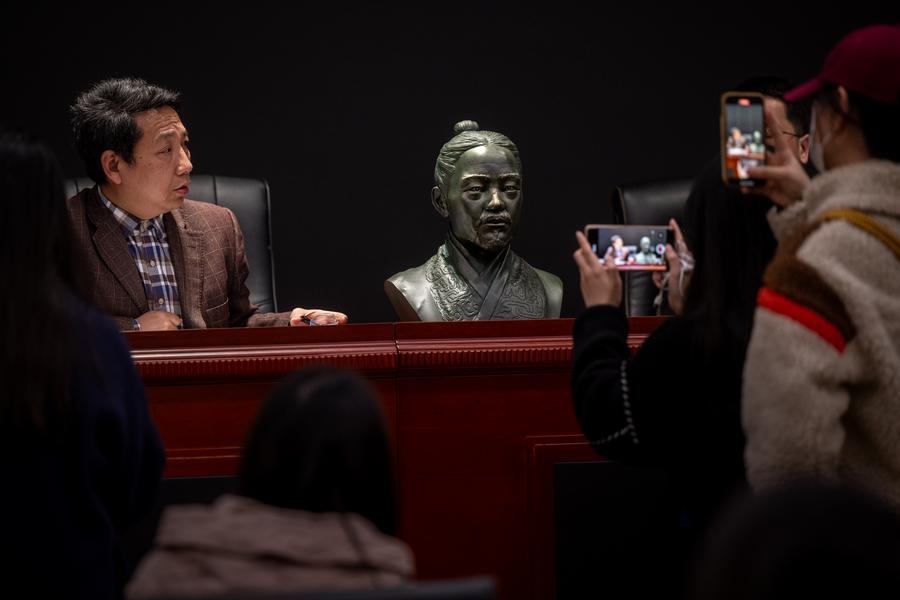
The newly opened site is part of a growing trend across China, where museums and cultural institutions are turning the spotlight on bamboo and wooden slips, or jiandu -- the country's primary writing medium for thousands of years before the invention of paper.
Once buried underground as silent witnesses to China's history, these fragile artifacts are now being revived as sources of cultural inspiration and economic vitality, bridging the gap between the country's distant past and its modern identity.
WITNESSES TO HISTORY
On Oct. 28, the Hubei Provincial Museum launched an exhibition on bamboo slips, highlighting pieces unearthed from the tomb of Marquis Yi, a ruler of the Zeng state during the Zhou Dynasty (1046 BC-256 BC), which record details of funeral carriages and horses and represent the earliest known bamboo texts in China.
That same day, neighboring Hunan Province unveiled its upgraded Liye Qin Slips Museum, displaying more than 600 artifacts, mainly bamboo slips, along with bronze and pottery pieces.
"I can't believe people in the Qin Dynasty already knew the multiplication table, and their records on grain distribution were even more detailed than my homework notes," said 10-year-old Zhou Shiyu, who joined a school study tour.
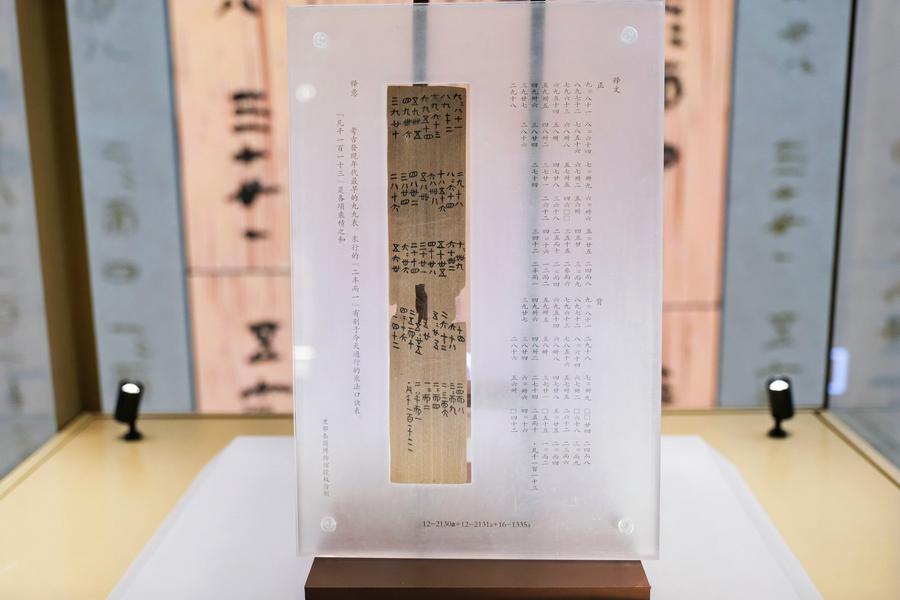
The small town of Liye is best known for the 2002 discovery of bamboo slips bearing nearly 200,000 characters on population, resources, taxation, postal services, judiciary and medicine from the dawn to the decline of the Qin Dynasty, the most significant Qin-era find since the Terracotta Warriors.
To date, Chinese archaeologists have unearthed more than 300,000 inscribed bamboo and wooden slips, most of them in Hunan, Hubei and Gansu provinces.
Beyond the Qin Dynasty finds, slips from the Warring States Period (475 BC-221 BC) discovered in Hubei in 1993 contain extensive Confucian and Taoist classics. Meanwhile, a trove of Han Dynasty (202 BC-220 AD) slips excavated in Gansu sheds light on the interactions among states and peoples along the ancient Silk Road, frontier political and economic life, and the postal and relay system.
"Traditionally, the Chinese have placed great importance on recording and studying history," said Chen Wei, a bamboo-slip researcher at Wuhan University. "As reliable evidence of the past, the slips are especially valued today, serving as rare records of China's history and the evolution of its civilization."
NEW VIGOR
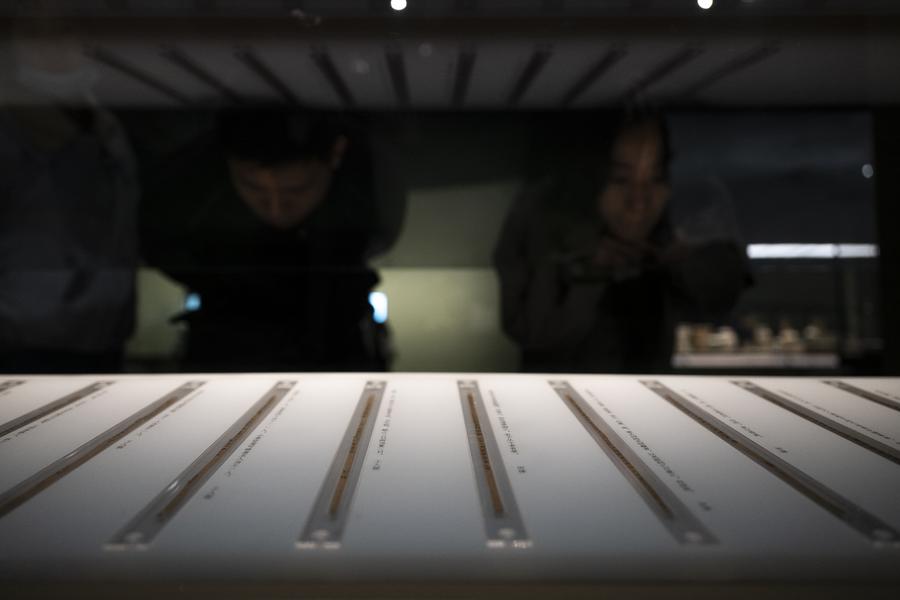
Amid a nationwide revival of traditional Chinese culture, bamboo slips are gaining new life and attracting a growing number of fans.
At the Liye Qin Slips Museum, a 3D virtual guide dressed in Qin-era attire greets visitors on a large screen, answering questions about the ancient slips in real time. Transparent displays let guests rotate and enlarge digital scans of the bamboo slips, revealing annotations, translations and historical context with a simple touch.
By combining academic research, digital preservation and cultural tourism, the museum is transforming the slips from static relics into living stories, said Zhou Dongzheng, the museum's director.
The museum also brings heritage to life through modern cultural products, from T-shirts and tote bags to cups and magnets adorned with bamboo-slip motifs. "I love how it brings culture into daily life," said Xiao Min, a visitor who bought a crossbody bag patterned with Qin scripts. "It makes distant history feel within reach."
This cultural renaissance reflects a broader national drive. The Communist Party of China Central Committee recently released its recommendations for formulating the 15th Five-Year Plan (2026-2030), which call for inspiring the cultural creativity of the entire nation and fostering a thriving socialist culture.
The 14th Five-Year Plan period (2021-2025) saw China's solid progress in the cultural sector. By the end of 2024, the country had 7,046 registered museums, more than 90 percent of which offered free admission. In the year, the total revenue of the cultural industry exceeded 19 trillion yuan (about 2.68 trillion U.S. dollars), generating a total profit of 1.77 trillion yuan.

Across the country, local governments are leveraging regional heritage to drive growth.
In Longshan County, home to Liye, the Qin slips have become a source of real prosperity. Themed travel routes have boosted tourism, drawing some 5.15 million visitors and about 5.24 billion yuan in revenue in the first nine months of this year, up 3.74 percent and 3.18 percent year on year, respectively.
In Liye's ancient town, more than 30 homestays and restaurants now thrive on rising interest in Qin-era heritage.
For young curator Hou, this revival also symbolizes a shift in public sentiment. With the rise of guochao, or "China Chic," and a deepening sense of cultural confidence, he said, people are developing a stronger appreciation for symbols rich in history and meaning.
Once seen as subjects of history studies, bamboo slips are now emerging as a new cultural IP, appearing in films, creative products, digital experiences, and educational programs. "They're becoming approachable, relatable and shareable icons of Chinese culture," Hou said.
(Reporting by Cheng Lu, Yu Pei, Zhang Yujie, Wang Teng and Yao Yuan; Video reporters: Rao Rao, Wang Teng and Zhang Yujie; Video editors: Liang Wanshan, Liu Xiaorui and Lin Lin.) ■











Comments