




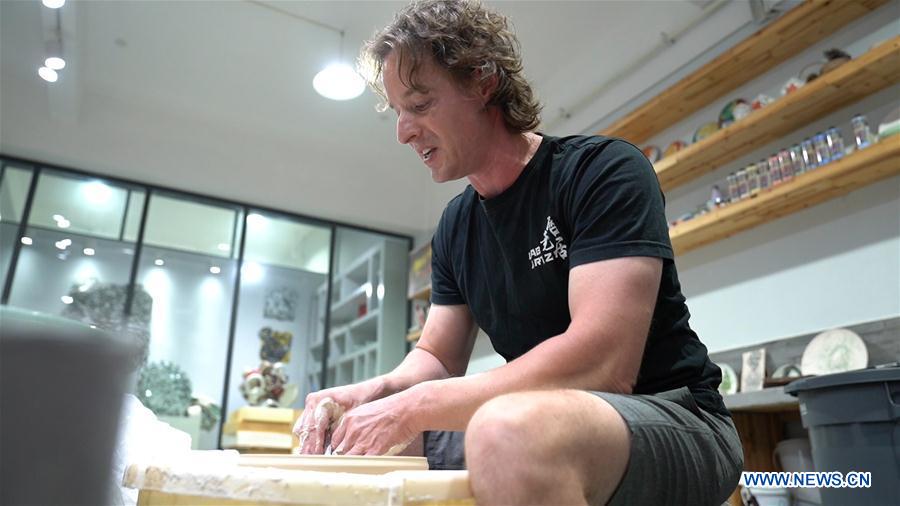
Ceramic artist Ryan LaBar from the United States works in a workshop in Jingdezhen, east China's Jiangxi Province, on Sept. 19, 2018. (Xinhua/Zhou Mi)
By H. L. Bentley
JINGDEZHEN, JIANGXI, Dec. 7 (Xinhua) -- Tucked away in a valley in the southeast of China is a tiny city with a huge history. Today it is called Jingdezhen, the name bestowed upon it by Song dynasty Emperor Zhenzong in 1004. Its current name tells us very little except that there was something about this small rural settlement that made it very important to the royal court.
That "something" can be found in Jingdezhen's previous name.
Until around 1,000 years ago, Jingdezhen was called Changnan. The town was famous throughout the world for its primary output -- porcelain. Porcelain was a commodity. It was used in politics as gifts from one nation to the next. It was allocated to important members of the royal household. It was worth more than gold.
Over time, through trade and interaction with outsiders, Changnan, or a corrupted pronunciation of the name, came to be used by outsiders to refer to porcelain -- or "china."
You can't talk about china in China without mentioning Jingdezhen -- the "ceramic capital" of the world.
I visited Jingdezhen at the end of September to speak to three ceramicists who had traveled thousands of miles to make their homes in the birthplace of china. Each had a very different story and reason for coming to Jingdezhen, but a common theme emerged from our conversations -- communication.
THE SEARCH FOR LANGUAGE
Camille Grandaty is a French artist. Her studio is in an old-apartment building near Taoxichuan, an art district built on the site of an old plate factory. The high ceilings of her studio lend themselves well to the huge vases, sculptures and pictures that she has created during her years in Jingdezhen.
By a door, stand three tall statues. Their human forms are all but hidden by layer-upon-layer of metallic-glazed porcelain strands as thick as worms, Delicate white hands stretch out from the suffocating confines of their china straight jackets.
Camille told me, "Creative work is like trying to find a language." I was obliged to ask if art really is all about "trying to find a language," how does relocation affect this quest?
"The language that I had when I was practicing in Europe seemed to work but here it seemed like the communication was broken. [So, now] I use a language that speaks about experience, that can be used anywhere. I made it my own," Camille explained.
While she may be speaking figuratively, language presented her with very real-world problems when she first arrived in Jingdezhen.
"I couldn't speak Chinese, I didn't know anything. I just knew that I needed to work under a master... the way he worked with clay was so natural."
The craftsman that she approached refused her, language being his greatest concern. It took her three years to feel confident enough to ask again.
Those fine, sculptured hands of the statues by the door were one product of her apprenticeship. A traditional eastern sculpture shrouded, but not hidden, by a western cloak -- a marriage of the old and new.
"This is the influence that foreigners bring to Jingdezhen," she said. "The development of the creative process."
A SON RETURNING HOME
In a corner of a renovated factory in Taoxichuan, American Ryan LaBar is wielding a pretty lethal-looking knife, attacking large thick sheets of foam. He is preparing to ship some of his work to Beijing for an exhibition.
Peering into the box, I was met with a piece of "off-the shelf" Jingdezhen trade-ware; a mass-produced vase decorated with the blue-and-white pattern that the city is best known for. But this nondescript piece was brought to life by a nest of pale porcelain ribbons.
"It is called 'Embrace,'" he explained. "I took my piece and I just married it around it. It is hugging tradition. What I want to do, instead of embracing tradition, is value tradition [and] use that process to say something more contemporary."
In his studio there are three or four potter's wheels lined up along the center leading to a glass wall which divides off a small exhibition space housing six of his ceramic sculptures. The kiln is in another room filled with shelves of simple clay shapes.
Ryan uses these shapes to construct his signature intricate sculptures, which manage to look sturdy -- architectural even -- while at the same time moments away from slipping and shattering.
"I set up things in the kiln to react to the temperature [...] the work moves and shifts and combines. And then I turn off the kiln. And it stops. So, it's frozen -- it is frozen motion," he explains gesturing to a large blue and white piece that looks like it is collapsing in on itself.
I asked if the giving of his creations to this outside entity -- the kiln -- was something he had developed during his years in Jingdezhen.
"This was my vocabulary before I came here, but at the same time it is a vocabulary that Jingdezhen is quite used to. There is a flow of chaotic energy here," he explained.
Anyone who has spent anytime in China will have experienced this frenetic vitality. Ryan likened this to his art.
"It calls for a look-ahead mentality -- and because of that there is this sort of flow that happens. Not just with traffic but with every sort of project or idea or any sort of event that happens. My work is like that."
Ryan seems settled. He has a dog and a cat. On the wall of his studio there is a hand-painted plate that features a couple -- a Chinese woman and a man painted in Ryan's likeness. His art is popular with the domestic audience. He seems to feed off the historic energy of the city. In fact, rather than adjusting to a new life in a foreign land, Ryan saw it as more of a homecoming.
"For me, it's almost as if I emanated from China 2,000 years ago and I am son returning home in a sense. I would say that anyone working with clay -- that knows anything about clay -- knows that Jingdezhen is the homeland."
CHINA, BIRTHPLACE OF CHINA
In the hills not far from Jingdezhen is a cave complex. Almost 2,000 years ago, people began to mine the pale, soft, earthy mineral. Today we call it kaolin, the clay used in porcelain. This is where it all started.
I kept being told that the clay in Jingdezhen is special. But it wasn't until I met Christiane Toewe, a German artist, that I really understood. Throughout our conversation, Christiane spoke with a slow confidence but didn't make eye contact until I asked her why she came to Jingdezhen.
"As someone who works with porcelain it is so important to touch the Chinese clay because porcelain was born here," her eyes brimmed with tears, and in that moment I felt the passion that she felt.
Clay is a natural element that has its own character, its own personality. You might have the best laid plans for your pot, sculpture or installation, but once the kiln doors close you release control.
In life, maybe, you do not have complete control over anything you try to do, but you do have to suffer - or enjoy - the effects of both your own actions and those that are beyond control. Life, it, seems, is like working with clay.
(Video by Li Na, H. L. Bentley, Xue Yanwen, Zhou Mi, Wen Meiliang)
